
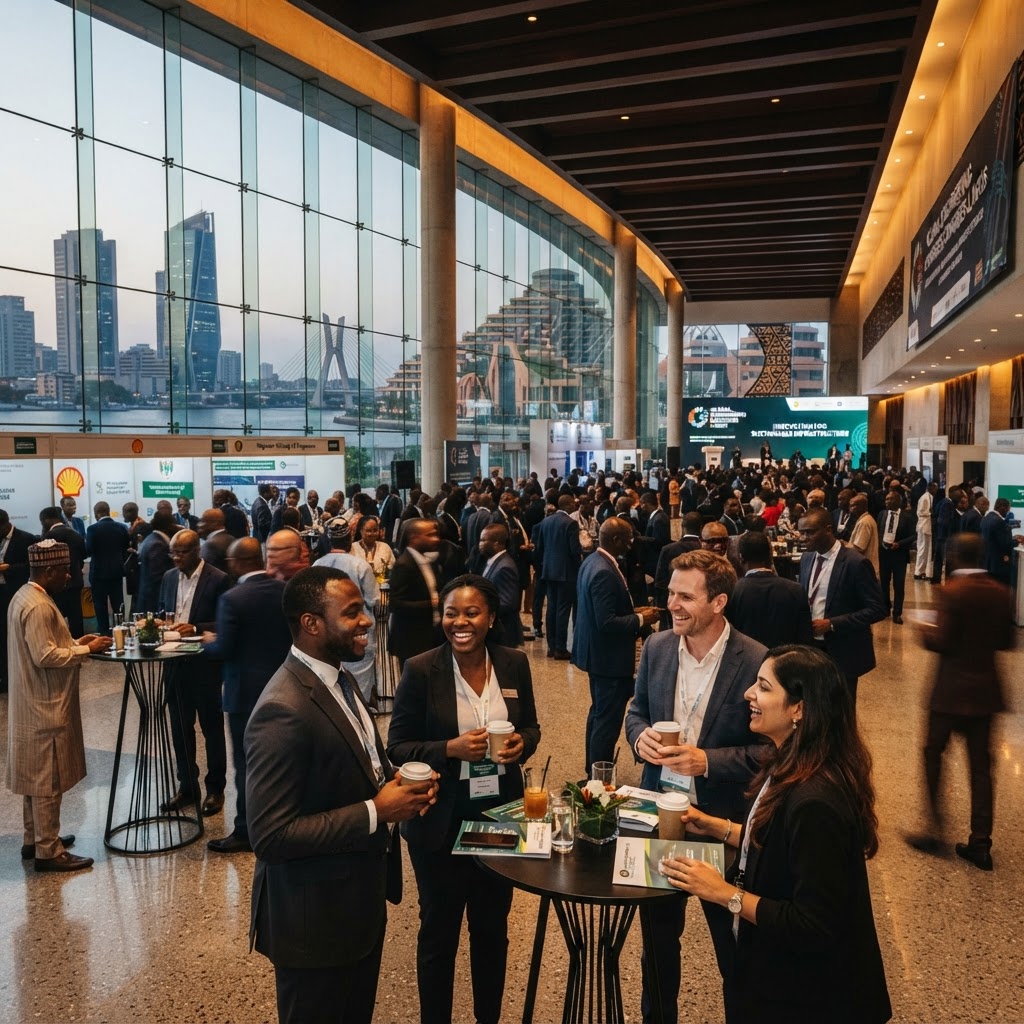
In June 2026, Energaia Institut participated in the Engineering Innovation Conference (EIC) in Lagos, Nigeria — one of West Africa's premier gatherings for engineering research, industrial innovation and cross-continental academic exchange. The conference brought together over 600 delegates from 28 countries, spanning mechanical engineering, AI, sustainable energy and advanced manufacturing.
For Energaia, this was not a first visit to Lagos. Our relationship with the Nigerian engineering research community began in 2024 through a joint proposal with the University of Lagos (UNILAG) on AI-driven environmental monitoring. EIC 2026 offered the opportunity to deepen that connection — and to lay the groundwork for something more structured and lasting.
Keynote: Engineering as a Connector
Our Managing Director opened Day 2 with a keynote titled "Engineering as a Connector: How Interdisciplinary Methods Bridge Global R&D". The presentation outlined Energaia's core thesis — that engineering, when structured as a connecting layer between physics, biology, AI and data science, can unlock innovation that no single discipline achieves alone. Case studies from SynKero.DT and our Digital Twin work in Munich anchored the talk, with particular focus on how these methods translate to the energy and manufacturing challenges facing sub-Saharan Africa.
Deepening the UNILAG Partnership
The highlight of our Lagos visit was a dedicated workshop with the Faculty of Engineering, University of Lagos. Over two intensive sessions, our team worked alongside UNILAG researchers to scope three potential collaboration tracks:
AI for Environmental Monitoring
Combining UNILAG's extensive field data on Lagos Lagoon water quality with Energaia's image recognition and neural network pipelines. Goal: a real-time environmental monitoring Digital Twin for coastal urban systems.
Renewable Energy Microgrid Modelling
Co-developing simulation models for decentralised solar-battery microgrids in peri-urban communities. Energaia brings Digital Twin methodology; UNILAG contributes local grid data, demand patterns and regulatory expertise.
Joint EU–AU Funding Applications
Identifying Horizon Europe and African Union research funding instruments that support cross-continental R&D. Our funding strategy team is mapping eligible programmes with UNILAG's grants office for a first joint submission in Q4 2026.
Professor Adeyemi Oladapo, Dean of the Faculty of Engineering at UNILAG, noted: "The intersection of classical engineering and AI that Energaia represents is precisely where Nigerian research institutions need strategic partners. This is not about technology transfer — it's about co-creation."
Conference Highlights
Beyond our UNILAG engagement, the EIC programme offered exceptional breadth. Standout sessions included a panel on hydrogen infrastructure in tropical climates, a workshop on AI-driven quality assurance in Nigerian manufacturing, and a compelling presentation by the Lagos State Ministry of Science and Technology on their Smart Lagos 2030 roadmap.
We also connected with research groups from the University of Ibadan, Covenant University and Obafemi Awolowo University — conversations that may feed into broader West African consortium-building for future EU-funded calls.
What's Next
A UNILAG delegation will visit Energaia's Munich headquarters in October 2026 for a two-week research sprint. The first joint funding proposal — targeting the Horizon Europe Cluster 5 (Climate, Energy & Mobility) — is scheduled for submission in November 2026. We'll share progress as milestones are reached.
Lagos reminded us why we do what we do. The energy, ambition and technical depth of the Nigerian engineering community are extraordinary — and the potential for structured, interdisciplinary collaboration between European and West African research institutions is vastly underexplored. Energaia intends to be part of changing that.