
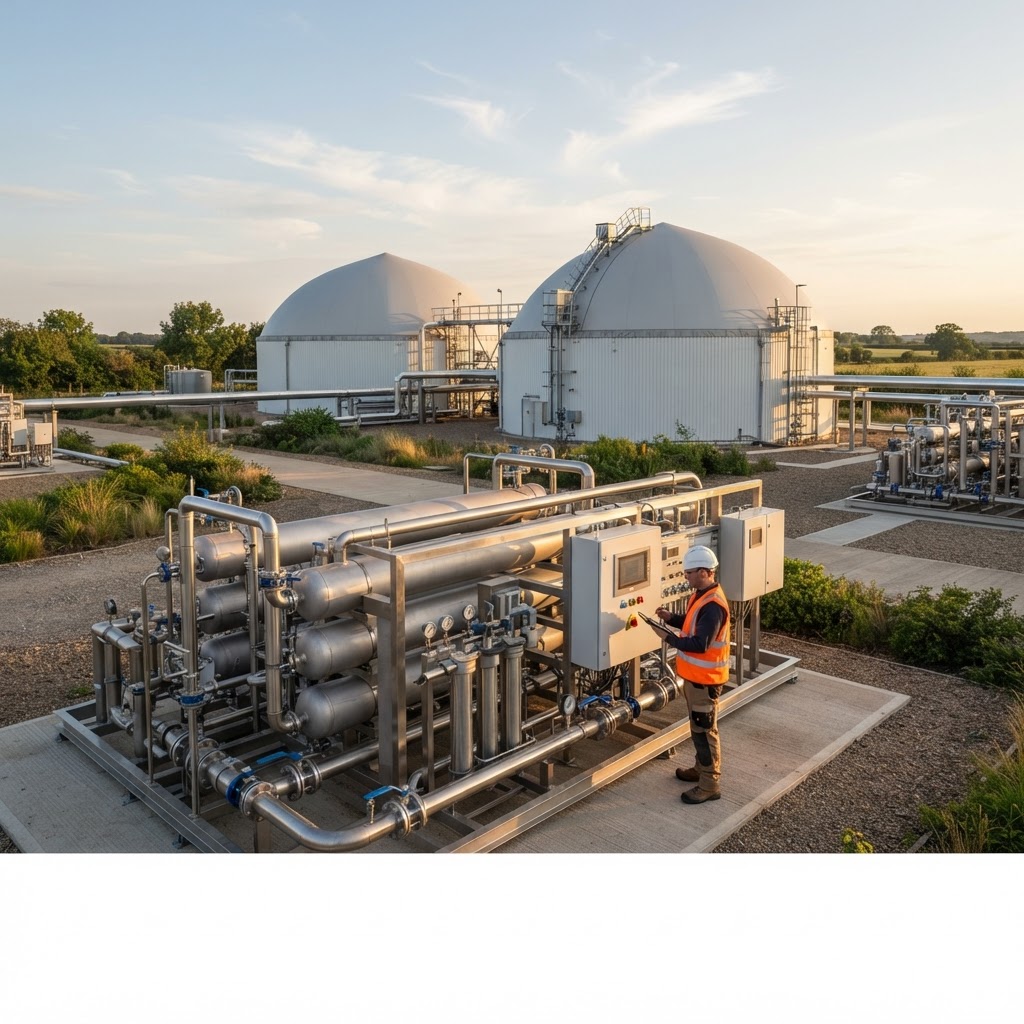
Raw biogas is a mediocre fuel. Depending on the feedstock, it is 50 to 70 percent methane and 30 to 50 percent CO2, saturated with water, and laced with traces of hydrogen sulphide and siloxanes. Burned in a boiler or a combined heat and power (CHP) unit, that is fine. The gas is worth roughly 6 to 7 kWh per cubic metre, about two-thirds of natural gas, and it does not travel well: a pipeline operator will not accept it, and a truck cannot carry enough of it.
Upgrade it, and the same gas becomes a commodity. Biomethane at 95 to 99 percent methane is interchangeable with natural gas. You can inject it into the grid, compress it into vehicle fuel, or bottle it as liquefied biomethane. That single step is the difference between an on-site waste treatment energy credit and a product you sell by the megawatt-hour.
At Energaia Institute we design waste-to-energy and gasification plants, and the upgrading question is one our clients get wrong most often: either they assume a digester alone produces "biogas like natural gas", or they budget for full grid-injection upgrading when a CHP unit on site would pay back twice as fast. This article is the guide we walk them through.
What Has to Come Out, and Before What
Upgrading is not one cleaning step, it is a sequence, and the order matters:
- H2S removal first. Hydrogen sulphide corrodes compressors, membrane fibres and engines at concentrations above a few hundred ppm. Most plants remove it before anything else, typically with iron oxide beds or biological desulphurisation inside the digester headspace.
- Drying. Raw biogas leaves the digester saturated with water. Refrigeration drying prevents condensation in downstream equipment.
- Siloxanes (if feedstock contains fats, sludge or food waste). Silica deposits destroy engine internals and foul upgrading media. Activated carbon handles it.
- CO2 separation. This is the actual "upgrading", where the methane content rises from about 60 percent to 95 to 99.9 percent.
- Odorisation, metering, quality monitoring. Before grid injection, gas must meet a grid standard (in Germany, the DVGW G 260 series) and match the calorific value of the local gas.
The CO2 separation step is where the cost concentrates, and where you pick your technology.
The Four Separation Routes
There are four industrially proven routes, plus cryogenic separation used mostly in large gas-grid hubs. Each trades equipment cost against recovery, energy demand and operational simplicity.
| Route | How it works | Typical CH4 recovery | Best when |
|---|---|---|---|
| Water scrubbing (pressurised water wash) | CO2 dissolves in water at 6-10 bar; methane stays in the gas phase | 96-98% | Water is cheap and you want simple, robust operation |
| Chemical scrubbing (amines) | CO2 binds chemically to an amine solvent, then released with heat | 98-99.9% | Waste heat is available and very high purity or very low slip is required |
| Pressure swing adsorption (PSA) | CO2 adsorbs onto zeolite or activated carbon beds; pressure swings regenerate them | 96-98% | Compact footprint matters; many valves, more maintenance |
| Membrane separation | Gas passes through polymer hollow-fibre membranes; CO2 permeates far faster than CH4 | 90-95% (1 stage) to 96-99% (2-3 stages) | Most new plants; modular, vendor-standardised, quick to build |
Two engineering facts drive most modern plant decisions:
Membranes now dominate new builds. A manufacturer can ship a containerised three-stage membrane skid, pre-tested, and commission it in weeks. Recovery scales with stage count: every additional stage recycles more of the methane that permeates through the first membrane, at the cost of another compressor pass.
Amine scrubbing has the lowest methane slip. Methane slip is the methane lost to the offgas vent, and it matters environmentally: methane is roughly 28 times more potent as a greenhouse gas than CO2 over 100 years. Water scrubbing and PSA typically lose 2 to 4 percent of the methane; a well-run amine plant can hold slip below 0.5 percent, and some operators advertise below 0.1 percent. An amine plant pays for that with regeneration heat. If you have no waste heat source, membranes usually win.
What Upgrading Actually Costs
Costs depend heavily on plant scale, because the equipment only comes in useful size steps. Rough tiers from recent European and West African project data, treating the raw biogas flow as the sizing basis:
| Plant scale (raw biogas) | Biomethane output | Upgrading capex (turnkey) | Upgrading cost |
|---|---|---|---|
| 100 m3/h | ~60 m3/h biomethane | EUR 0.5-1.0 million | EUR 20-30 per MWh |
| 500 m3/h | ~300 m3/h | EUR 1.5-2.5 million | EUR 12-18 per MWh |
| 1,500 m3/h+ | ~900 m3/h | EUR 4-6 million | EUR 8-12 per MWh |
Three qualifications:
- These are upgrading costs only, not the digester or feedstock handling. As a rule of thumb, upgrading adds 40 to 60 percent on top of the digestion-side investment.
- Grid connection can cost more than the upgrading plant. If the nearest suitable pipeline is 10 km away, the grid operator study, compressor station, pipework and metering frequently reach several percent of the project value. In emerging markets the gas grid often does not exist at all, which pushes projects toward compressed or liquefied biomethane instead of injection.
- Compression to vehicle fuel is not free. Compressing biomethane to 200-250 bar for CNG use typically adds EUR 4-8 per MWh and meaningful electricity demand, which matters off-grid.
For context, the European market is scaling fast: the REPowerEU plan set a target of 35 bcm of sustainable biomethane per year by 2030, and production is on the order of 4-5 bcm today with more than 1,500 producing plants. That gap is why upgrading bottlenecks, connecting pipelines and feedstock logistics are where the commercial attention sits.
When to Upgrade, and When Not To
The decision rule we apply is straightforward:
- If you can consume the energy on site, raw biogas in a CHP unit usually wins. You skip the 15 to 20 percent recovery loss, the EUR 0.5 million-plus capex, and the offgas handling, and you harvest both electricity and heat (a CHP converts 35-42 percent to electricity and 40-50 percent to usable heat).
- If gas sells at a premium where you are, for example bottled CNG for transport fleets, off-grid industrial heat, or a grid paying biomethane tariff prices, upgrading changes the product from "power at the local tariff plus heat you might waste" to "gas at the gas price".
- If feedstock has problematic traces (sewage sludge, slaughterhouse waste), upgrading concentrates those contaminants into the pre-treatment stage. Budget for it early, not after the first compressor failure.
This last rule matters most in the markets we work in. In Nigeria, the compressed natural gas (CNG) conversion push for transport is creating a visible buyer for compressed biomethane at CNG stations, and palm oil mill effluent (POME) and abattoir waste give digesters a serious feedstock base near exactly the corridors where diesel is most expensive. In Germany, the economics run through grid injection and the EEG support framework for repowered or substrate-flexible plants. Same equipment, two completely different routes to revenue.
The upgrading step is also the main lever on the carbon story. Biogas burned in a flare or unutilised digester vent offsets nothing, and a plant leaking 4 percent of its methane through a single-stage skid erodes a large part of its greenhouse gas advantage. Low-slip design is not an environmental luxury; it is the product's ability to claim its CO2 avoided tonnes credibly.
Conclusion
Upgrading is a commodities trade, not a technical checkbox: the equipment is mature, the four routes are well understood, and the real work is matching recovery, slip and capex to the gas price you can actually capture. Pick the separation route by what you have locally (water, waste heat, space, grid distance), size the plant honestly against feedstock, and let the offgas handling decide whether your climate claim holds. The digesters make the gas. The upgrader decides what the gas is worth. Now that we know how the separation trains work: how much raw biogas could your feedstock actually produce, and what does the full plant cost? That is the sizing question, and it is the next article in this series.