
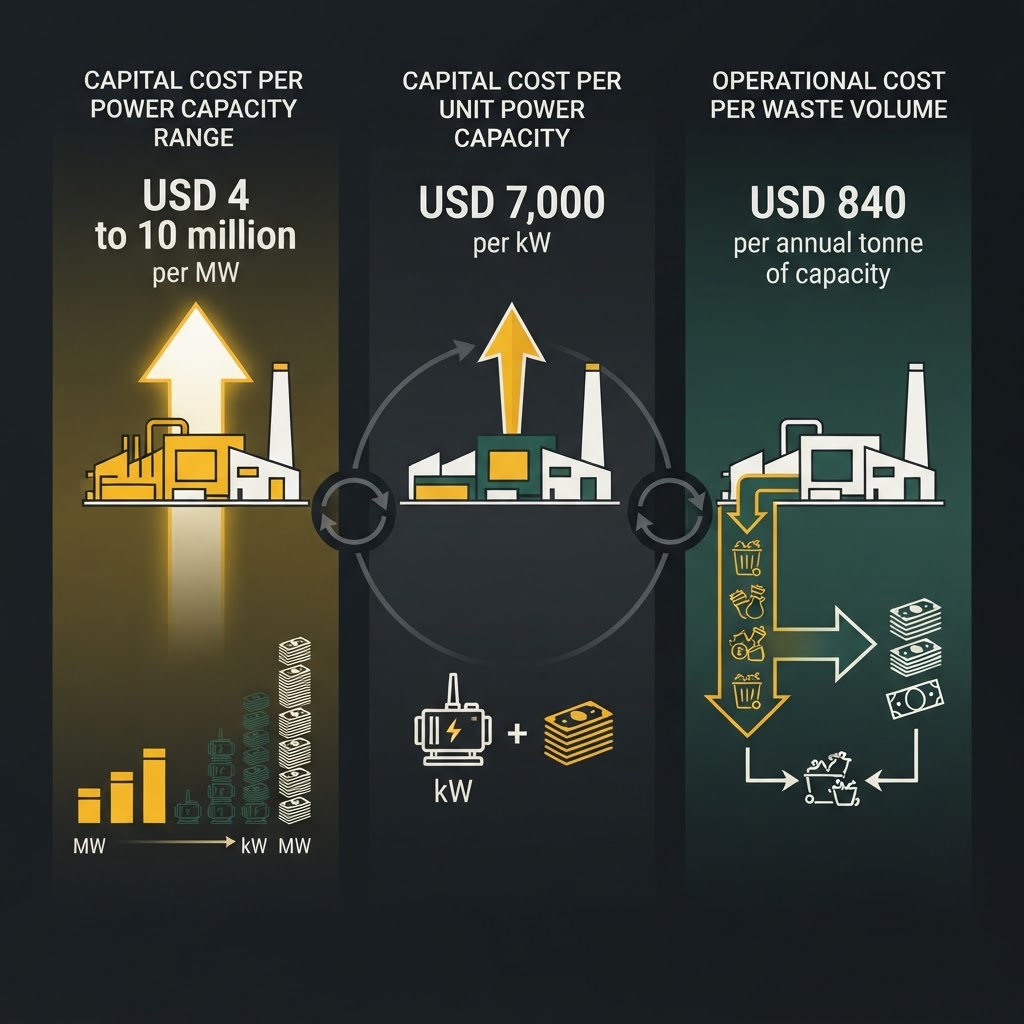
Every quoted waste to energy plant cost is a fraction, and almost every argument about the figure is really an argument about what sits under the line. Quote the same facility per megawatt installed and it costs USD 4 to 10 million. Quote it per kilowatt for an energy model and it is around USD 7,000 per kW. Quote it per annual tonne of capacity, which is the unit the waste contract is written in, and the US fleet averages USD 840, across a range of 386 to 1,811.
Same plants. Three numbers that cannot be compared with each other. So this page does the thing the cost pages usually skip: it fixes the denominator, breaks the capital cost into what it actually buys, puts published 2025 contract sums next to the modelled benchmarks, and names the cost line that almost every financial model omits.
Start with the denominator, not the range
Pick the unit before you pick the technology, because the unit encodes what you are buying.
Per kW of installed capacity is the power engineer's unit. It is useful for comparing a waste plant against solar or a gas engine, and useless for a municipal tender, because nobody is contracting to buy your kilowatts at a fixed price for twenty years.
Per annual tonne of capacity is the lender's unit. It maps directly onto the tonnage obligation that produces the gate fee, and it is the only denominator that survives a change of technology.
The EPC order value is the buyer's unit and the only one that is not an estimate. It is also the one nobody publishes an average for, which is why the section below is worth more than the ranges above it.
One trap before the numbers. Tonnes are not tonnes. A German sewage sludge plant is specified in tonnes of dry matter per year, while a press release may quote the dewatered mass that arrives at the gate. EEW's Stavenhagen facility is a 50 million euro plant taking up to 160,000 tonnes of compressed sewage sludge a year. Dewatered sludge is still mostly water, so the dry matter capacity behind that headline is a fraction of it, and the per tonne figure moves several fold depending on which mass you divide by. Get that wrong in a comparison and you will reject the cheaper plant.
What the capital cost actually buys
The per megawatt headline splits into six blocks, and their relative sizes tell you where the risk is: waste processing and handling at 1 to 2.5 million per MW, energy conversion at 2 to 5 million, power generation at 0.5 to 2 million, emission control at 1 to 3 million, civil works at 0.5 to 1.5 million, and engineering, design and permitting at 0.5 to 1 million.
Notice that emission control can be as expensive as the power block. That is not a technical fact, it is a regulatory one, and the cleanest evidence sits in the American fleet history: US facilities built before the MACT air standards averaged about USD 750 per annual tonne of capacity, and those built after averaged about USD 1,050. That is roughly 40 percent more capital for the same job, written by a rule rather than by an engineer. The same source finds Chinese projects averaging USD 250 per annual tonne against the US average of 840, with Chinese-built plants exported to Vietnam and Ethiopia landing near 350.
For gasification the bands are tighter and quoted in euros. Fixed and fluidised bed gasifiers run 1,965 to 5,235 EUR per kW installed, rising to 5,115 to 6,010 EUR per kW once a CHP system is attached, with electricity-only plants averaging 8,583 EUR per kWe. Adding the engine roughly doubles the floor of the range, which is the single most common surprise in a first budget. We take gasification capex on its own terms separately, and the mechanics of why the two routes cost differently are in waste to energy versus incineration.
For a public-sector sanity check, the UK government's review of energy from waste costs settles on capex of 3,500, 7,000 and 10,000 GBP per kW as low, medium and high cases for advanced conversion technologies, and 8,000, 14,000 and 16,959 GBP per kW for energy from waste with CHP. The authors state plainly that the evidence base behind the revision is weak. Treat every published range as having that caveat attached, whether or not the author had the discipline to write it down.
Scale is the biggest lever, and below 1 MW it stops working
Bigger is cheaper per unit, up to a point. Plants of 1 to 5 MW sit at the top of the range at 7 to 10 million per MW, 5 to 20 MW plants at 5 to 8 million, and plants above 20 MW at 4 to 6 million. The returns follow: an Italian analysis of bubbling fluidised bed gasification CHP found payback of 13 years at 13.6 kWe, 6 years at 136 kWe and 3 years at 1.94 MWe, with internal rates of return of 10, 25 and 71 percent.
Then the curve flattens, and the reason is architectural. A 2025 techno-economic study of a 225 kWel plant built from five 45 kW drying and gasification modules found that unit capital cost barely improves with size at this end, because the industry scales horizontally by adding modules rather than by building one larger reactor. In the same model, raising annual operating hours from 7,500 to 8,000 lowered the levelised cost by only 2 percent, while dropping from 8,000 to 5,000 hours raised it by 35 percent, making operating hours the most sensitive parameter of all, above biomass cost and above plant size.
Read that as a purchasing instruction. Below a megawatt, availability is worth more than scale. A quote that assumes 8,000 hours and delivers 5,500 has repriced your electricity by a third, and no discount on the capex recovers it. If modular capacity is the route you are considering, what putting the plant in a container changes is the sibling question worth answering first.
Real 2025 prices, not ranges
Germany is currently the best-lit market in the world for this, because the Sewage Sludge Ordinance is forcing a build queue and the orders are being announced with capacities attached.
At Wuppertal-Buchenhofen, Andritz took an order close to 100 million euros for a plant handling 47,500 tonnes of dry matter a year, covering sludge reception, drying with vapour condensation, bubbling fluidised bed incineration, boiler, multi-stage flue gas cleaning, steam turbine and generator. That is roughly 2,100 euros per annual tonne of dry matter.
At Halle-Lochau, the developer invested around 18 million euros for 10,750 tonnes of dry matter a year plus 2,750 tonnes of externally dried sludge, processing 30,000 to 35,000 tonnes of dewatered sludge. That is roughly 1,700 euros per annual tonne.
The smaller plant is cheaper per tonne than the larger one. Scale did not lose to physics, it lost to scope: Halle-Lochau takes some of its sludge pre-dried and landfills its ash, while Buchenhofen buys a full drying line and a power island. A third order, at Boeblingen, sits in the low three-digit million range for 36,000 tonnes of dry matter a year serving more than 70 municipalities, which puts it above 2,800 euros per annual tonne on the most conservative reading of that phrasing.
The lesson is not that one vendor is expensive. It is that per tonne comparisons between plants with different battery limits are meaningless, and battery limits are exactly what a press release omits.
At the small end, prices are published rather than estimated. A German gasification supplier lists gas generator plus gas treatment plus CHP genset at 4,200 to 4,800 EUR per kWel for mobile 40 to 80 kWel units, 4,000 to 4,500 for stationary 50 to 200 kWel, 3,500 to 4,000 for 250 to 750 kWel and 3,000 to 3,500 above 1 MWel. Those are ex works Germany and exclude transport, on-site assembly and start-up, which is the gap between a list price and a project.
Opex, and the line nobody provisions
Capital cost decides whether you can build. Operating cost decides whether you should.
The workable rule of thumb for gasification is fixed opex of 3 to 6 percent of initial capex per year with variable opex around 3.4 EUR per MWh. India's central regulator uses a comparable convention on mass-burn: on a normative capital cost of 1.7 million GBP per MWe, operations and maintenance is set at 5 percent of capital cost escalating 5 to 5.72 percent a year, total fixed cost lands at 25 to 26 percent of capital cost annually, and the resulting levelised cost of electricity is 0.078 GBP per kWh.
Then the line that appears in government models and almost never in vendor quotes. The UK review provisions decommissioning at 5 percent of base capex against a 2 percent scrappage value, and notes that if the land has to be cleaned up and the site cannot be repurposed, a further 5 percent may be required. On a 100 million euro plant that is a multi-million euro obligation with no revenue attached. Whether the plant earns any of it back is a separate question, answered in whether the plant earns that money back.
The cost line the models leave out
Every published model in this article starts at the reactor. Feedstock does not.
Waste arrives wet, mixed and inconsistently sized, and the equipment that fixes that is not a rounding error. In the Italian investment breakdown cited above, the biomass hopper and pre-treatment section costs 47,673 euros of a 264,850 euro gasifier plant at 100 kWth, against 55,619 euros for the gasifier itself. The thing that prepares the fuel costs almost as much as the thing that converts it, and it scales with the plant: 663,608 euros of a 3.69 million euro plant at 10 MWth.
This is where our own work sits. Energaia's published engineering position is that thermal pre-treatment is non-negotiable in gasification and pyrolysis, because moisture reduction, energy density and feedstock homogenisation determine whether the reactor holds its design throughput at all. And because drying sludge releases volatile organic compounds that are a real permitting exposure rather than a footnote, we built a MATLAB-based VOC simulation suite to model those emissions before any steel is ordered.
The commercial argument for modelling first is unglamorous and easy to check: a pre-treatment scope that is wrong on paper is a change order, and a pre-treatment scope that is wrong in the ground is a permitting reopening. One is priced in weeks, the other in years of idle equity. If you want the process context before the cost context, start with how the process works end to end.
Two markets ask two different cost questions
In Germany the cost is set by a deadline. Against existing mono-incineration capacity of 620 thousand tonnes of dry matter, roughly 1.1 million tonnes need a new route, with around 34 new-build projects in the pipeline, and the phosphorus recovery obligation bites from 2029. A statutory deadline plus a capacity shortfall compresses a decade of building into a few years of ordering, and in that market the schedule is the cost. What the tonnes cost to get rid of today is the other half of the equation, and we size that in what sewage sludge disposal costs.
In emerging markets there is no gate fee, so the plant is sized to a single site and the benchmark is the fuel it displaces. Nigeria's National Bureau of Statistics put average retail diesel at N3,277.47 per litre in May 2026, up 86.40 percent year on year. Against a fuel bill that reprices upward every quarter, a high capex with a near-zero fuel cost is a different instrument entirely, which is why we run that comparison separately in the diesel benchmark in Nigeria.
Turning a range into a budget for one site
Six questions, in order, convert everything above into a number you can defend.
- What is the denominator, and is it dry matter or wet tonnes at the gate?
- How many tonnes are contracted, for how long, and by whom?
- What is inside the battery limits of each quote, specifically drying, flue gas cleaning and the power island?
- What annual operating hours does the quote assume, and what happens to the levelised cost at two thirds of that?
- Is the price ex works, and who carries transport, assembly, commissioning and grid connection?
- What is provisioned for decommissioning and site recovery?
Answer those and the ranges in this article stop being trivia and become bounds. Skip them and you will compare two quotes that are not describing the same plant, which is the most expensive mistake available in this sector and also the most common.
FAQ
How much does it cost to build a small waste to energy plant?
Published German list prices for a gasifier with gas treatment and a CHP genset run about 4,200 to 4,800 euros per kWel for a mobile 40 to 80 kWel unit, falling to 3,000 to 3,500 euros per kWel above 1 MWel, before transport, assembly and commissioning. Expect the unit cost to improve less than you hope as you size up, because sub-megawatt systems are usually expanded by adding parallel modules rather than by building a bigger reactor.
Why do waste to energy cost estimates vary so much?
Three reasons, none of them technology. The denominator differs, so per MW, per kW and per annual tonne figures get compared as if they were the same measurement. The regulatory regime differs, and air quality rules alone moved US capital cost from about 750 to about 1,050 dollars per annual tonne. And the market differs, with the US fleet averaging 840 dollars per annual tonne against 250 in China.
What does a sewage sludge incineration plant cost in Germany?
Recent published orders give roughly 2,100 euros per annual tonne of dry matter at Wuppertal-Buchenhofen and roughly 1,700 at Halle-Lochau. The smaller plant is cheaper per tonne because it takes some sludge pre-dried and landfills its ash, so compare battery limits before comparing prices.
What is the annual operating cost of a waste to energy plant?
For gasification, fixed operating cost commonly runs 3 to 6 percent of initial capital expenditure a year with variable cost around 3.4 euros per MWh. Mass-burn regulatory models use a similar convention, taking operations and maintenance at 5 percent of capital cost with annual escalation of roughly 5 to 5.7 percent.
Is decommissioning included in a waste to energy plant cost?
Rarely in a vendor quote. Government cost models provision 5 percent of base capital expenditure for decommissioning against a 2 percent scrappage value, with a possible further 5 percent where the land must be remediated and the site cannot be repurposed. Add it yourself if the tender does not.