
Are biochar carbon credits reliable? As a pathway, yes, and by a wider margin than any other durable removal on the market today. As a purchase, not automatically. Those are two different questions and almost every page answering the first one quietly lets you believe it has answered the second.
The gap between them is a reactor. Two plants running the same feedstock under the same methodology can produce credits with genuinely different climate value, and the variables that decide which one you bought are temperature, moisture, methane control and chain of custody. We build gasification and pyrolysis plants and we run carbon credit management as a service, covering certification, trading strategy and MRV. So this is written from inside the process that either earns the credit or does not.
If you need the mechanism first, our sibling piece covers how a biochar carbon credit is calculated from reactor conditions to net tonnes. If you need the commercial picture, start with the biochar carbon credit market, its prices and standards. This page is about trust.
What the Ratings Data Actually Says
Reliability in this market is measurable, because independent agencies now rate thousands of projects and publish the distribution.
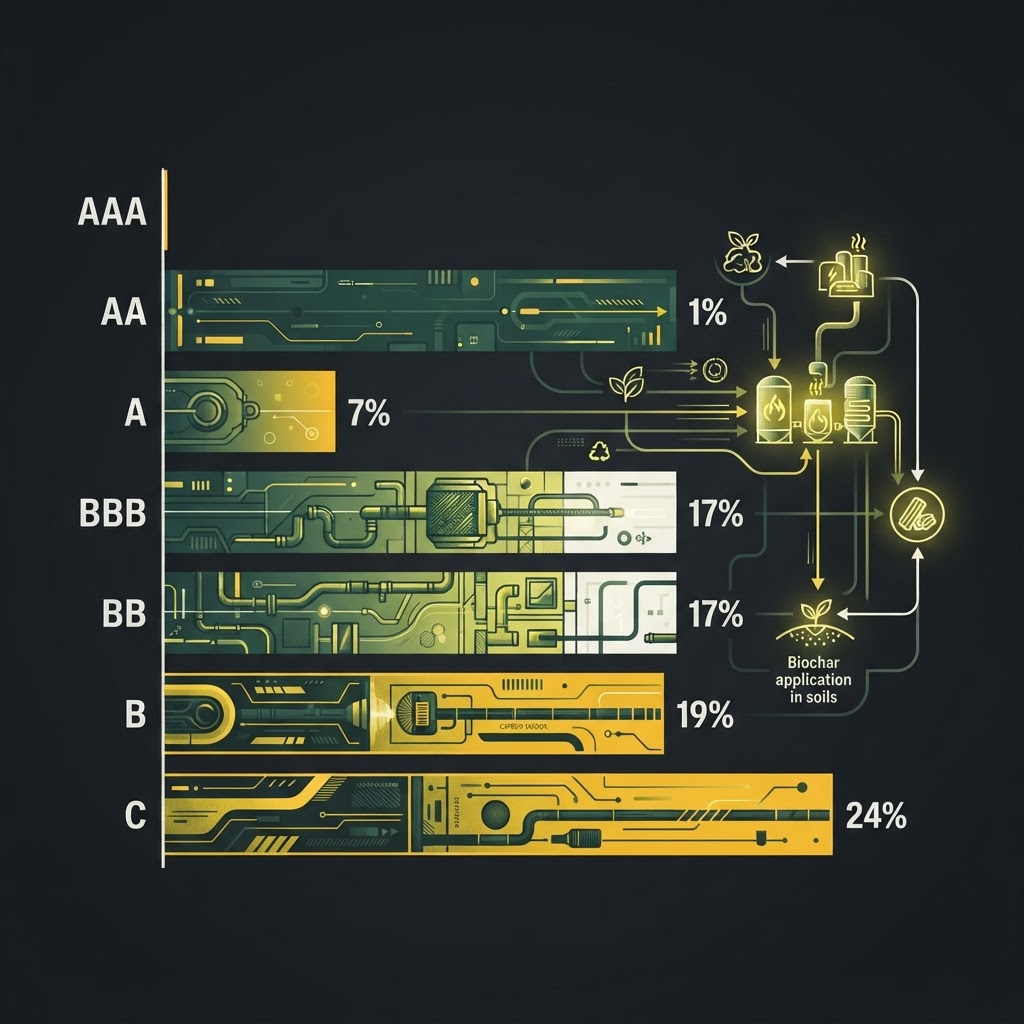
It is not flattering. Across Sylvera's rated universe, the largest share of projects sits at C (24 percent), then B (19), D (17) and BBB (17). Only 7 percent reach A, 1 percent reach AA, and no project is rated AAA, which means roughly a quarter of the market is BBB or better. Read plainly: most carbon credits on sale are mediocre.
Biochar is one of the exceptions, and the same distribution is the evidence. Biochar and afforestation projects show a more balanced spread with a higher share at BBB and above, while renewable energy and cookstove credits cluster at C and D. That is the honest case for the pathway. It is not that biochar credits are good. It is that the odds of finding a good one are materially better here than almost anywhere else.
BeZero, having assessed most of the largest issuing biochar projects, reaches the conclusion the vendor pages skip: biochar credit quality varies significantly, which is precisely why project-level due diligence cannot be delegated to the label.
One marketplace puts a number on how much variance there is in practice. Supercritical assessed hundreds of biochar projects against a 118-point framework and rejected 88 percent of them. Nine in ten projects offering credits under a recognised standard did not clear one buyer's quality bar.
Reliability Is Decided Inside the Reactor
Everything a rating agency later measures was set months earlier by hardware and operating discipline.
Pyrolysis temperature and the H/Corg ratio
The hydrogen to organic carbon ratio is the single number that predicts whether a tonne stays put. Below 0.4, roughly 75 percent of the carbon exists as stable polycyclic aromatic structures expected to persist in soil for more than 1,000 years regardless of climate or soil type. Above 0.7, only 40 to 50 percent is genuinely stable over the long term, per the same Supercritical analysis.
Temperature drives that ratio. Above 500C the biochar is more stable with higher aromatic carbon content, and below 450C the H/Corg ratio rises, indicating more labile carbon that decomposes faster. The European Biochar Certificate and the International Biochar Initiative both specify maximum H/Corg thresholds for certified material.
Practically, buyers should be asking for a reactor running above 550C and an independently tested H/Corg below 0.4, with the analysis following approved DIN norms or accredited lab standards. Not a claimed figure. A tested one, with the lab named.
Methane is the failure mode nobody asks about
Poorly controlled pyrolysis produces methane, which warms about 30 times more than carbon dioxide over 100 years. Even small leaks can cancel a project's entire climate benefit.
This is where production method stops being a preference and becomes an accounting fact. Open pit and flame curtain kilns are open to the atmosphere by design, so direct methane measurement is impossible: you cannot measure what you cannot enclose. Wet biomass is a primary driver of methane during pyrolysis, and while projects routinely claim to exclude high moisture feedstocks, that claim is unverifiable without emissions monitoring.
That is why we have argued publicly that thermal pre-treatment is non-negotiable in gasification and pyrolysis. Moisture reduction, energy density and feedstock homogenization are usually sold as efficiency measures. They are also the difference between a methane figure you can defend and one you are asserting.
Feedstock is a carbon accounting decision
Feedstock sets both the stability ceiling and the contamination risk. Sewage sludge biochar has different stability characteristics and may carry contaminants that disqualify it for soil application in some jurisdictions, which matters if the credit assumes a soil end use. For a municipality the feedstock question usually starts from the disposal cost it already carries, and the answer has to survive the crediting methodology, not just the balance sheet.
The reliability framework most buyers work from rests on three pillars: genuinely waste or sustainably sourced feedstock, transparent MRV from biomass through pyrolysis conditions and stability testing to final application, and evidenced permanence of at least 100 years. Its named failure modes are a useful pre-mortem: feedstock misclassification and leakage where the biomass had another beneficial use, weak lifecycle assessment that ignores transport emissions, inconsistent pyrolysis conditions, and unmonitored end use.
The Protocols Do Not Agree With Each Other
A registry logo is not a quality grade, because the protocols behind those logos handle risk differently.
The Environmental Defense Fund's comparison finds that while biochar protocols follow similar accounting steps and derive durability from the H:Corg ratio, they diverge materially on leakage, uncertainty, permanence and additionality. Uncertainty is the clearest example. The Climate Action Reserve protocol requires organic carbon content to be taken from the lower bound of the 95 percent confidence interval and H:Corg from the upper bound, guarding against overestimation in both directions. The Global Biochar C-Sink applies a flat margin of safety of 20 kg CO2e per tonne of biochar. Isometric requires reported uncertainty on every input variable plus a sensitivity analysis. Puro.earth added a full uncertainty section in its 2025 revision. Verra's VM0044 does not explicitly address uncertainty at all.
Two plants, two protocols, identical char: different issued tonnage and different defensibility. The same review flags an elevated double counting risk when biochar is applied to land already enrolled in a soil carbon programme, and notes that credits only materialise once the char reaches an approved end use, which makes end-user demand a structural constraint on the whole market.
The Case Against Biochar Credits, Taken Seriously
The critics are worth reading, because their strongest points are about measurement rather than chemistry.
The core objection is that permanence claims rest on modelling. Without multi-decade field trials, long residence times are extrapolated from short-term laboratory and field work, and field studies have produced mixed results including low carbon residence times in tropical soils and at lower soil pH. The same review documents heavy metal accumulation risk from certain feedstocks, PAHs and dioxins as potential soil contaminants, and work by Cornelissen and colleagues showing that flame curtain pyrolysis produced significantly different results even under expert supervision in optimal conditions. It also notes that the ICVCM's working groups include buyers, traders and rating firms, which is a fair governance question.
We do not think that argument retires the pathway, and we do not think it should be waved away either. Look at where each criticism actually lands: unenclosed kilns, unmeasured emissions, variable operators, unmonitored end use, feedstocks nobody characterised. Every one is an argument for instrumented, temperature-controlled, continuously monitored production. The critique of uncontrolled biochar is the strongest available case for engineered biochar.
The honest position on permanence is that the 1,000 year figures are model outputs anchored in H/Corg, not observations. A supplier who says so is more credible than one who does not.
The Diligence Checklist Buyers Actually Run
Ask for these, in writing, before money moves:
- Feedstock provenance with proof of waste status and certification where it exists, plus chain of custody to the reactor.
- Lab-tested H/Corg with the accredited laboratory named and the sampling frequency stated.
- Pyrolysis operating data: temperature range, whether conditions are continuously monitored, and whether emissions including methane are directly measured.
- The full lifecycle assessment, cradle to grave, including transport.
- A third-party verified MRV plan, not a self-reported one.
- The methodology name, registry, and traceable serial number, plus the retirement record tied to your organisation. An unnamed certification claim is unverifiable, and an unverifiable claim is a reporting risk you are buying.
- A buffer, reserve or insurance arrangement covering under-delivery, and written confirmation the credits are not listed on other marketplaces at the same time.
Red flags, from the same buyer checklists: vague feedstock answers, no H/Corg lab data, permanence claims beyond 200 years without lab evidence, no registry listing, one-off rather than continuous monitoring, and big promises from a pilot plant using unproven equipment.
Delivery is its own risk category and the one most often underestimated. Supercritical reports that 73 percent of biochar projects revised their capacity forecasts downward in a single year. A credit that never gets delivered is not a quality problem, it is a hole in your inventory. Ask how many tonnes the supplier has delivered to paying customers to date, and treat that number as more informative than any projection.
Where Reliability Meets Price
Quality has a floor price and it is not subtle. The market spans roughly 100 to 300 US dollars per tonne, with over 1 million tonnes of CO2 issued to date across 128 active projects globally and Puro.earth volumes growing 166 percent between 2023 and 2024. Against that, Supercritical reports that no industrial biochar meeting its quality standard exists below 165 dollars per tonne on the spot market.
The bottom of the range is cheap for reasons that show up in diligence. There is more on what drives the price per tonne in the dedicated piece.
What Reliability Looks Like From the Build Side
Our public five-step process is deliberately ordinary: collect local biomass and sludge, gasify at high temperature to clean syngas, convert it to dispatchable electricity and heat, capture biochar plus verified CO2 offsets, and run it on site. The credit is a product of the same process discipline that makes the plant work as an energy asset.
That is the practical reason to build for the credit and the kilowatt together. Homogeneous, pre-treated feedstock produces consistent stability results batch after batch, and consistency is what an auditor is testing. Erratic input forces conservative assumptions, and every conservative assumption costs issued tonnes at every verification.
The same logic runs upstream of construction. We built a MATLAB-based simulation suite to model volatile organic compound emissions in biomass-to-energy before anything is fabricated, because an emissions profile you predicted and then measured is a different asset from one you discovered during commissioning. Selling the result is a separate exercise: see selling the credits once they are issued.
Where These Credits Are and Are Not Accepted
Biochar credits are voluntary market instruments, and their reliability for compliance purposes is a separate question from their environmental integrity. Per the IETA business brief, eligibility in compliance markets remains limited and is most advanced in Japan, where biochar is covered by J-Credit methodology AG-004 and J-Credits can be used in the GX-ETS subject to limits. The EU's Carbon Removal Certification Framework is adopting methodologies for permanent removals including Biochar Carbon Removal, but forthcoming CDR provisions under the EU or UK emissions trading schemes are unlikely to include biochar.
No biochar credit discharges an EU ETS obligation today. Any supplier suggesting otherwise is selling a market that does not exist. And because these are removals rather than avoided emissions, it is worth being clear that a removal, not an avoidance is what you are claiming.
FAQ
Are biochar carbon credits a scam?
No, and the registry mechanics are the reason: credits are issued only after independent third-party verification of sustainably sourced biomass converted to characterised biochar and stored in an approved end use. The reasonable version of the worry is over-crediting on a specific project, not fraud across the category. That is a diligence problem, and diligence has answers.
How long does biochar actually store carbon?
It depends on the H/Corg ratio. Below 0.4, about 75 percent of the carbon is stable aromatic structure expected to persist beyond 1,000 years. Above 0.7, only 40 to 50 percent is genuinely stable. Treat the long horizon figures as model outputs extrapolated from short-term data rather than field observations, because that is what they are.
Is artisanal biochar worse than industrial biochar?
On measurability, yes. Open kilns cannot be enclosed, so methane emissions cannot be directly measured, and operator-to-operator variability makes credible sampling difficult. Closed-system distributed kilns with sensors are the emerging middle category, combining industrial process control with community co-benefits and lower prices.
Which biochar registry should I trust most?
Judge the uncertainty treatment rather than the logo. Isometric and Puro.earth have explicit uncertainty procedures, the Climate Action Reserve uses 95 percent confidence bounds on lab measurements, the Global Biochar C-Sink applies a flat margin of safety, and VM0044 does not explicitly address uncertainty. Then check which registry your own reporting audience already recognises.
Can biochar carbon credits be double counted?
Yes. The elevated risk case is soil application on land already enrolled in a soil carbon programme, which centralised registry tracking is meant to prevent. Separately, ask whether the same credits are listed on multiple marketplaces, which creates double-selling exposure before any registry issue arises.