
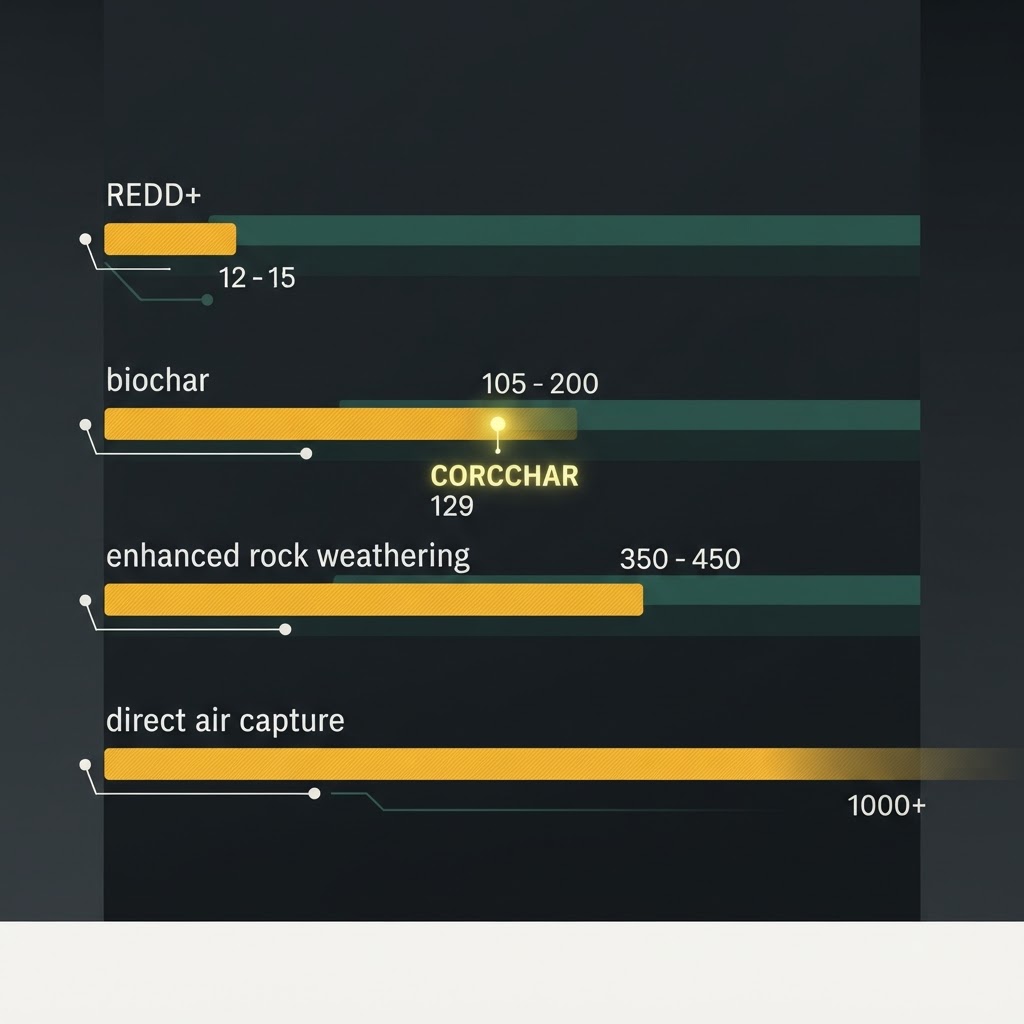
The biochar carbon credit price per ton in 2026 runs roughly 100 to 250 US dollars, and the published benchmark index sits below that. The Nasdaq-calculated CORC biochar index closed July 2026 at 129.21 euros, up 7.08 percent on the month, against a 138.35 euro composite for all Puro removal transactions. The transacted average has been climbing for years: 164 US dollars per tonne in 2025, up from 131 in 2023.
Both numbers are true and neither is a quote. The spread inside biochar is about 150 dollars wide, which is wider than the entire price range of the nature-based market it gets compared to. So the useful question is not what biochar costs. It is which biochar you are buying, or building.
We design the gasification and pyrolysis plants that make the char and we run carbon credit management as a service, covering certification, MRV and trading strategy. This page is written from both sides of that invoice.
Why the Benchmark Index Sits Below Every Quoted Range
CORCCHAR tracks settled transactions under Puro Standard methodologies. The ranges quoted in buyer guides are largely forward offers on new supply, which is higher spec, more recently certified and priced against demand that has not been filled yet. An index of what cleared and a menu of what is being offered are not the same instrument, and the gap between them is not an error in either.
Senken puts the 2026 Nasdaq and Puro benchmark average at around 130 euros while its own transacted band for biochar removal runs 100 to 210 euros. Same market, two honest numbers.
The practical consequence lands on developers. Model your revenue off the index and you have priced a settled, average, often older tonne. Model it off the top of the offer range and you have assumed a buyer who wants exactly your origin, your permanence evidence and your co-benefit documentation. Neither is a plan.
The Four Things That Move Your Number
Origin: the European premium is real
Geography is the single largest lever. German biochar transacts at 189 to 200 euros, South American industrial at 142 to 190 with the typical price clustering between 160 and 180, and Indian biochar at around 105 euros for artisanal projects and 120 to 150 for industrial scale. The same source reports German credits trading at a 2x to 3x premium over identical methodologies in lower-cost geographies, and is blunt that this reflects genuine procurement preference rather than transport cost.
For a project in Saxony that is a structural advantage. For a project in Lagos it is a structural discount on an identical tonne, which is worth knowing before the financial model is built rather than after.
Production route: artisanal, industrial, heat-integrated
Within one geography, how the char is made sets the tier. Standard wood-feedstock biochar sits at 140 to 160 dollars, high-temperature char produced above 700 degrees Celsius reaches 160 to 200, biochar co-located with district heating commands 170 to 180 because the verifiable energy displacement strengthens the lifecycle maths, and smallholder or social-impact projects reach 180 to 250.
Read that list as a design brief rather than a price list. Three of those four tiers are decisions made at the plant, years before a buyer sees the credit.
Permanence: what the reactor temperature buys
Higher pyrolysis temperatures produce more aromatic carbon structures, which is what extends a permanence claim past a hundred years. Storage in the durable tier is credited at 100 to over 1,000 years with a 10 percent buffer applied. That buffer is a real haircut on issued tonnes and belongs in the model.
Co-benefit claims: priced, and now measurable
A 2026 hedonic pricing study of biochar transactions found that credit prices rise 0.14 percent for every 1 percent increase in associated sustainable development claims, against an average price of 170 US dollars per tonne in the dataset, implying that credits with the most claims are roughly 46 percent more expensive than those with the fewest, with economic co-benefit claims priced higher than environmental ones. The authors' own conclusion is the important part: because the market pays for these claims, auditing them is what keeps the pricing honest.
What Is Actually Inside the Invoice
Nobody is charging 180 dollars for a tonne of atmosphere. The credit is a stack of physical inputs.
Analysis built from anonymised developer financial models puts high-quality biochar at 140 to 250 US dollars per tonne with feedstock alone at about 25 percent of the credit price, and finds feedstock, labour, MRV and certification all rising while biochar capital costs stay broadly stable because there is no technology curve waiting to halve pyrolysis cost. That is an inflation-sensitive stack pointing in one direction.
Certification is the line item developers underestimate. Independent testing, feedstock documentation, process audits, sampling and lab analysis, permanence modelling and third-party verification are not optional if you want to sell at premium removal prices, and the same analysis warns that cheap pyrolysis kilns raise the effective cost rather than lowering it, through downtime, inconsistent char and harder certification.
That failure mode has an engineering root, which is why we argue that thermal pre-treatment is non-negotiable in gasification and pyrolysis. Moisture reduction, energy density and feedstock homogenisation are usually sold as efficiency measures. In carbon accounting they are price measures. Homogeneous input gives consistent stability results batch after batch, and consistency is precisely what an auditor tests. Erratic input forces conservative assumptions, and conservative assumptions cost issued tonnes at every single verification. There is more on the mechanics in our piece on how a biochar credit is calculated from reactor conditions to net tonnes.
Where Biochar Sits Against the Other Removals
The comparison that makes biochar look expensive is the wrong comparison. Set it against the durable tier instead: direct air capture at 450 to over 1,000 euros, enhanced rock weathering at 350 to 450, biochar at 105 to 200, and REDD+ at 12 to 15. Biochar is the accessible middle of durable removal, not a marked-up offset. The gap against REDD+ is a durability gap, and if that distinction is fuzzy it is worth knowing that carbon credits and carbon offsets are not the same instrument.
Against engineered peers specifically, biochar at 130 to 200 dollars competes with DAC above 500, BECCS around 389 and enhanced weathering around 200, while forestry offsets sit at 3 to 20 dollars in a different market entirely.
Where the Price Goes Next
Almost every buyer arrives with 100 dollars per tonne in mind. That number was a 2016 US Department of Energy research target for direct air capture under the Carbon Negative Shot strategy, not a market benchmark, and the OPIS and CDR.fyi pricing survey found suppliers across major methods expecting breakeven prices of 140 to 340 dollars per tonne in 2030 while buyers expect prices to fall significantly. A structural mismatch of that size does not resolve into lower prices. It resolves into less supply.
Demand is not the constraint. Between Q1 2022 and Q2 2025, 3.04 million tonnes of biochar removal were contracted with 1.6 million in the first half of 2025 alone, against 658 thousand tonnes actually delivered and 302 thousand retired, across 290 unique purchasers with Microsoft alone accounting for 46 percent of contracted volume, as the market grew from 14.6 million dollars in 2022 to 181.5 million in 2024. Roughly four tonnes have been bought for every one delivered.
Every tonne in that gap is a plant that has not been built, commissioned or certified. Contracts close in a quarter. Pyrolysis capacity does not. Prices hold while that stays true, and the diligence buyers apply is tightening in parallel, which is covered in our piece on what buyers check before they pay.
The Number a Developer Should Actually Model
Here is the correction that the buyer-side guides never make. The price per tonne is not project revenue. Certification, MRV, buffer deductions and platform fees come out of it first, and those lines are rising rather than falling.
The geography split cuts deeper than the headline premium suggests. Global North projects carry higher labour and feedstock costs and typically rely on revenue from waste heat or physical biochar sales to reach viability, while in Global South projects the char is often given away, so the credit price has to cover everything. A project whose entire business case rests on a credit price is exposed to a young voluntary market with one dominant buyer.
Our public five-step process is built the other way round: collect local biomass or sewage sludge, gasify at high temperature to clean syngas, convert that to dispatchable electricity and heat, and capture biochar plus verified CO2 offsets from the same process, on site. Four revenue lines, not one. Power, heat, avoided disposal cost and credits. The credit becomes the upside rather than the premise, and the plant survives a bad pricing year.
That is also the honest answer to a municipality asking whether credit revenue justifies a gasifier. On its own, at today's prices, usually not. Alongside a disposal cost you are already paying and power you are already buying, the arithmetic changes completely. Once the tonnes exist, finding buyers and structuring the offtake is a separate exercise, and the wider commercial picture is in our overview of the biochar carbon credit market, standards and buyers.
FAQ
How much does one biochar carbon credit cost in 2026?
Roughly 100 to 250 US dollars per tonne of CO2 depending on origin, production route, permanence evidence and co-benefit documentation. The Nasdaq-calculated CORC biochar index closed July 2026 at 129.21 euros, while the transacted average was 164 dollars in 2025 against 131 in 2023.
Why does German biochar cost more than Indian biochar?
Higher labour and feedstock costs plus genuine buyer preference for domestic origin. German biochar transacts at 189 to 200 euros against roughly 105 euros for Indian artisanal projects, a 2x to 3x premium on methodologies that are otherwise identical.
Will biochar carbon credits ever cost 100 dollars per tonne?
Unlikely as a market-wide price. The 100 dollar figure began life as a US Department of Energy research target for direct air capture in 2016 and drifted into use as a procurement benchmark. Suppliers across durable removal methods expect breakevens of 140 to 340 dollars in 2030, and the cost lines that dominate a biochar credit are rising.
How much of the credit price does a project developer keep?
Less than the headline, and the gap is not small. Feedstock alone runs about a quarter of a high-quality biochar credit price before labour, MRV, certification, buffer deductions and platform fees. Projects that also sell heat or physical char are working with a materially different margin from those where the credit carries the whole business case.
Does a higher price mean a better credit?
Not automatically, but the price drivers and the quality drivers are largely the same variables: permanence evidence, traceability, audit-grade documentation and verified co-benefits. A cheap tonne is usually cheap because one of those is missing, which is worth identifying specifically rather than treating price as a proxy.