
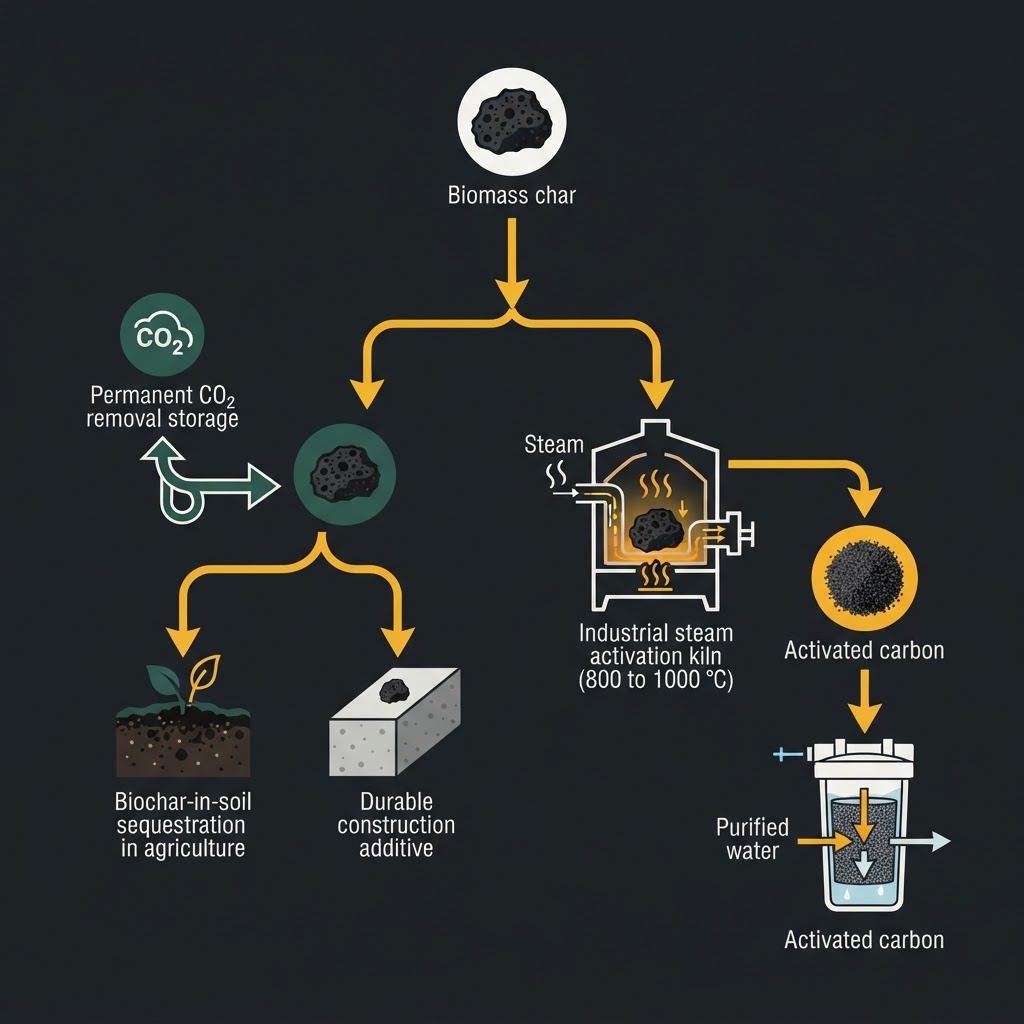
Producing a kilogram of activated carbon takes on average 97 MJ of energy and emits 6.6 kg of CO2 equivalent. A kilogram of biochar takes 6.1 MJ and comes out at minus 0.9 kg CO2 equivalent, a net removal. Those averages come from a meta-analysis of more than 80 data points, and they frame the whole biochar vs activated carbon question better than any definition. The two materials can start from the same feedstock and even the same char. What separates them is one extra thermal step, and that step decides whether the carbon is a sorbent you sell or a carbon removal you can certify.
For a gasification or pyrolysis plant, this is not an academic distinction. It is a product decision made at the plant gate, and it shapes revenue, energy balance and eligibility for carbon credits. Below is the comparison in measured numbers, then what it means for an operator.
The short answer
Both are pyrogenic carbon materials made by heating carbon-rich feedstock with little or no oxygen. The cleanest working definitions come from Hagemann, Schmidt and colleagues in MDPI Water:
- Biochar is made from sustainably sourced biomass and used in non-oxidative applications such as soil, concrete or animal feed. By definition it serves carbon sequestration. If it is burned as fuel, it is charcoal, not biochar.
- Activated carbon is made from any carbon source, fossil, waste or renewable, and engineered as a sorbent for gases and liquids. Its definition sets no rule on how sustainable the production is or what happens to the carbon after use.
The process gap is temperature plus activation. Activated carbon production needs 600 to 1,200 °C and a dedicated steam or chemical activation step, while biochar is typically produced at 500 to 800 °C with no activation, according to the Pacific Northwest Biochar FAQ. That is why biochar is so often described as the precursor of activated carbon: activate it and you get activated carbon.
Side by side: the numbers that separate them
| Dimension | Biochar | Activated carbon |
|---|---|---|
| Typical process temperature | 500 to 800 °C, no activation | 600 to 1,200 °C plus steam or chemical activation |
| Specific surface area | Average 8 to 132 m²/g for engineered biochar | Above 1,000 m²/g after activation |
| Energy demand (average) | 6.1 MJ/kg | 97 MJ/kg |
| Greenhouse gas balance (average) | -0.9 kg CO2eq/kg | 6.6 kg CO2eq/kg |
| Feedstock | Sustainable biomass only | Any carbon source, including coal |
| Fate of the carbon | Must stay out of oxidation to count | Not specified |
Surface area
Surface area is where activated carbon wins on paper. A 2025 technical review in Carbon Capture Science and Technology puts engineered biochar at an average of 8 to 132 m²/g, with values above 500 m²/g reachable for certain feedstocks and conditions, and above 1,000 m²/g after activation. The same review notes that most biochar uses benefit from a moderate surface area of a few hundred m²/g.
A corn stover study shows the jump in one feedstock: slow pyrolysis biochar at 500 °C measured 5.0 m²/g, while chemically activated carbons from the same material reached 646 to 1,167 m²/g. Direct activation of the raw stover gave 956 m²/g, which the authors note is around the range of many commercial activated carbons.
Energy and carbon footprint
The meta-analysis numbers above are averages across studies, not a single plant. They still show an order of magnitude difference: roughly 16 times more energy per kilogram for activated carbon. The authors also tested long-distance transport of biochar and found it would not overturn the result.
Adsorption and cost per job
Surface area is not the same as performance. In the same meta-analysis, surface area correlated positively with adsorption capacity for chromium, zinc and lead, but not for cadmium and copper, where ion exchange rather than pore space appears to drive removal. Per unit of contaminant removed, biochar was cheaper than activated carbon for chromium and zinc with 95 percent confidence, and comparable for lead and copper. No single material outperformed the other in every category, so the answer depends on the target contaminant.
For price context, fossil-derived commercial activated carbon sells at USD 1,543 to 2,645 per ton, according to a techno-economic study on algal activated carbon in Fuel Communications.
How a char becomes activated carbon
Activation is controlled burning. In physical activation, steam or CO2 at high temperature partly oxidises the char, opening clogged pores and then creating new micropores. Hagemann and colleagues point out that steam becomes an oxidant for carbon above about 750 °C, and that burn-off above 40 to 50 percent of the mass can destroy porosity rather than build it. CO2 activation tends to produce microporous carbons, while steam gives a wider pore size distribution.
An industrial example: a study in Energies steam-activated three softwood biochars in a rotary calciner with zones at 816 and 927 °C, injecting 1.5 kg of steam per kg of biochar. Surface area rose from 2.0, 177.3 and 289.1 m²/g to 868.4, 1,092.9 and 744.8 m²/g. Iodine numbers of 951 to 1,218 mg/g compared favourably with commercial carbons from bituminous coal and coconut shell. The same paper places physical activation above 800 °C and chemical activation, with agents such as H3PO4, ZnCl2 or KOH, above 500 °C.
The cost of that step is mass. In the Fuel Communications study, activated carbon yield from biochar ranged from 28 to 52 percent, falling as temperature, residence time and KOH ratio rose. Every percentage point of burn-off is carbon leaving the product as CO and CO2.
The carbon removal question
This is where the comparison stops being symmetrical. Biochar carbon removal rests on one condition: the carbon stays out of oxidation for a long time. If you want the durability side in detail, our piece on how long biochar stores carbon covers it. Activated carbon carries no such condition: its definition says nothing about where the carbon ends up after use.
Three consequences for anyone weighing the two:
- Activation spends the carbon you would otherwise certify. A 28 to 52 percent yield means half or more of the char's carbon can leave as gas during activation.
- Activated carbon from biomass can still count as biochar if it comes from renewable feedstock, meets biochar specifications and is left in place, for example in soil remediation, as Hagemann and colleagues note. Standards are the gatekeeper here; see biochar quality standards.
- The credit value is real but variable. The PNW Biochar FAQ estimates 1.9 to 2.7 t of CO2 per ton of biochar produced and cites biochar removal credits at USD 90 to 600 per ton in 2022. How those credits are issued and sold is covered in biochar carbon credits.
There is also a cascade route. Hagemann and colleagues describe cascade use, where one batch of biochar serves several functions before it ends in soil. Whether that works for a given waste stream is a question of contaminants and standards, which we unpack for municipal plants in biochar wastewater treatment.
What this means at a gasification plant
Energaia's public process runs in five steps: collect local biomass or sludge, gasify it to clean syngas, convert that to dispatchable power and heat, and capture biochar plus verified CO2 offsets, all on site. In that design the char is not waste. It is the second revenue line, and how you sell it decides the economics.
Gasification adds a twist. Hagemann and colleagues note that in high-temperature production above 800 °C, steam from feedstock moisture can partly activate the char in the reactor. A gasifier char may therefore sit between the two products before any dedicated activation step. That is why the char deserves the same attention as the syngas at the feasibility stage of gasification biochar production projects.
A practical decision frame:
- Sell as certified biochar when you have a soil, concrete or other durable sink and want carbon removal revenue. Lower energy, net negative footprint, and the carbon stays bankable.
- Upgrade to activated carbon when a buyer needs high surface area for a specific contaminant, typically water treatment, air and emissions treatment or solvent recovery, and pays activated carbon prices. Budget for steam above 800 °C, a yield of roughly half, and the loss of removal eligibility unless the product ends in a durable sink.
- Test plain biochar first for metals such as chromium and zinc, where the meta-analysis found biochar cheaper per unit removed. Activation may buy surface area the job does not need.
For DACH sludge projects and decentralised plants in Nigeria alike, the default is the first route. Activation is an upgrade you justify with a buyer contract, not a step you add by habit.
FAQ
Is activated carbon just activated biochar?
Often, when it is made from biomass. But activated carbon can also come from coal or other fossil sources, so not all of it starts as biochar. Conversely, biomass-based activated carbon that meets biochar specifications and stays in a durable application can be classed as biochar.
Can you make activated carbon at home from biochar?
Not to commercial grade. Physical activation needs steam or CO2 above 800 °C under controlled conditions, and chemical activation uses agents such as KOH or phosphoric acid. Industrial trials use rotary calciners with dosed steam to hit iodine numbers above 950 mg/g.
Is biochar or activated carbon better for removing heavy metals?
It depends on the metal. Biochar matched or beat activated carbon on adsorption cost for chromium, zinc, lead and copper in the meta-analysis, while for cadmium and copper higher surface area did not reliably mean higher capacity. Test against the actual contaminant before specifying either.
Does activated carbon store carbon like biochar?
Only under the same conditions biochar must meet: renewable feedstock, compliant quality and an application that keeps it from being burned. Activated carbon that is regenerated or incinerated after use does not store its carbon.