
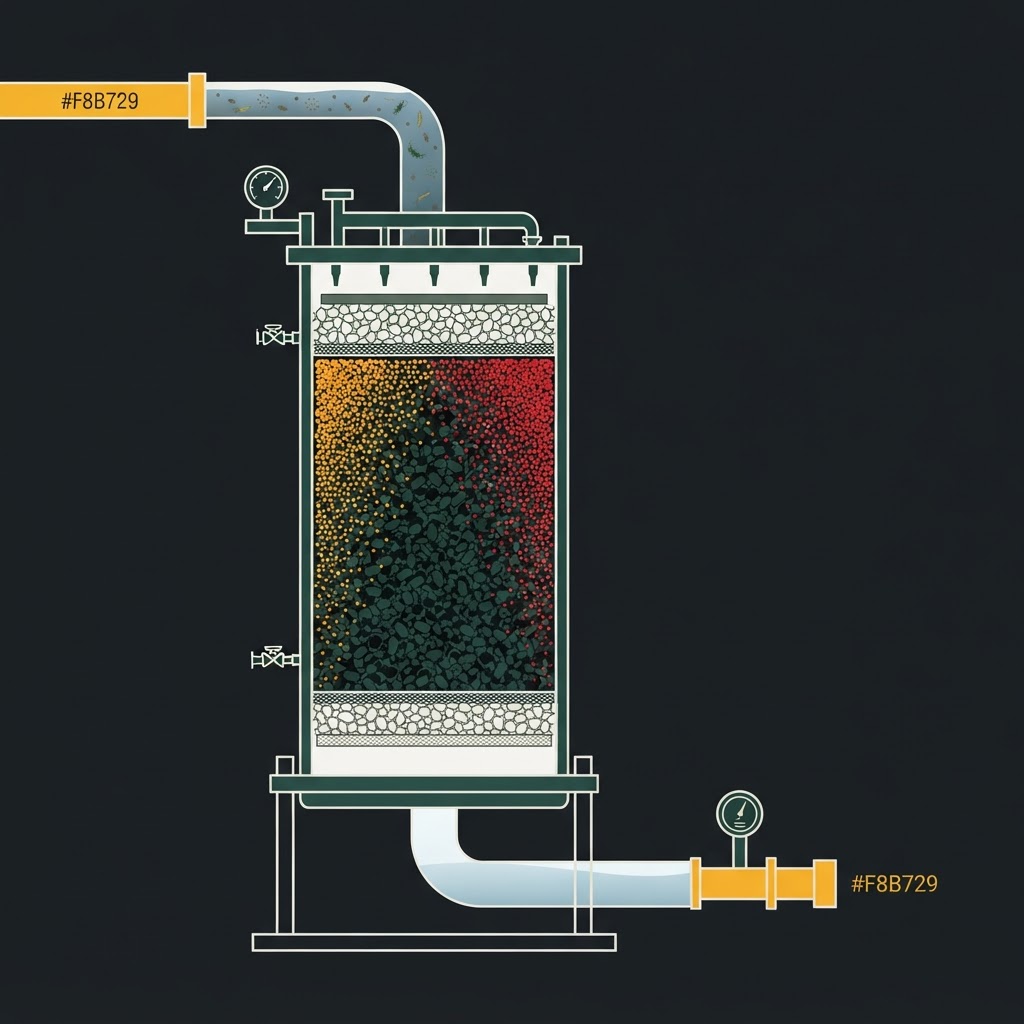
A sewage sludge biochar pyrolysed at 600 °C held back 87 percent of the phosphate in a column test on wastewater, at a flow of 8 mL/min, within the first hour of filtration. That single number explains why biochar wastewater treatment has moved from a research curiosity to a question municipal engineers now put to us directly: if a plant turns its own sludge into syngas and biochar, can that biochar go back into the treatment train?
The honest answer is "yes, for specific pollutants, under specific conditions". This article sets out those conditions with the measured figures from the peer-reviewed studies that currently rank for the term, and then places them inside the plant loop Energaia designs for.
What biochar actually does in wastewater
Biochar is the carbon-rich solid left after biomass or sludge is heated without oxygen. The thermal decomposition window runs from roughly 250 to 900 °C, and the temperature chosen within that range sets the pore structure, the surface chemistry and the mineral content of the product.
Three mechanisms do the work in water. The first is physical adsorption into pores: sorbents derived from sewage sludge typically carry a specific surface area of 100 to 200 m2/g with developed microporosity. The second is electrostatic attraction between charged pollutant molecules and oxygen-bearing surface groups, which is why the charge and size of a pharmaceutical molecule predicts how well it binds. The third is precipitation: sludge biochar made at higher temperatures concentrates calcium, magnesium and potassium, and those alkali metals bind phosphate while pushing the pH of the water upward.
Which of the three dominates depends on the feedstock, the pyrolysis temperature and any activation step. That is the design space, and it is wider than most vendor brochures admit.
What it removes, with the measured numbers
Phosphorus
The phosphorus study behind the opening figure pyrolysed sewage sludge at 400, 500 and 600 °C and ran the biochars as filter columns. The 600 °C material retained phosphorus best, at 87 percent in the first experiment and 78 percent in the second. Its total surface area was lower than the 400 °C material, but its mesopore surface area was higher, and that is what mattered for phosphate.
For a plant operator this is useful in two directions. Phosphate removal to meet discharge limits is one. Phosphorus capture into a solid that can later be processed for recovery is the other, and it is the one that connects to the German sludge rules we cover in our guide to what happens to sewage sludge after treatment.
Heavy metals
A sludge biochar produced at 700 °C and then activated with hydrochloric acid showed adsorption capacities of 22.85 mg/g for copper, 17.55 mg/g for zinc, 15.08 mg/g for cadmium, 7.97 mg/g for chromium and 3.68 mg/g for arsenic, along with 14.53 mg/g for the dye rhodamine B. The same review cites a pulp mill sludge biochar reaching 256.4 mg/g for lead on a Langmuir isotherm.
Two cautions belong next to those figures. They come from batch tests in prepared solutions, not from a flowing municipal effluent with competing ions. And the acid activation step that raised the capacities is an extra process with its own cost and chemical handling. Untreated sludge biochar performs well below those values for metals.
Pharmaceuticals and micropollutants
This is where biochar has the strongest field evidence. A Swedish study ran five biochars as packed bed columns on real tertiary effluent for 45 weeks and 635 bed volumes. The sewage sludge biochar and the forest biomass biochar removed more than 99 percent of the pharmaceuticals across that run, and the materials as a group retained over 80 percent of the pharmaceutical load over the extended period. Packing density, feedstock and surface chemistry explained the differences between materials, and the 20 percent breakthrough point could be modelled per compound.
A multi-module biochar filter tested on post-septic wastewater at Chalmers reached over 99 percent removal of pharmaceutically active compounds, with the first aerobic module alone contributing more than 92 percent and the three aerobic modules together more than 98 percent. The same paper notes that diclofenac, a compound conventional activated sludge plants remove at around 29 percent, was captured in the biochar modules.
Why the 2024 EU directive changes the business case
Until recently a plant could treat micropollutant removal as a research topic. The revised EU Urban Wastewater Treatment Directive ends that. Urban plants above 100,000 population equivalents must add a quaternary treatment stage with a minimum of 80 percent removal of a defined set of organic micropollutants, and the studies above were designed against exactly that threshold.
The directive does not prescribe the technology. Ozonation and powdered or granular activated carbon are the incumbents. Biochar enters the comparison as a medium that can, on the evidence so far, meet the 80 percent target over hundreds of bed volumes, while being producible from a feedstock the plant already has to dispose of. That second property is the one that changes the economics, because the plant is no longer only buying an adsorbent. It is deciding what to do with its own sludge.
Pyrolysis temperature decides the product
If one variable has to be controlled, it is temperature. In the phosphorus study, raising the sludge pyrolysis temperature from 400 to 600 °C increased the calcium, magnesium and potassium concentrations in the biochar by 9, 3 and 11.5 percent respectively. Those minerals drove the better phosphate retention, and they also raised the pH of the filtrate by 3 to 4 percent in the first column and 15 to 18 percent in the third. For metals, the strongest results came from 700 °C plus chemical activation. For pharmaceuticals, surface chemistry and packing density mattered more than any one temperature.
None of this works on wet, heterogeneous sludge. Our engineering position, stated publicly, is that thermal pre-treatment is non-negotiable in gasification and pyrolysis: moisture has to come down, energy density has to come up and the feedstock has to be homogenised before the reactor sees it. The same pre-treatment that protects the reactor is what makes the biochar a consistent product rather than a variable one. We cover the drying and conversion routes in detail in thermal treatment of sewage sludge, including the volatile organic compound emissions that sludge drying releases and that most feasibility studies leave out.
Where sludge biochar fits inside a treatment plant
Energaia's process has five steps, published as our waste-to-energy explainer: collect local biomass or sludge, gasify it at high temperature to clean syngas, convert the syngas to dispatchable electricity and heat, capture the biochar and the verified CO2 offset, and run the whole system on site. For a wastewater plant that loop closes on itself. The sludge that was a disposal cost becomes power for the aeration blowers and a carbon product, and the evidence above says that carbon product has a second job in the plant's own tertiary or quaternary stage.
Three engineering details decide whether that second job is real:
- Feedstock chemistry. Plants dosing ferric chloride for phosphate precipitation send iron into the sludge, and the Swedish study notes that on pyrolysis that iron ends up mixed into the sludge biochar. That can help with electrostatic binding, but it has to be designed for, not discovered.
- Spent biochar. A filter medium that has captured metals and pharmaceuticals needs a defined route at end of life. Returning it to the thermal stage is the obvious one in a plant that already runs a gasifier, and it has to be in the mass balance from day one.
- Mass balance. The biochar yield of a sludge gasifier is a fraction of the dry input. Whether it covers the plant's own adsorbent demand is a calculation, not an assumption, and it is the first thing we model in a feasibility study. Our overview of sewage sludge to energy sets out the input and output figures that go into it.
What biochar does not do
The ranking papers are honest about limits, and so should any supplier be.
Adsorption is reversible. In the Chalmers filter, one anoxic module showed a roughly 2 percent increase in pharmaceutical concentration, which the authors attribute to desorption of previously captured compounds or a shift in microbial activity. A biochar filter is a stage with a breakthrough curve, not a permanent sink.
The pH shift is real. A 15 to 18 percent rise in the third column of the phosphorus study is within what downstream processes may tolerate, but it is not zero, and a high-alkali 600 °C sludge char will not suit every discharge consent without buffering.
Lab results overstate field results. The agro-waste biochar study was built specifically to test performance in real municipal wastewater because batch figures in clean solutions do not transfer. The useful numbers are the column and pilot figures, and they are the ones we have used here.
Finally, biochar in a filter is not the same product as biochar sequestered for carbon removal. The removal credit depends on the carbon staying out of the atmosphere, which is a separate chain of custody we explain in how biochar removes CO2 from the air. A plant can produce both from one gasifier, but it has to decide which tonnes go where.
FAQ
How long does a biochar filter last before breakthrough?
The longest public column run on real tertiary effluent lasted 45 weeks and 635 bed volumes with the best biochars still above 99 percent removal for pharmaceuticals. The breakthrough point varies by compound, which is why the study fitted a separate curve for each pharmaceutical and estimated the 20 percent breakthrough individually. Service life therefore has to be stated per target pollutant, not as a single figure.
Does biochar change the pH of treated water?
Yes. Sewage sludge biochar made at 600 °C raised the filtrate pH by 3 to 4 percent in the first column and 15 to 18 percent in the third in the phosphorus study, because higher pyrolysis temperatures concentrate calcium, magnesium and potassium in the char. Lower-temperature chars shift pH less but retain less phosphate.
Is biochar better than activated carbon for wastewater?
The studies cited in this article compare biochars with each other, not with activated carbon on cost or capacity, so no honest answer can be given from them. What they do show is that sludge and wood biochars can meet the 80 percent micropollutant removal threshold the EU directive sets, which is the bar activated carbon is usually bought to clear.
Can biochar used as a wastewater filter still earn carbon credits?
None of the studies cited here measure that, and a carbon removal credit depends on the carbon being kept out of the atmosphere under a verified method. A filter medium that is later thermally treated has a different fate from biochar applied to soil or stored. Treat filtration and carbon removal as two separate product streams from the same gasifier.