
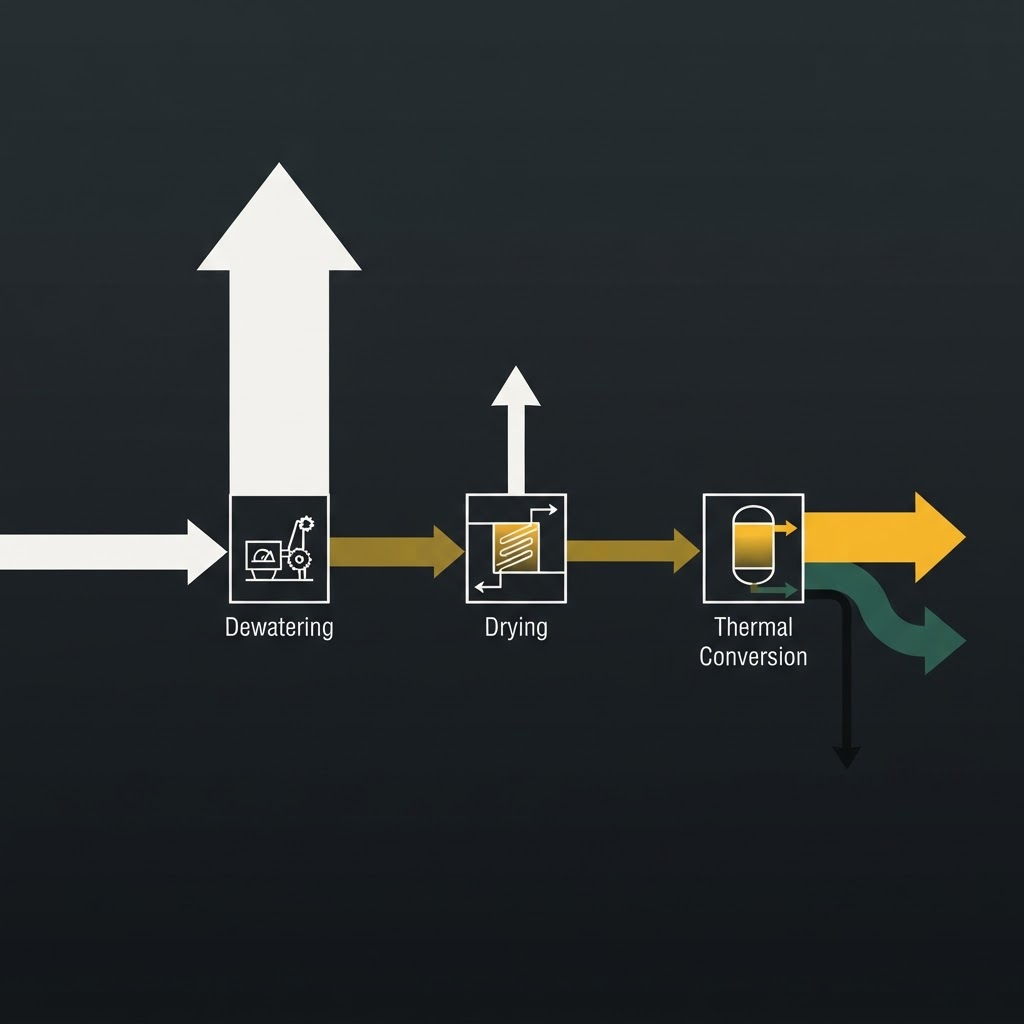
Sewage sludge to energy is not a question of whether sludge contains energy. It does. The question is how much of that energy you spend getting rid of the water before you can use the rest. Even after mechanical dewatering, sludge cake still retains more than 60% moisture, which means most of what a treatment plant hauls away is water it paid to move. Every route from sludge to electricity, heat or biochar is, underneath, a strategy for dealing with that water.
This guide compares the three routes that operators actually choose between, anaerobic digestion, incineration and gasification, by the number that decides them: the energy balance. It then sets out why German regulation has turned sludge-to-energy from an option into a planning deadline.
Why sludge is an energy problem before it is an energy source
Wastewater treatment concentrates everything the plant removes into one stream: organics, nutrients, heavy metals, drug residues and microplastics. The German Environment Agency describes sewage sludge as containing all the "waste" from the treatment process, and notes that more than half of German municipal sludge is already treated in (co-)incineration plants.
That shift happened because of pollutants, not because of energy. Energy recovery came along as the way to pay for it. For a plant operator, this framing matters: a sludge-to-energy project is judged first on the disposal cost it avoids and second on the kilowatt-hours it produces. We covered the cost side in detail in our breakdown of what sewage sludge disposal costs.
The frustration is also public. On community forums people ask why sludge ends up in landfill at all and call it a complete waste of a useful resource. The engineering answer is that the resource is locked inside a material that is mostly water.
Route 1: anaerobic digestion to biogas
Anaerobic digestion is the most widely used energy-positive method for sludge. Microbes break down the organic solids in four stages and produce biogas containing 45 to 65% methane, with typical yields of 0.20 to 0.35 cubic metres of methane per kilogram of volatile solids removed. Most plants run mesophilic stirred tanks at 35 to 38 °C with 15 to 25 days of retention.
What digestion does well
Digestion works on wet sludge, so it avoids the drying penalty entirely. The biogas runs a combined heat and power engine, and the heat keeps the digester warm. Life cycle work comparing methane routes found that digestion-based routes have lower energy demand and are more competitive in terms of costs than thermal alternatives.
Where digestion stops
Digestion is slow and incomplete. Reaction times run from 7 days to 5 weeks, and 40 to 70% of the organic constituents remain unconverted when it finishes. Pretreatment can help: across studies, mechanical, thermal and chemical pretreatments raised methane production by 10% to over 100%, though usually at high capital and energy cost.
The key point is what comes out the other end. Digestate is still sludge. It still has to be dewatered, transported and disposed of, and in Germany that increasingly means a thermal route. Digestion reduces the problem; it does not close it.
Route 2: incineration with heat recovery
Incineration fully oxidises sludge at 850 to 1000 °C in fluidised-bed or multiple-hearth furnaces, achieving up to 90% mass reduction and complete pathogen destruction. The same comparative study shows the drying logic in numbers: sludge is first dried to around 66% moisture, which lifts its lower heating value to about 3,800 kJ/kg, the level needed for autothermal combustion. Below that, the furnace needs support fuel.
Historically, incineration was built for volume reduction and destruction of harmful components, not for energy recovery. Adding heat recovery on the flue gas turns it into a combustion system, but the design priority is still disposal. For operators this means incineration is reliable and proven, and its net energy output is modest because much of the sludge's heat goes back into evaporating its own water.
Route 3: gasification to syngas and biochar
Gasification converts sludge under limited oxygen at 700 to 1400 °C into a combustible gas rather than burning it directly. The result is a syngas whose main components are hydrogen and carbon monoxide, which can be used for power generation, hydrogen production or conversion to liquid fuels. The same review calls gasification mature, tolerant of diverse feedstocks and practical on small scales, which it flags as especially important for installations at wastewater treatment plants.
The solid residue is the other half of the value. Gasification leaves a vitrified slag with reduced leachability, or, under the right conditions, a char. That is why Energaia's public process runs in five steps: collect local biomass or sludge, gasify it at high temperature to clean syngas, convert that to dispatchable electricity and heat, and capture biochar with verified CO2 offsets, all on site.
Why sludge is a hard gasifier feed
Sludge is not wood chips. Engineering reviews list its high water content, high ash content and tar formation tendency as the main challenges. All three trace back to feed preparation. Wet feed lowers reactor temperature and syngas quality; variable feed makes tar harder to control. This is why we argue that thermal pre-treatment is non-negotiable in gasification and pyrolysis: moisture reduction, energy density and a homogeneous feed decide whether the reactor performs as modelled.
The comparison that matters: energy balance
Here is how the three routes line up on the points a feasibility study has to answer.
| Route | Operating range | Handles wet sludge | Main energy product | Residue |
|---|---|---|---|---|
| Anaerobic digestion | 35 to 38 °C, 15 to 25 days | Yes | Biogas (45 to 65% methane) | Digestate, still needs disposal |
| Incineration | 850 to 1000 °C | No, dried to about 66% moisture | Heat, steam | Ash, up to 90% mass reduction |
| Gasification | 700 to 1400 °C | No, needs dried, uniform feed | Syngas for power, heat or hydrogen | Vitrified slag or char |
Thermal routes decompose 80% or more of the organic matter quickly and under control, against the 40 to 70% left behind by digestion, but their costs are still significantly higher. Efficiency depends heavily on configuration: one techno-economic assessment found hydrothermal gasification reaching 59.8% exergy efficiency when coupled with a transcritical CO2 power cycle, against roughly 16% for digestion-based routes. The same study found gasification with CO2 mineralisation could reach net-negative emissions of -466 kg CO2-eq per tonne of sludge.
Read that table from the operator's side and the pattern is clear. Digestion wins on simplicity and cost but leaves a residue. Thermal routes close the loop but only pay back if drying is designed as part of the energy system rather than bolted on in front of it. The waste heat from a gas engine or syngas cooler is exactly the heat a belt dryer needs, and integrating the two is where most of the net gain is found or lost. Our planned guide to thermal treatment of sewage sludge goes deeper into that heat integration.
The overlooked risk: emissions from drying
Drying sludge is not a clean step. Heating wet organic material releases volatile organic compounds, and those emissions sit outside the combustion chamber, where flue gas cleaning does not reach them. Energaia has flagged VOC emissions from sludge drying as a critical and overlooked challenge in waste-to-energy, and built a MATLAB-based VOC simulation suite to model them in biomass-to-energy systems before any equipment is specified.
This matters for permitting. A project that models its furnace emissions carefully and ignores the dryer can pass design review and fail its first measurement. We cover mitigation in our planned article on VOC emissions from sludge drying.
Why German regulation makes this a deadline
The Sewage Sludge Ordinance moves the question from engineering preference to legal obligation. Operators of wastewater treatment plants and sludge incineration plants must meet phosphorus recovery requirements starting in 2029 at the latest wherever sludge contains 20 grams or more of phosphorus per kilogram of dry solids. The ordinance does not prescribe a technology, which leaves room for recovery from sludge directly or from its ash. The process options and their costs are laid out in Zero-X's guide to phosphorus recovery from sewage sludge.
At the same time, spreading sludge on farmland is being phased down by plant size. The practical consequence for large plants is that their sludge needs a thermal route, and a thermal route is an energy decision whether or not it was framed as one. For a plain-language overview of the current disposal paths, see what happens to sewage sludge after treatment.
How to decide: a feasibility checklist
Before comparing vendor quotes, a municipality or utility should be able to answer these questions from its own data:
- Dry solids after dewatering. Every percentage point of dry solids changes the drying load and the net energy of any thermal route.
- Phosphorus content per kilogram of dry solids. Above the 20 g threshold, the residue has to feed a recovery step, which shapes the choice between ash and char.
- Existing digestion. If a digester is already running, the question is what to do with digestate, not whether to digest.
- Heat sinks on site. A dryer, a digester or a district heating line determines whether recovered heat has value.
- Emissions boundary. Include the dryer, not only the stack.
- Scale. Gasification's practicality at small scale opens decentralised options for mid-sized plants and for regions with unreliable grids, where dispatchable on-site power has value of its own.
Energaia's approach is to answer these in simulation first, running the heat balance and the emissions model before steel is ordered, because the most expensive sludge-to-energy mistake is a plant sized for sludge the operator does not actually have.
FAQ
Can sewage sludge be turned into hydrogen?
Yes, through gasification. The syngas from sludge gasification is rich in hydrogen and carbon monoxide, and hydrogen can be separated from it through a water-gas shift reaction followed by pressure swing adsorption. It is a gas cleaning and separation challenge more than a gasification one.
Is sewage sludge still allowed as fertiliser in Germany?
Only for smaller plants. From 2029, soil application is permitted only for sludge from treatment plants below 100,000 population equivalents, and from 2032 only for plants below 50,000. Sludge with at least 20 g phosphorus per kg of dry solids must go to phosphorus recovery.
What is hydrothermal carbonisation of sludge?
It is a thermal route that avoids drying. Hydrothermal carbonisation processes wet sludge at 180 to 250 °C and 2 to 10 MPa and produces a solid hydrochar. It is attractive precisely because it skips the drying penalty, but it is still scaling toward full commercial deployment.
Does sludge-to-energy make sense outside Europe?
Often more so. Where the grid is unreliable and diesel is the backup, a small gasifier running on local sludge and biomass provides dispatchable power and a disposal route at once. The engineering constraints, moisture, ash and tar, are the same everywhere; the value of the electricity is not.