
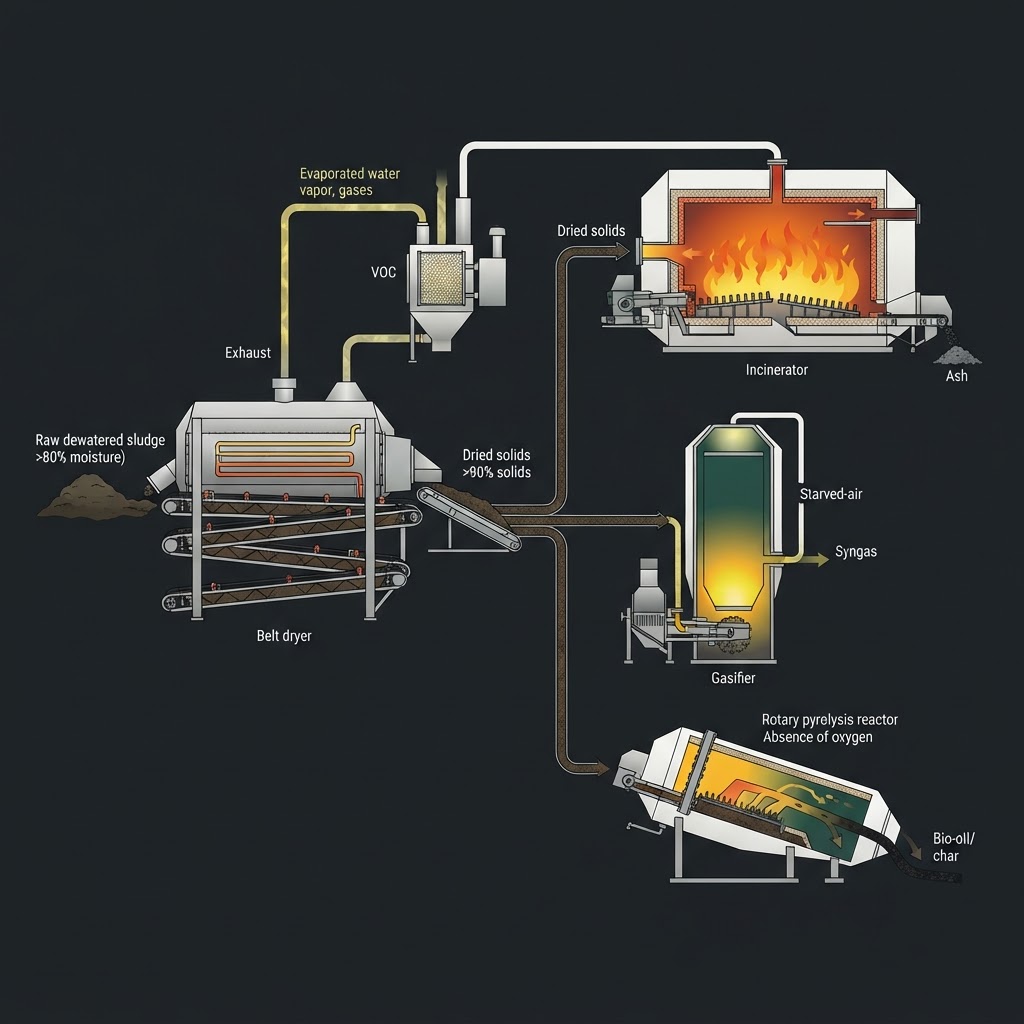
Most published comparisons of thermal treatment of sewage sludge rank the four routes on life cycle impact scores and stop there. That is useful science and it is the wrong first question for anyone actually specifying a plant. The first question is how much water you have to evaporate before the process will run at all, because that single number decides which routes are even available to you and what each one costs to operate.
This article covers the four thermal routes with the operating window each one needs, the German deadlines that are turning this into a procurement decision rather than a research topic, and the drying step that most feasibility studies treat as a footnote.
Germany already sends most of its sludge down a thermal route
In 2024 German public wastewater treatment plants disposed of 1,666,268 tonnes of dry matter of sewage sludge. Of that, 733,758 tonnes went to thermal treatment and a further 592,265 tonnes to thermal co-treatment, with 44,210 tonnes recorded under an unknown thermal process. Agricultural use took 204,086 tonnes, landscaping 12,774 and other material recycling 67,862.
Put plainly: more than four fifths of German sludge is already thermally treated. The remaining agricultural share is the part the law is closing.
The energy recovered is real but modest. For 2023, the federal statistics office reported that sludge combustion produced 473.8 million kWh of electricity and 852.4 million kWh of heat, and that dedicated sewage sludge incineration plants handled 49 percent of the thermally treated tonnage, with 20 percent going to coal plants, 13 percent to cement works, 12 percent to waste incineration and 6 percent to other thermal processes.
That distribution matters more than the energy figure, because it is the part that is about to change.
What the German ordinance requires, and by when
The 2017 amendment to the Sewage Sludge Ordinance introduced a phosphorus recovery obligation. The German Environment Agency sets out the thresholds: where sludge contains at least 20 g of phosphorus per kg of total solids, the operator must use a process that recovers at least 50 percent of the phosphorus from the sludge itself, or reduces the content below 20 g/kg TS, or recovers at least 80 percent of the phosphorus held in the incineration ash. The deadline is 1 January 2029 for plants with an approved size above 100,000 population equivalents, and 1 January 2032 for plants above 50,000 PE. Plants at or below 50,000 PE may continue using sludge on soil indefinitely.
Two details in that text do most of the work for anyone scoping a plant.
First, the ordinance names thermal pre-treatment as an alternative to recovering phosphorus at the works, and it counts mono-incineration, co-incineration and sub-stoichiometric processes such as pyrolysis and gasification within that definition. Gasification is a compliant route under German waste law, not a pilot-scale curiosity that still needs a regulatory carve-out.
Second, the obligation moves with the material. Once sludge enters a thermal plant, recovery from the resulting ash or carbonaceous residue becomes the thermal operator's duty, while the works still has to evidence that it happened.
The ordinance was drafted as an article law, with Article 4 in force from 2023 requiring every operator to measure phosphorus content and file a recovery concept, repeated in 2027, then Article 5 from 2029 and Article 6 from 2032 widening the scope. The practical consequence is that from 2029 co-incineration only remains open if phosphorus has already been separated upstream. Otherwise the route is mono-incineration, or an equivalent thermal process, with recovery afterwards.
If you are still working out where your sludge currently ends up, start with what happens to sewage sludge after treatment and then come back to the route comparison.
The four routes and the window each one needs
A 2026 comparative assessment in Energies modelled all four routes on one functional unit, and its operating windows are the cleanest published set.
Incineration
Full oxidation at 850 to 1000 degrees C in fluidised bed or multiple hearth furnaces, achieving up to 90 percent mass reduction and complete pathogen destruction. It is the mature option. It is also capital and energy intensive, needs advanced flue gas treatment, and leaves an ash that has to be managed rather than forgotten.
Gasification
Oxygen-limited conversion at 800 to 1000 degrees C, producing a combustible syngas and a vitrified slag with reduced leachability. Dioxin and NOx emissions are lower than incineration. The costs are a feedstock that must be dried hard, and tar formation in the gas train.
Pyrolysis
No oxygen, 350 to 700 degrees C, yielding char, pyrolytic oil and pyrolytic gas. Fewer emissions than incineration, and the char opens a carbon sequestration route. Heavy metals concentrate in that char, and the oil is unstable enough to need upgrading before it is worth anything.
Hydrothermal carbonisation
Wet sludge at 180 to 250 degrees C and 2 to 10 MPa, producing hydrochar with no prior drying at all. It improves dewaterability and reduces pathogens. Metals accumulate in the hydrochar, and the technology is still scaling toward full commercial deployment.
A 2026 critical review of biosolids thermal options reached the conclusion the German route split has not yet caught up with: dry thermal processes have substantial benefits over traditional incineration, with pyrolysis and gasification more energy efficient and producing saleable products in biochar and bioenergy. A Germany-specific review of mono-incineration, co-incineration and gasification covers the same ground for this market.
Drying is the decision, not the preliminary step
Here is the number that governs everything above.
Sludge leaving mechanical dewatering exceeds 80 percent moisture. At that moisture content its lower heating value sits below 1000 kJ/kg and frequently goes negative, meaning the material consumes more energy than it releases and the process needs a high-calorific support fuel simply to stay stable.
Now look at what each route demands of that feedstock in the modelled cases. Incineration dries to roughly 66 percent moisture, which lifts the heating value to around 3800 kJ/kg and lets the fluidised bed run autothermally at about 950 degrees C. Gasification has to reach roughly 15 percent moisture. Pyrolysis, roughly 20 percent.
That is the trade nobody states plainly. The routes with the better products, the syngas and the char, are the routes that demand the driest feedstock, and therefore the biggest drying duty. In the modelled gasification and pyrolysis cases the dryer could not be fed on process heat alone: LPG was burned in the incineration chamber as additional fuel to close the heat balance.
So a route comparison that scores syngas quality against ash disposal without pricing the evaporation is comparing the wrong things. The honest comparison is between total energy in and the value of what comes out, and the drying duty is usually the largest single term on the input side. It is also where the difference between a project that pencils and one that does not tends to sit, which is worth reading alongside what sludge disposal actually costs per tonne.
What the dryer emits, and why it decides the permit
The drying step is not only an energy cost. It is an emissions event, and in our experience it is the one most consistently under-specified in feasibility work.
This is why thermal pre-treatment is non-negotiable in gasification and pyrolysis: it does three jobs at once, reducing moisture, raising energy density and homogenising a feedstock that arrives with variable composition. Do it badly and the reactor downstream never reaches stable operation.
Do it without modelling the exhaust and the permit application becomes the schedule risk. At Energaia we built a MATLAB-based VOC simulation suite that models volatile organic compound emissions in biomass-to-energy systems, precisely so the exhaust train is sized from predicted composition before steel is ordered rather than after a trial run. Sludge dryers release a wide range of volatile compounds and the mix shifts with temperature, so the compound-level detail is its own subject: see which compounds actually leave the dryer.
The reason we treat pre-treatment as the centre of the design rather than an inlet detail is the shape of the full process chain: collect local sludge or biomass, gasify it at high temperature to clean syngas, convert that to dispatchable electricity and heat, capture biochar and verified CO2 offsets, and run the whole thing on site. Every stage after the dryer inherits whatever the dryer produced.
How to choose a route without guessing
Two practical screens.
The first is capacity, and it is tighter than most operators assume. Germany holds roughly 620,000 tonnes of dry matter of mono-incineration capacity, about 460,000 municipal and 160,000 industrial. Against that sits roughly 1.1 million tonnes currently going to co-incineration, 400,000 tonnes to coal plants, 125,000 to cement works and 42,000 to waste incineration, plus around 700,000 tonnes still going to agriculture. Around 34 new mono-incineration projects are at varying stages of planning and approval, and none of them had a settled phosphorus recovery solution. If your plan for 2029 is that somebody else will have built the capacity, that plan has competition.
The second screen is your own scale. Population equivalent is the fastest proxy: a 100,000 PE works produces roughly 15 kg of dry solids per PE per year, about 1,500 tonnes of dry solids annually, which is the scale at which the modelling literature treats a dedicated thermal line as a realistic case rather than an exercise. Below it, the question is usually which regional plant takes your sludge and on what contract. At or above it, an on-site route that converts the material into dispatchable energy starts to compete with a gate fee that only ever goes up.
Either way, the sequence is the same: establish the moisture and phosphorus content you actually have, model the drying duty and the exhaust from those numbers, and only then compare reactors. Simulate first, order steel second.
FAQ
Is thermal treatment of sewage sludge mandatory in Germany?
Not universally. From 1 January 2029, plants above 100,000 PE lose soil-based utilisation, and from 1 January 2032 the same applies above 50,000 PE. Where phosphorus content is at least 20 g/kg TS, those operators must recover it, which in practice routes the sludge to a thermal process. Plants at or below 50,000 PE may keep using sludge on soil.
Does thermal treatment destroy PFAS and pharmaceuticals in sludge?
Thermal routes are used partly because they destroy organic contaminants and pathogens that biological treatment leaves behind. Inorganics do not burn. Heavy metals concentrate in the ash, the char or the hydrochar, which is why residue handling shows up as a dominant toxicity hotspot in life cycle assessments rather than as a leftover.
How much sludge do you need before an on-site thermal plant makes sense?
Use population equivalent as the first screen. At roughly 15 kg of dry solids per PE per year, a 100,000 PE works generates about 1,500 tonnes of dry solids annually. That is the scale the modelling literature treats as a realistic standalone case.
What is the difference between mono-incineration and co-incineration?
Mono-incineration burns sewage sludge on its own, keeping phosphorus concentrated in a single ash stream that can be processed afterwards. Co-incineration mixes it into coal plants, cement works or waste incinerators, diluting the phosphorus past the point of recovery. That distinction is the whole reason the German rules push toward mono-incineration from 2029.