
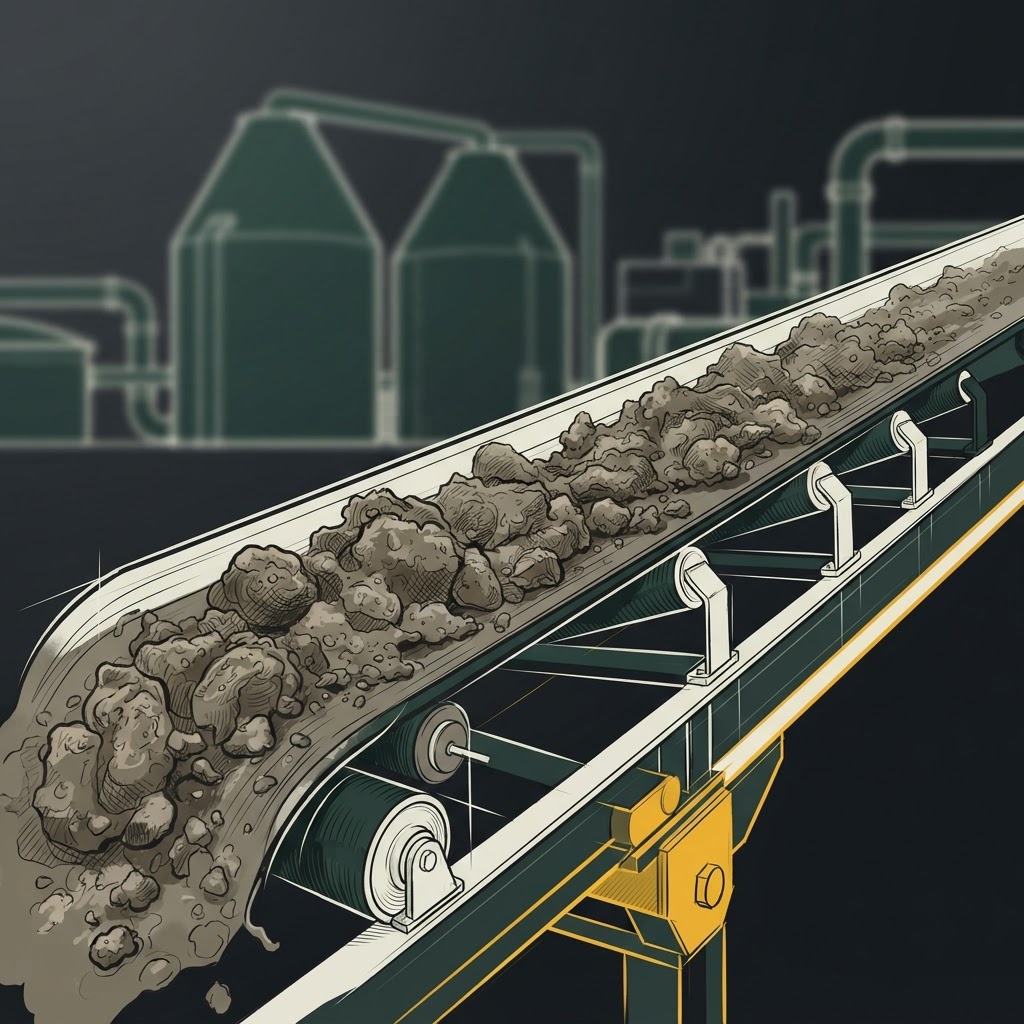
Wastewater treatment does not make solids disappear. It concentrates them. What happens to sewage sludge after treatment is that every tonne leaves the plant by one of four doors: onto farmland as biosolids, into a landfill, into an incinerator, or into a thermal recovery process that pulls the phosphorus and the energy back out before anything is thrown away.
Most explainers stop after listing the first three, as though a plant simply picks one and keeps picking it. That is the part they get wrong. Two of those three doors are being closed by law. Germany shut the landfill route to untreated sludge in 2005 and closes agricultural application for its large plants in 2029. In the United States, PFAS is closing the farmland route state by state. The useful question is not which route your sludge takes today. It is which route will still exist when your current disposal contract expires.
Where treated sewage sludge actually goes today
The two markets that matter here have already diverged, and the gap tells you where this is heading.
The United States
America still recycles the majority of its wastewater solids to soil. The National Biosolids Data Project puts it at 53 percent treated and returned to land as fertilisers and soil amendments, with the remaining 47 percent landfilled or incinerated. Under the EPA's biosolids reporting, roughly 982,000 dry metric tonnes went to municipal solid waste landfills, 102,000 dmt to sludge-only monofills, about 558,000 dmt into sewage sludge incinerators, and 81,500 dmt through other practices such as deep well injection or use as auxiliary fuel.
Germany
Germany has already burned its way past the American position. Of roughly 1.8 million tonnes of municipal sewage sludge produced annually, 74 percent is incinerated, 17 percent goes to agriculture and 9 percent is landscaping or unaccounted for. The German Environment Agency attributes the collapse of the agricultural route to what the sludge carries with it: heavy metals, pharmaceutical residues and plastics.
Same material, same treatment processes, opposite answers. The difference is regulation, not engineering.
Route 1: Back onto farmland as biosolids
This is where the terminology matters. Sewage sludge is the residue itself. Biosolids is sludge that has been treated to meet a standard and is intended for land application. Class B processes significantly reduce pathogens without eliminating them, so Class B material carries restrictions on where it can go and how soon a field can be harvested. Class A material clears a stricter bar, and Class A Exceptional Quality biosolids, which meet the tightest pollutant, pathogen and vector limits, can be bagged and sold straight to the public for lawns and gardens.
It is a genuinely good use of the nutrients. It is also the most fragile route on the list. The EPA's draft guidance on PFOA and PFOS in biosolids notes that nearly 60 percent of US sewage sludge is land applied while reaching under 1 percent of American farmland, and that Maine banned land application of all sewage sludge in 2022 regardless of PFAS concentration. About 40 percent of Maine's sludge had been going to fields. The ban produced immediate cost increases, because landfill capacity in the state is limited and Maine has no sewage sludge incinerators of its own.
One state, one legislative session, and 40 percent of a disposal strategy had nowhere to go. That is the risk profile of this route, not the nutrient value.
Route 2: Landfill, the route Germany already closed
Landfilling comes in two forms: a sludge-only monofill, which the EPA treats as surface disposal, or co-disposal alongside household waste in a municipal solid waste landfill. It is the simplest option to operate and, on paper, among the cheaper ones.
It is also the one Europe closed first. Under German landfill rules it has been inadmissible since 2005 to landfill waste exceeding total organic carbon limits of 1 to 6 percent by mass depending on landfill class, which means sewage sludge has to be mechanically-biologically or thermally pre-treated before it can be buried at all. Landfill stopped being a destination and became something you do with the residue of another process.
The environmental logic behind that is straightforward. Penn State Extension points out that organic sludge in a landfill decomposes anaerobically and generates methane, and that both landfilling and incineration forfeit the organic matter and plant nutrients entirely. You pay to bury a fertiliser and get a greenhouse gas back. If you are benchmarking, it is worth understanding what sewage sludge disposal actually costs per tonne before assuming the cheap route stays cheap.
Route 3: Incineration, and what is left in the ash
Incineration does what it promises. It destroys pathogens completely, decomposes most organic chemicals, and recovers the modest heat value in the sludge. The residual ash is a stable inorganic material at 10 to 20 percent of the original sludge volume, with most trace metals concentrated into it at five to ten times their original concentration.
Two distinctions decide what that ash is worth to you.
Mono-incineration versus co-incineration
Mono-incineration burns sewage sludge alone, keeping the ash as a single, characterised stream. Co-incineration burns it alongside coal or waste in a plant built for something else, which dilutes the ash into a mixed stream. That sounds like an operational detail. Under German law it is the difference between compliance and non-compliance, as the next section explains.
Why the ash is not fertiliser
The phosphorus is still in there. It is just not available to plants. Sewage sludge ash is unsuitable as a fertiliser because of that low plant availability, which is the single fact that turns phosphorus recovery from a nice idea into a required processing step. Burn the sludge and you have not solved the nutrient problem, you have moved it into a mineral that needs its own chemistry to unlock. This is also the sharpest practical line between waste to energy versus straight incineration: one is designed around what comes out, the other around what goes away.
Route 4: Thermal recovery, where the regulation is pushing everyone
The German Sewage Sludge Ordinance is the clearest statement anywhere of where this ends up, so it is worth reading precisely rather than in summary.
The 2029 and 2032 deadlines
Under the amended ordinance, soil-related use of sewage sludge is permitted from 2029 only for treatment plants below 100,000 population equivalents, and from 2032 only for plants below 50,000. Phosphorus recovery becomes obligatory where the sludge contains 20 grams of phosphorus or more per kilogram of dry solids. Sludge under that threshold is exempt. Critically, the ordinance names no specific technology, leaving room for recovery processes that did not exist when it was written.
The recovery targets are quantified: at least 50 percent of the phosphorus out of the sludge dry solids, or reduction below 20 g/kg, or at least 80 percent of the phosphorus contained in incineration ash. That is also where the mono versus co-incineration distinction bites. In practice, co-incineration is only permitted where phosphorus has already been sufficiently separated at the treatment plant; otherwise mono-incineration with subsequent recovery is required, and from 2029 soil-related use survives only as a rare or time-limited exception.
Gasification and pyrolysis count
Here is the provision most operators miss. The ordinance's definition of thermal treatment includes sub-stoichiometric processes, meaning pyrolysis and gasification sit inside the compliance pathway alongside conventional incineration. Starved of oxygen rather than fed with it, the same tonne of sludge yields syngas and a carbon-rich solid instead of flue gas and ash.
That is the route Energaia engineers. Our published five-step process runs it end to end: collect local biomass and sludge, gasify at high temperature to clean syngas, convert that to dispatchable electricity and heat, capture biochar and verified CO2 offsets, and run the whole thing on site. Read alongside how waste to energy works end to end, the appeal for a municipality is that a disposal line item turns into three outputs: power, a phosphorus-bearing solid, and a carbon removal product that can be certified as biochar carbon credits.
The engineering caveat is the part vendors skip, and we have published on it deliberately. Thermal pre-treatment is non-negotiable ahead of any gasification or pyrolysis step, because moisture reduction, energy density and feedstock homogenisation determine whether the reactor performs as modelled or not at all. Sludge is a wet, variable, awkward feedstock, and drying it creates its own compliance exposure through volatile organic compound emissions. That is precisely why our institute built a MATLAB-based VOC simulation suite to model those emissions before anyone orders steel. A gasifier that works on paper and fails on wet sludge is an expensive way to learn what thermal treatment of sewage sludge demands, and the same modelling discipline decides whether sewage sludge gasification and downstream phosphorus recovery from sewage sludge land inside budget.
What this means if you operate a plant
Find your plant on the timeline first. Above 100,000 population equivalents, the agricultural route closes in 2029. Above 50,000, it closes in 2032. Below that, you may keep applying sludge to soil indefinitely, but you inherit the contaminant exposure that shut the route for everyone else, and Maine is the demonstration that a legislature can remove that option faster than you can procure an alternative.
Then two decisions follow, and they are engineering decisions rather than procurement ones. First, does the phosphorus come out at the plant, before the thermal step, or out of the ash afterwards? That choice sets your recovery percentage and rules co-incineration in or out. Second, is the thermal step bought as disposal or built as production? Both burn the same tonne. Only one gives you back power, biochar and a credited carbon removal, and only one changes the sign on the budget line.
Sludge is not going to stop arriving. The question is what leaves the site with it.
FAQ
Is treated sewage sludge the same thing as biosolids?
Not quite. Sewage sludge is the semi-solid residue produced when a treatment plant separates liquids from solids in domestic sewage. The EPA reserves the term biosolids for sewage sludge that has been treated to meet the requirements of 40 CFR Part 503 and is intended for land application as a soil conditioner or fertiliser. All biosolids are treated sewage sludge; not all treated sewage sludge qualifies as biosolids.
Can treated sewage sludge be used in a home garden?
Some of it, yes. Class A Exceptional Quality biosolids meet the strictest pollutant, pathogen and vector attraction limits in Part 503, carry no additional land application requirements, and are often bagged and sold to the public for lawns and home gardens. Class B material may not be used this way, because its treatment significantly reduces pathogens without eliminating them.
Is sewage sludge still dumped at sea?
No. Ocean dumping of sewage sludge was banned after concerns about excess nutrient loading of ocean waters, ending a route that had absorbed large volumes until 1991. Every tonne produced now has to go to land, to an incinerator, or through a recovery process.
Which sewage sludge route is cheapest?
On the National Biosolids Data Project's US per-ton figures, the order runs composting at 49 dollars, landfill disposal at 58.25, land application at 62 and incineration at 95.30. Ranking by unit price alone is misleading once a route can be legislated shut mid-contract, which is exactly what happened to the cheapest options in Germany and in Maine.
Do small wastewater plants have to recover phosphorus?
No. Plants below 50,000 population equivalents may continue soil-related utilisation of their sludge indefinitely under the German ordinance and can adopt phosphorus recovery voluntarily. The obligation is tied both to plant capacity and to the 20 g P/kg dry solids threshold, so a small plant with low-phosphorus sludge falls outside it twice over.