
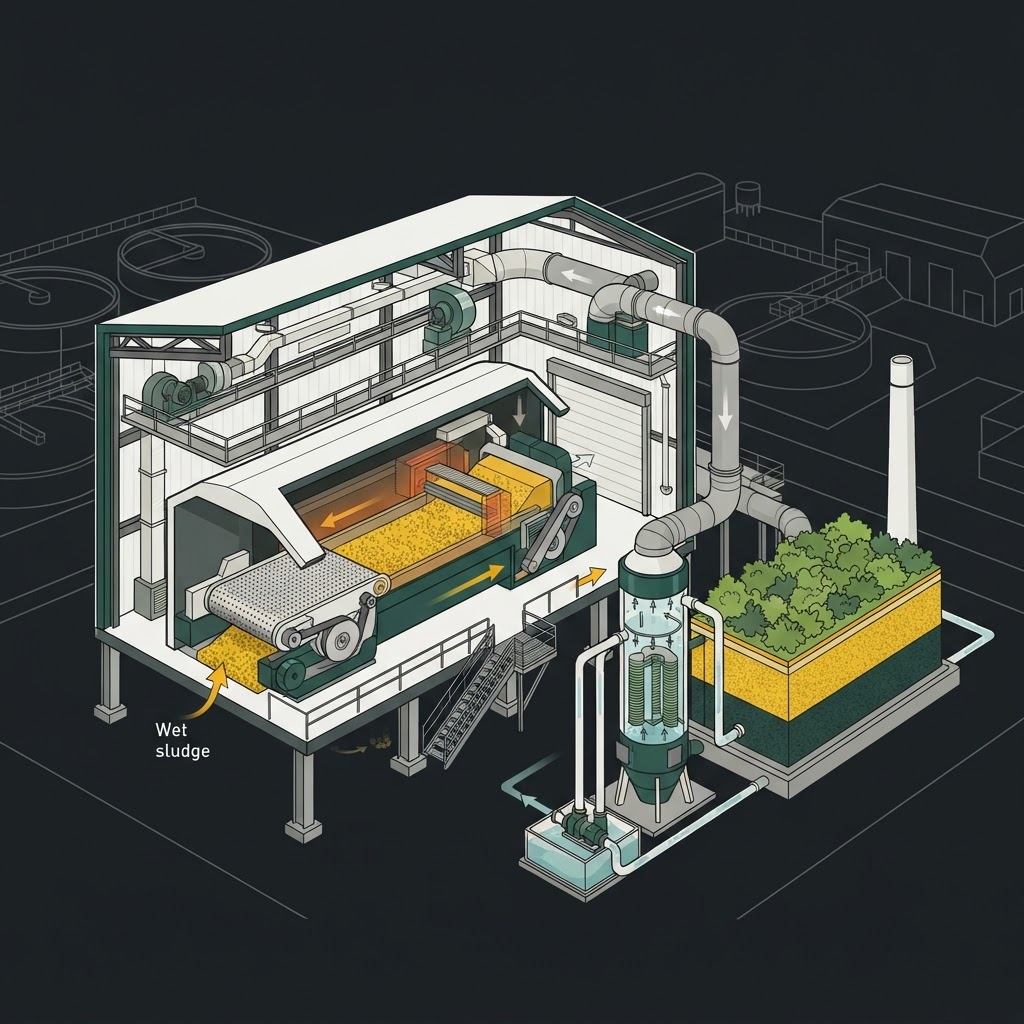
Domestic sewage sludge dried in a laboratory at ordinary dryer temperatures released more than forty identifiable volatile compounds. That is the starting point for any serious discussion of VOC emissions from sludge drying, and it is the part most project plans treat as a footnote. The dryer is usually specified for throughput and dry solids content. The exhaust is specified afterwards, when the permit application asks what is in it.
That order is backwards, and in Germany it is about to matter at scale. Below we set out what comes off a sludge dryer, how drying temperature changes it, what the permit demands, and which exhaust trains actually meet the limit.
Why sludge drying is becoming an emissions question
Drying used to be a niche step. It is turning into infrastructure. The German Environment Agency's 2023 study counted 167 sewage sludge drying plants in operation as of March 2021, 82 of them solar dryers and 35 belt dryers. In 2019 those plants dried 541,463 tonnes of dry solids and evaporated 1,445,450 tonnes of water.
The same study expects mono-incineration to take roughly 85 percent of German sewage sludge by 2029, driven by the phosphorus recovery obligation, and estimates that about 1,000,000 tonnes of additional evaporation capacity will be needed compared with 2019. Fluidised bed mono-incinerators need partial drying to around 40 percent dry solids, while alternative decentralised systems need about 75 percent. More drying, to higher dry solids, in more places: every one of those dryers has an exhaust stack. If you are unsure where your sludge will be allowed to go after 2029, start with what happens to sewage sludge after treatment.
What actually comes off a sludge dryer
The three pollutant families
A 2023 review of sludge drying exhaust gas groups the emissions into three families: volatile nitrogen compounds, represented by ammonia; volatile sulfur compounds, represented by hydrogen sulfide; and the benzene series, BTEX. VOCs are only one of the three, but they are the family with the most compounds and the least intuitive behaviour.
The compounds that dominate the VOC fraction
The most detailed compound-level data comes from Gómez-Rico, Fullana and Font, who dried domestic sewage sludge at 80, 90, 100 and 120 °C. They identified more than forty compounds, with a total yield of 545 to 591 mg per kg of dry weight. Four compounds dominated at every temperature: dimethyl disulfide, toluene, dimethyl trisulfide and 1,2,4-trimethylbenzene. The list also included chlorobenzenes, naphthalene and 1,4-dichlorobenzene. The authors note that most of the identified VOCs are toxic, harmful by inhalation or possibly carcinogenic.
Two further details from that study deserve attention. Their apparatus did not recirculate air, while full-scale dryers do, so plant emission levels could be higher when a purge is released. And drying plants normally include deodorisation, but its efficiency is often not controlled.
The dryer itself is not the only source. An exhaust air specialist's breakdown by process step lists belt and fluidised bed drying (ammonia, VOCs, sulfur compounds, in high air volumes with sticky aerosols), cooling and condensation (residual and diffuse emissions), and storage of dried sludge, which acts as a long-term source whose emissions fluctuate with the weather.
Temperature: the lever that works differently than you expect
The intuitive assumption is that hotter drying releases more VOCs. The data says it depends which side of a threshold you are on.
Below about 120 °C the VOC load barely moves
Across 80 to 120 °C, Gómez-Rico and colleagues found that temperature had no significant effect on either the number of compounds or the total yield. That is logical: in this range the dryer is mostly evaporating compounds that are already in the sludge, from industrial wastewater inputs or from bacterial metabolism in the treatment plant. Hotter drying releases them faster, not in larger quantities.
Above 150 °C new pollutants switch on
Past that range, the chemistry changes from evaporation to decomposition. Ding, Li and Liu dried sludge from two treatment plants at 100 and 150 °C. Reaching 30 percent moisture took 51 minutes at 100 °C and only 27 minutes at 150 °C, but the peak concentrations climbed sharply:
| Peak concentration (ppm) | 100 °C | 150 °C |
|---|---|---|
| Odour | 503.13 | 1,250.79 |
| Total VOCs | 3.01 | 8.10 |
| Sulfur-containing compounds | 8.15 | 53.51 |
| Amines | 11.27 | 37.80 |
The main VOCs released were benzene series compounds and organic acids. Halving the drying time cost roughly a sixfold rise in peak sulfur compounds.
A 2024 study across 90 to 210 °C located the thresholds more precisely. Carbon monoxide appeared from 150 °C and its maximum unit release rose about 13 times between 150 and 210 °C. Hydrogen sulfide and methane both began forming at 180 °C, with methane rising roughly fivefold by 210 °C. The authors recommend staying below 150 °C to avoid CO and below 180 °C to limit H2S and methane.
The engineering reading: drying temperature is not a free throughput variable. Above the decomposition thresholds you are running a mild pyrolysis step without designing for it.
What the permit demands in Germany
Sludge drying plants above a certain size need a permit under the Federal Immission Control Act and the 4th BImSchV, and TA Luft 2021 sets the emission limits for ammonia, VOCs and sulfur compounds, with the GIRL odour guideline governing impacts near housing, as the same exhaust air specialist summarises.
The number that sizes the treatment train is the VOC limit. According to a review of biological waste gas treatment, TA Luft restricts clean gas VOCs to 50 mg C per m3 in total. Municipal waste air of this kind typically arrives at 10,000 to 100,000 m3 per hour carrying 10 to 300 mg C per m3 of VOCs, up to 500 mg per m3 of ammonia, more than 20,000 odour units per m3, and 10 to 150 mg C per m3 of methane. At the top of that raw gas range, meeting 50 mg C per m3 is not a polishing job.
There is a second, less known constraint on what may enter the dryer at all. The German Environment Agency's technical guide on sludge treatment states that drying installations without appropriate exhaust gas cleaning should only accept sludge with PFOS up to 125 µg per kg of dry solids; higher loads should go to incineration directly after dewatering.
Exhaust treatment trains that meet the limit
The 2023 review frames control as two complementary strategies: suppress pollutant release inside the dryer through temperature, residence time and conditioning, and remove what remains at the end of the pipe by condensation, adsorption, absorption or biodegradation. In practice, three trains dominate.
Scrubbers plus biofilter
Biofilters with preconditioning stages are established at most German drying sites. The configuration depends on dryer temperature. Solar dryers run up to about 50 °C with residence times of up to seven days, and typically use an acidic scrubber for ammonia plus a biofilter at a volume load of 250 m3 per m3 per hour. High-temperature dryers, from 80 to about 300 °C with residence times in minutes, need at least two upstream scrubbers and a thermophilic biofilter below 100 m3 per m3 per hour. Both configurations are suited to TA Luft compliance, with one important exception: they cannot effectively treat methane.
Real plants confirm the performance and the effort. At a Polish solar drying plant, a 2,500 m3 wood chip biofilter fed through a water scrubber achieved more than 90 percent H2S reduction and more than 70 percent ammonia reduction, but only after the operator completed the filling, sealed the drying halls and changed how the bed and supply air were humidified.
Condense and burn the inert gas
Contact dryers offer a cleaner route. The UBA technical guide describes how their vapour can be almost totally condensed, with the remaining inert gases deodorised in the boiler furnace. The catch moves to the water side: the condensate can be difficult to treat because of ammonium hydroxide and high total organic carbon. This option fits naturally where the dryer sits next to a combustion or gasification step that can take the gas.
Regenerative thermal oxidation
Where VOCs must be destroyed rather than biologically degraded, a regenerative thermal oxidiser (RTO) is the standard answer. At the Morris Forman plant in Louisville, Kentucky, dryer exhaust passes through an RTO before release. Tests found that firing the dryer on biogas instead of natural gas changed RTO flue gas concentrations of the selected compounds by only 2 to 10 µg per m3, an insignificant difference.
Design it before you build it
Every source above points to the same conclusion. The biological waste gas review is explicit that emissions vary so much with dryer temperature and sludge that preliminary tests are needed to characterise the actual emissions before selecting the treatment technology. Chemical conditioning is not a shortcut either: the 2024 study found calcium oxide at 10 to 20 percent reduced ammonia and H2S but had no significant effect on methane or CO, and it increases the solids you then have to handle.
This is why Energaia treats VOC emissions from sludge drying as a design input, not a permitting afterthought. We have publicly flagged them as a critical, overlooked challenge in waste-to-energy and built a MATLAB-based VOC simulation suite to model volatile organic compound emissions in biomass-to-energy systems before steel is ordered. The reason is structural. Thermal pre-treatment is non-negotiable ahead of gasification or pyrolysis, because moisture, energy density and feedstock homogeneity decide whether the reactor performs. So the dryer is not optional, and its exhaust is not optional either.
In practice that means answering four questions in order. What dry solids content does the downstream process need? What is the lowest drying temperature that reaches it at acceptable throughput, ideally below the 150 °C and 180 °C thresholds? What raw gas does that sludge produce at that temperature? And can the exhaust be routed into the thermal step itself rather than a standalone treatment train? A plant designed that way handles thermal treatment of sewage sludge as one integrated system, which is also how sewage sludge gasification and sewage sludge to energy projects stay inside their permit and their budget.
FAQ
Does solar sludge drying avoid VOC emissions?
No. Solar dryers run at lower temperatures, up to about 50 °C, but hold sludge for up to seven days, and are typically paired with an acidic scrubber and a biofilter. Odour from solar drying halls is a known source of neighbour complaints.
Can biogas fire a sludge dryer without raising VOC emissions?
The Louisville study suggests yes when an RTO treats the exhaust: switching from natural gas to biogas made no meaningful difference to the flue gas. For plants turning sewage sludge into biogas upstream, that makes the digester a practical heat source for the dryer.
Why does dried sludge storage still smell?
Dried sludge keeps releasing organic residues and odorous substances in storage, acting as a long-term emission source whose output fluctuates with the weather. Storage belongs in the emissions design, not only the dryer.
Does adding lime reduce emissions during drying?
Partly. Calcium oxide dosed at 10 to 20 percent inhibited ammonia and hydrogen sulfide release at 180 °C, but did not reduce methane or carbon monoxide, and the extra solids raise downstream handling cost.