
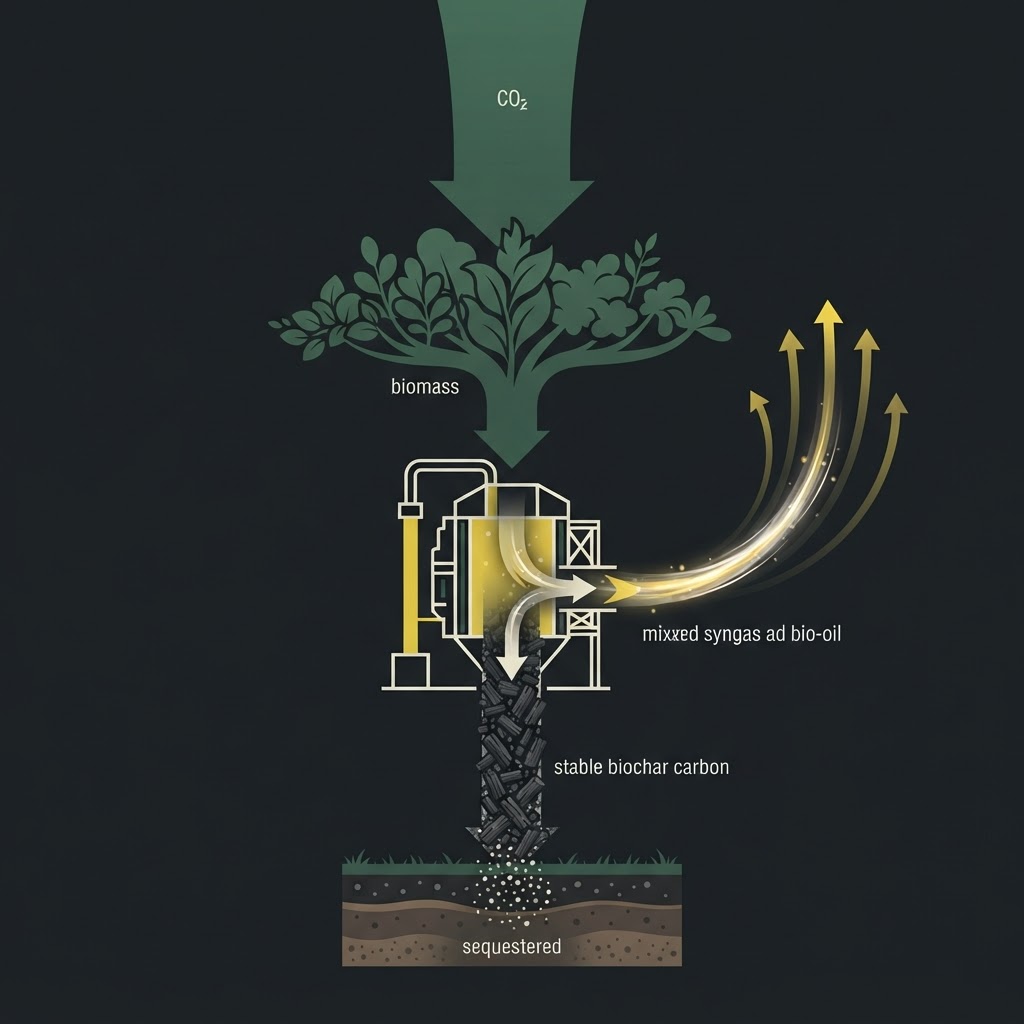
Start with the part most explainers get backwards. When people ask how biochar removes CO2 from the air, they usually picture a black powder soaking up carbon dioxide like a sponge. It does not. The removal from the air is done by plants. Biochar's job is to stop that carbon going back.
That distinction matters, because it tells you where the climate benefit is actually won or lost: not in the soil, but in the reactor, in the choice of feedstock, and in what the plant does with the half of the carbon that never becomes char.
We design gasification and waste-to-energy plants that turn biomass and sludge into power, heat and biochar from the same feedstock, so we look at this as a carbon balance rather than a slogan. Here is where every tonne goes.
Biochar Does Not Pull CO2 Out of the Air. Plants Do.
There is a real technology in which biochar captures CO2 directly. Researchers modify char, for example by pyrolysis at 800 C in an ammonia rich atmosphere, to raise its affinity for CO2 as an adsorbent. That is a gas treatment application for exhaust streams. It is not what carbon removal registries credit, and it is not what happens when char goes into a field.
The credited mechanism is a detour. A field of crop residue left to rot returns almost all of its carbon to the atmosphere within a few years as microbes break it down. Turn that residue into biochar and a durable share of the carbon misses the return trip. The removal is the difference between those two fates.
Step 1: Photosynthesis Does the Capture
Every carbon atom in biochar was CO2 in the air before a plant fixed it. The mass conversion is simple chemistry: carbon makes up 3/11 of the mass of a CO2 molecule, so one tonne of carbon corresponds to roughly 3.7 tonnes of atmospheric CO2. Keep that factor in mind, because it is why a tonne of char represents far more than a tonne of CO2.
On its own, this capture is temporary. Plants die, residues rot or burn, and the carbon cycles back within years to decades. Growing biomass removes CO2; keeping it removed is the hard part.
Step 2: Pyrolysis Decides How Much Carbon Stays
Biochar is made by heating biomass with little or no oxygen. Instead of burning, the material decomposes. At 350 to 700 C the process yields three products: biochar, bio-oil and syngas.
Where the other half of the carbon goes
This is the number the SERP buries. Pyrolysis locks roughly half of the feedstock's carbon into stable biochar. The rest leaves the solid as gas and condensable vapours.
What happens to that other half decides the climate result. Flared without use, it is simply emitted. Burned for process heat or electricity, it displaces fuel that would otherwise have been bought. If you want the engineering of how a reactor splits feedstock between gas and solid, we covered how a biomass gasifier splits feedstock into gas and char separately.
Why the char resists decay
Heat drives off hydrogen and oxygen and rearranges the remaining carbon into condensed aromatic rings that soil microbes can barely attack. The chemistry is tracked with the hydrogen to organic carbon ratio: the lower it is, the more condensed the carbon. Char produced at 600 C or above is chemically close to fossil inertinite, with permanence estimated at more than 1,000 years.
Step 3: Storage, and the Fraction That Actually Counts
Once the char is in soil, concrete or asphalt, the carbon stays out of the atmosphere for centuries. But not all of it, and a credible accounting does not pretend otherwise.
Certification thresholds sit at an H/Corg of 0.7, with 0.4 marking more stable material, and the European Biochar Certificate assumes 0.3 percent annual carbon loss, leaving 74 percent of the carbon in place after 100 years. Crediting therefore counts the persistent fraction, not the total carbon in the char, and deducts process emissions on top.
What does that leave per tonne? The EU biochar industry works with a conversion rate of 2.7 tonnes of CO2 per tonne of biochar, and market analysts put the range at roughly two to three tonnes of CO2 per tonne of biochar. The spread is the feedstock, the temperature and the accounting horizon. For the arithmetic that turns a tonne of char into a certificate, see how that tonne becomes a credit.
The Trade-Off Most Explainers Skip: Char or Energy
Here the story stops being a diagram and becomes a design decision.
The most cited review of the field, Lehmann and colleagues in Nature Geoscience, found that half of the emission reductions and the majority of CO2 removal from biochar systems come from the one to two orders of magnitude longer persistence of biochar compared with the biomass it is made from. Persistence is the whole mechanism.
The same review quantified the trade-off. Every tonne of carbon kept in char is a tonne not burned for energy, and whether that is a good deal depends on what the energy would have replaced. Relative to producing bioenergy, the emissions of a biochar system rise by 3 percent when the char would otherwise replace coal, and fall by 95 percent when it would otherwise replace renewable energy.
In plain terms: in a grid still running on coal or diesel, maximising energy recovery can be almost as good as maximising char. In a grid already decarbonised, the char is where the climate value sits. There is no universal optimum, only a site specific one.
This is why gasification belongs in the conversation. The March 2026 Mission Innovation status report on biochar as CO2 removal treats gasification as its own production route alongside pyrolysis. Our public five step process is built on the same logic: collect local biomass and sludge, gasify at high temperature to clean syngas, convert it to dispatchable electricity and heat, and capture biochar plus verified CO2 offsets on site. The syngas side is the carbon that would otherwise be flared; the char side is the carbon that stays down.
Feedstock discipline decides how repeatable that split is. We have argued publicly that thermal pre-treatment is non-negotiable in gasification and pyrolysis, for moisture reduction, energy density and feedstock homogenization. Wet, uneven feedstock gives uneven char chemistry, and uneven chemistry forces conservative permanence assumptions.
How Big Can This Get
Biochar is not a lab curiosity. It accounted for 87 percent of all permanent carbon removal deliveries in the voluntary market according to 2024 data, and has a technology readiness level of 8 to 9. By 2025 it made up more than 90 percent of the durable carbon removal credits actually delivered.
At global scale, the Lehmann review estimates biochar systems could deliver emission reductions of 3.4 to 6.3 billion tonnes of CO2e a year, half of which is CO2 removal. The IPCC AR6 figure cited by market guides is 2.6 gigatonnes of annual removal potential by 2050.
The ceiling is feedstock and quality control, not chemistry. For the buyer's view of that quality question, read whether biochar carbon credits are reliable, and for the market side, what a tonne of biochar removal sells for. If you are weighing the producer route, our guide to starting a biochar business covers it.
FAQ
Does biochar absorb CO2 directly from the air?
No. Plants capture the CO2 through photosynthesis, and biochar keeps that carbon from returning. Engineered biochar can be modified to adsorb CO2 from exhaust gas streams, but that is a separate gas treatment use and not the carbon removal that registries certify.
Is charcoal the same as biochar for carbon removal?
Chemically they can be almost identical. The difference is fate: charcoal is made to be burned, which releases its carbon, while biochar is made to be stored in soil or materials. Only stored char counts as removal.
Is biochar better than planting trees for removing CO2?
They do different jobs. Market comparisons put tree planting at decades of storage and biochar at centuries or more, with biochar costing more per tonne. Forests store more carbon over large areas; biochar stores less carbon per project, but for far longer.
Can a gasification plant produce biochar?
Yes. Gasification is recognised as a biochar production route alongside pyrolysis. A plant can be tuned toward more energy or more char, and the right balance depends on what energy the plant displaces locally.