
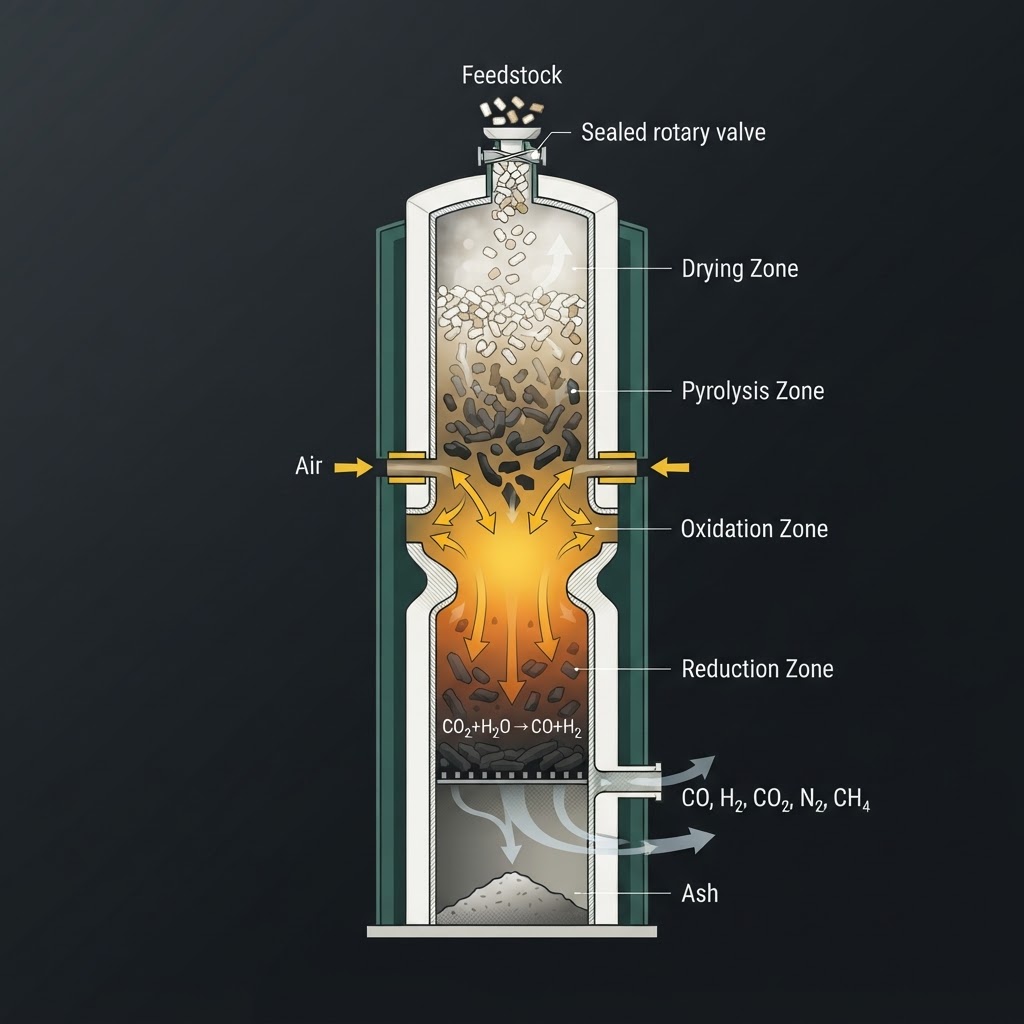
So how does biomass gasification work? It turns wood chips, agricultural residue or dried sludge into a burnable gas without ever fully combusting the material. Inside a sealed reactor, a limited amount of oxygen or steam drives the feedstock through four distinct stages, drying, pyrolysis, oxidation and reduction, ending in a fuel gas called syngas plus a solid char byproduct. The reaction runs above 700°C, but with only a fraction of the oxygen a full burn would need, which is the entire mechanism that separates gasification from incineration (Wikipedia).
That distinction matters for anyone sizing a real project, because the four stages are not just chemistry trivia. Each one is a control point an engineer has to design around, and the step most explainers skip, feedstock pre-treatment, is usually what decides whether a gasifier runs cleanly or clogs with tar.
What biomass gasification actually is
Gasification is a thermochemical process: feedstock reacts at high temperature with a restricted supply of oxygen and/or steam, producing a gas mixture dominated by carbon monoxide (CO), hydrogen (H2), carbon dioxide (CO2) and, if air is used, nitrogen (N2). Because the material is never given enough oxygen to fully oxidize, most of its chemical energy ends up stored in that gas rather than released as heat on the spot (Wikipedia).
That is the opposite design goal from incineration, which burns waste completely to release heat immediately and leaves ash as the main solid output. Gasification instead treats the feedstock as a refining step: crude biomass in, a combustible gas out, ready to be burned later in an engine, turbine or boiler where combustion can be controlled far more precisely.
The four-stage reaction inside a gasifier
Every gasifier, from a small genset unit to a municipal plant, pushes feedstock through the same four zones. All Power Labs, a small-scale gasifier manufacturer, breaks the sequence into five named steps: drying, pyrolysis, combustion, tar cracking and reduction, with the middle two often treated as a single oxidation stage (All Power Labs).
Drying
The feedstock enters at ambient moisture and is heated to roughly 100-150°C, an endothermic step that drives off surface and bound water as steam. Nothing chemical happens here yet; it is purely evaporation (All Power Labs).
Pyrolysis
Between about 200°C and 700°C, in the absence of oxygen, the dried biomass thermally decomposes. Cellulose, hemicellulose and lignin break down into volatile gases, condensable tar vapors and a solid carbon-rich residue called char, with char typically retaining 10-25% of the original carbon (MDPI).
Oxidation (combustion) and tar cracking
A restricted amount of air, oxygen or steam is introduced and reacts with part of the volatiles and char, producing temperatures above 800°C. This is the only stage that releases net heat, and that heat is what drives the endothermic drying and pyrolysis steps upstream. The same high temperature also cracks a large share of the tar vapors into lighter, non-condensing gases, roughly half the combustible content of finished syngas comes from cracked tar rather than direct pyrolysis gas (All Power Labs). The ratio of oxygen actually supplied to the oxygen a full burn would require is called the equivalence ratio, and gasifiers are tuned to hold it between about 0.2 and 0.4 (Engineering LibreTexts).
Reduction
In an oxygen-poor zone at 700-1,000°C, the hot char reacts with carbon dioxide and water vapor from the earlier stages. The Boudouard reaction (C + CO2 to 2CO) and the water-gas reaction (C + H2O to H2 + CO) convert solid carbon into the two gases that make syngas useful as a fuel: carbon monoxide and hydrogen (Engineer Fix).
Why pre-treatment decides whether the reactor actually works
None of the four stages above matter if the feedstock walks in wrong. Biomass typically needs to be dried and sized down to under about 10% moisture by weight before it can gasify cleanly, a pre-processing step (drying, cutting, milling, sometimes pelletizing) that itself consumes 100-200 kWh per tonne of feedstock, 2-3% of the material's own energy content (MDPI). Feed it wet or oversized, and the drying stage inside the reactor eats into the process heat that oxidation is supposed to supply, dragging down temperatures across every downstream zone and pushing tar output up rather than down.
This is the step most gasification explainers treat as a footnote and the one Energaia treats as the actual engineering problem. Thermal pre-treatment, moisture reduction, energy-density improvement and feedstock homogenization before the reactor, is the difference between a project that runs and one that fouls its own gas train, which is why Energaia has stated publicly that pre-treatment is non-negotiable rather than optional ahead of gasification or pyrolysis (Energaia on LinkedIn).
What comes out: syngas and biochar
The gas leaving the reduction zone, syngas or producer gas, is mostly CO and H2 with some CO2, water vapor and, if air was the gasifying agent, nitrogen. It can be burned directly in engines or boilers, or refined further into methanol, hydrogen or Fischer-Tropsch synthetic fuel (Wikipedia).
The solid left behind, char mixed with the biomass's original ash content, is the second output. Used as a soil amendment it is called biochar; used for industrial purposes it is called biocarbon (All Power Labs). Energaia's own public description of the process states this outcome directly: local biomass or sludge in, high-temperature gasification to clean syngas, conversion to dispatchable electricity and heat, and capture of biochar plus verified CO2 offsets, run on-site (Energaia on LinkedIn).
How gasifier design changes the four zones
The four stages above always happen, but reactor design decides their order and how cleanly they separate. In a downdraft fixed-bed gasifier, biomass and the gasifying agent both move down together, so pyrolysis gases pass through the hot oxidation and reduction zones and get cracked before they exit, producing relatively clean gas. In an updraft design, gas flows counter to the biomass, giving higher thermal efficiency but letting more uncracked tar escape with the gas stream (MDPI). Picking between updraft, downdraft, fluidized-bed and other configurations is really a decision about where you want tar handled: inside the reactor, or downstream in a cleanup system. That choice deserves its own breakdown of the different types of biomass gasifiers.
From mechanism to a real project
At industrial scale, gasifiers split into two broader designs. Direct gasifiers run pyrolysis, oxidation and reduction in a single vessel, with air or steam fed straight in. Indirect gasifiers separate pyrolysis and gasification from combustion, using a heat-transfer medium such as hot sand to carry energy between two vessels, which keeps the syngas free of combustion-derived nitrogen (DOE).
Which design fits a given site depends on feedstock, scale and what the syngas needs to power, and that is a feasibility question, not a chemistry one. If the mechanism above checks out for a project you're evaluating, the next questions are usually how gasification compares to incineration on cost and emissions and what a gasification project actually costs to build.
FAQ
Is biomass gasification the same as incineration?
No. Gasification uses a restricted amount of oxygen to convert feedstock into a combustible gas without fully burning it; incineration supplies enough oxygen to fully combust the material for immediate heat, leaving ash rather than syngas as the main output (Wikipedia).
What is syngas made of?
Mainly carbon monoxide and hydrogen, with smaller amounts of carbon dioxide, water vapor, methane and, if air rather than pure oxygen was used, nitrogen (Wikipedia).
Does biomass need to be dried before gasification?
Yes. Feedstock is typically dried and sized down to under about 10% moisture by weight before it enters the gasifier, a pre-processing step that costs energy in its own right but prevents the reactor's internal drying stage from starving the rest of the process of heat (MDPI).
What happens to the leftover char after gasification?
It exits the reactor as char-ash, the solid carbon and mineral residue left after reduction. Rather than being discarded, it is typically used as biochar for soil or as biocarbon for industrial applications (All Power Labs).