
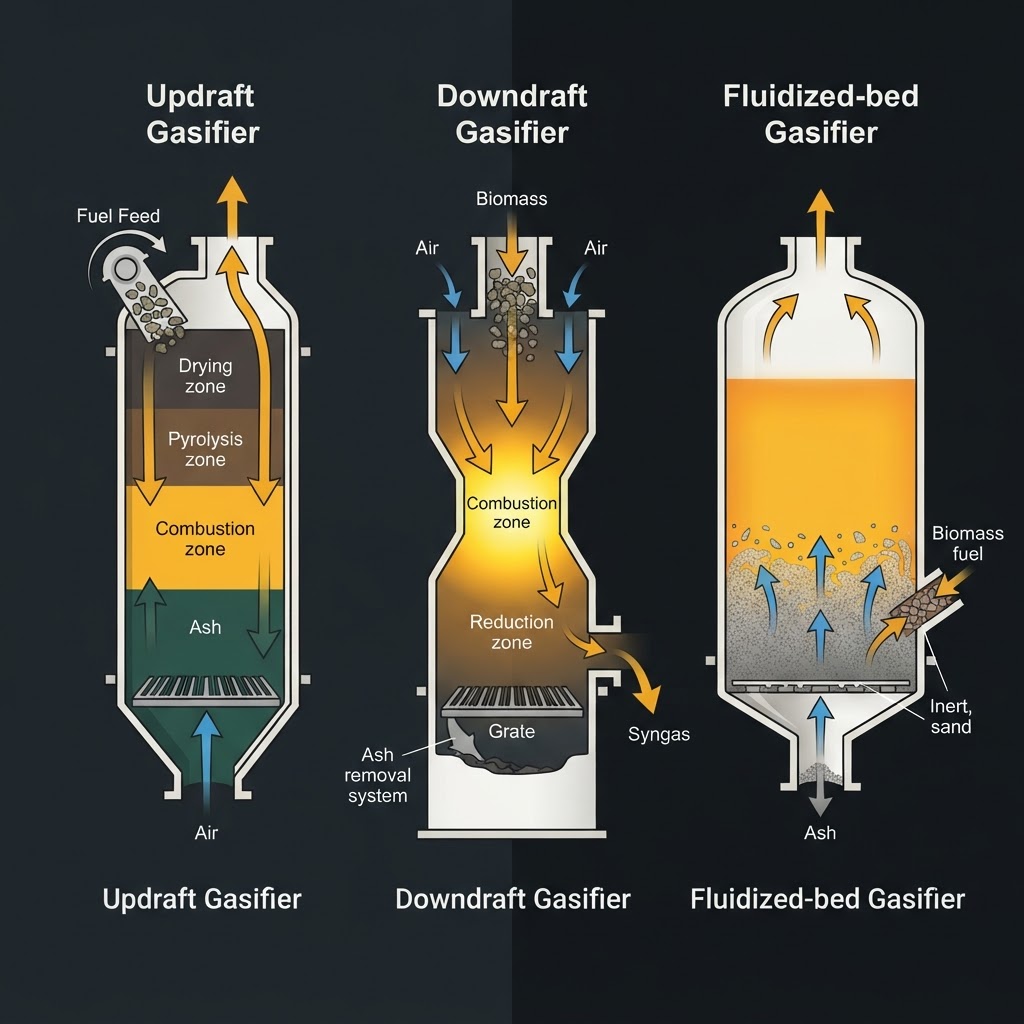
The types of biomass gasifiers in commercial use fall into three families: fixed bed (updraft, downdraft and cross-draft), fluidized bed (bubbling and circulating) and entrained flow, with plasma and rotary kiln reactors as two further commercial options (Cardona-Giraldo et al., 2025). They are told apart by how the fuel is held in the reactor, which direction the fuel and the oxidant move, and how heat reaches the reaction (NETL benchmarking study).
That taxonomy is where most guides stop. For a project owner it is the wrong starting point. The real question is not "what types exist" but "which types can run on the feedstock I actually have, at the moisture it actually arrives with, at the scale I actually need". This guide gives you the numbers for each type, puts them in one table, and then works backwards from the feedstock.
The short answer: three families, seven common designs
| Family | Designs | Where it fits |
|---|---|---|
| Fixed bed | Updraft, downdraft, cross-draft | Small to medium plants, simple construction |
| Fluidized bed | Bubbling, circulating, dual | Medium to large plants, variable or fine feedstock |
| Entrained flow | Slagging, non-slagging | Very large plants, finely milled dry fuel |
| Other | Plasma, rotary kiln | Wet, mixed or difficult feedstock |
The deciding variables are always the same four: operating temperature, tar in the gas, tolerance to moisture and particle size, and the capacity range the design works at.
Fixed-bed gasifiers
In a fixed bed, the fuel sits on a grate and moves slowly down through distinct zones for drying, pyrolysis, oxidation and reduction. If you want the chemistry of those zones first, read how biomass gasification works stage by stage. What changes between the three fixed-bed designs is where the air enters and where the gas leaves.
Updraft (counter-current)
Air enters under the grate and the gas rises against the falling fuel. Hot gases leave the combustion zone at about 1000 °C, are cooled to 750 °C in the reduction zone, and exit the top at around 500 °C after drying the incoming fuel, according to NETL. That internal heat exchange makes updraft the most forgiving design on feedstock: a 2025 market evaluation for the National Research Council of Canada puts its moisture tolerance at up to 60% and its practical range at 1.1 to 12 MW (Shadbahr et al., NRC).
The price is tar. The same NRC review reports 50 to 100 g/Nm³ of tar in updraft producer gas, and NETL puts it at 10 to 20% by weight of the syngas. That is why updraft gas is mostly burned directly for heat, where tar is simply combusted, rather than sent to an engine.
Downdraft (co-current)
Fuel and air move down together, so the tarry pyrolysis vapours must pass through the hottest zone before leaving. NETL's benchmarking study reports that this burns up to 99.9% of the tar formed, and NRC measures the result at under 1 g/Nm³, clean enough for gas engines. NRC also cites cold gas efficiency of 56 to 77% for downdraft against 36 to 73% for updraft.
Three limits matter in practice:
- Moisture. Feed must be dried below 20%, and 4 to 7% of the carbon stays unconverted.
- Scale. NRC gives a range of 1 kW to 1 MW. An older FAO technical guide calls downdraft impractical above about 350 kW of shaft power because the throat cannot hold a uniform temperature across a wider cross-section.
- Fuel form. FAO notes that fluffy, low-density material causes flow problems and must be pelletized or briquetted, and that tar-free operation holds over a turn-down ratio of about 3, with 5 to 6 considered excellent.
Cross-draft
Air enters from one side and gas leaves from the other. FAO describes it as an adaptation for charcoal, economic below 10 kW of shaft power thanks to a very simple cleaning train of a cyclone and a hot filter, but with minimal tar-converting capability. The NRC review agrees that it is rarely used for raw biomass because it produces more tar. For most biomass projects it is a niche option.
Fluidized-bed gasifiers
A fluidized bed replaces the grate with a bed of hot sand, alumina or olivine kept in suspension by the gasifying agent. There are no fixed zones: drying, pyrolysis and gasification happen everywhere in the bed at once, at a near-uniform temperature of around 900 °C. A 2023 review in Sustainable Energy and Fuels gives throughputs of up to 80,000 kWth, which is why this family dominates larger plants (Tondo Alves et al., RSC).
Bubbling fluidized bed
Gas velocity is just above the fluidization point, so the bed "boils" but stays in the reactor. NETL lists the advantages as uniform gas, uniform temperature, acceptance of a wide range of particle sizes including fines, and high conversion. FAO adds the key practical point: bed temperature can be kept below the ash melting point, so problem fuels such as rice husks and sawdust can be fed without pre-processing into pellets.
Circulating fluidized bed
Higher gas velocity carries bed particles out of the reactor; a cyclone catches them and returns them. This suits fast reactions and high heat transport, at the cost of temperature gradients along the solids path and the added complexity of the cyclone loop.
Dual fluidized bed
One bed gasifies with steam while a second burns char to supply the heat. Because no air enters the gasification side, the gas is not diluted with nitrogen. A 2026 review of gasifier operating windows reports systems above 80% cold gas efficiency with hydrogen concentrations of up to 80% (Configuration-Dependent Multi-Parameter Optimization in Biomass Gasification).
The weaknesses of the family, per FAO: tar of up to 500 mg/m³, incomplete carbon burn-out, poor response to load changes, and control equipment that makes very small units uneconomic, which puts the practical floor above about 500 kW of shaft power.
Entrained-flow and plasma gasifiers
Entrained flow blows finely milled fuel through an oxygen flame at over 1200 °C. Tar and methane are virtually eliminated and ash leaves as slag. The catch for biomass is preparation: the RSC review specifies particles under 0.15 mm and names milling energy as a considerable cost, and NRC notes these units come from the coal industry and are associated with capacities above 200 MW. The 2025 multi-criteria review ranked entrained flow last among biomass options for exactly this reason: poor compatibility with residual biomass.
Plasma gasifiers use an electric arc to reach 2000 to 4000 °C, accept feedstock of any moisture and particle size, and produce near-zero tar. The trade-off is the electricity bill for the torch and the capital cost of the plant.
Side-by-side comparison table
The operating windows below come from the 2026 operating-window review cited above. Treat them as typical ranges, not guarantees for a given design.
| Type | Temperature (°C) | Feed moisture (%) | Particle size (mm) | Tar level |
|---|---|---|---|---|
| Updraft | 700 to 900 | Up to 35 | 10 to 50 | Very high |
| Downdraft | 850 to 1050 | 10 to 20 | 20 to 60 | Low |
| Cross-draft | 1100 to 1400 | Under 15 | 10 to 40 | Very low (charcoal) |
| Bubbling fluidized bed | 750 to 900 | 10 to 20 | 0.5 to 3 | Moderate |
| Circulating fluidized bed | 800 to 950 | 10 to 15 | 0.3 to 1 | Low |
| Dual fluidized bed | 800 to 900 | 10 to 20 | 0.3 to 1 | Low |
| Entrained flow | 1200 to 1500 | Under 10 | Under 0.2 | Very low |
| Plasma | 2000 to 4000 | Any | Any | Near zero |
Two caveats. First, sources disagree at the edges: the table caps updraft moisture at 35%, while NRC reports tolerance up to 60%. Second, the "very low" tar figure for cross-draft assumes charcoal feed; FAO and NRC both warn that raw biomass in a cross-draft reactor produces far more.
Choosing by feedstock, not by brochure
Vendors sell the design they build. A feasibility study should start from the feedstock and let it eliminate options. The 2025 multi-criteria review, which ranked all the main designs with Monte Carlo simulation, found downdraft and bubbling fluidized bed consistently most favorable, and counted twelve commercial or pre-commercial fuel plants using them: seven downdraft and five fluidized bed. That is a useful prior, but your feedstock decides between them.
Wood chips and pellets
Dense, uniform, low-ash fuel is what downdraft was built for. Below roughly 1 MW, and especially where the goal is running a gas engine for on-site power, downdraft is usually the first candidate. Above that scale, bubbling fluidized bed takes over.
Rice husks, sawdust and other fines
Fluffy, fine or high-ash residues block the throat of a downdraft reactor unless they are pelletized, which adds cost. Fluidized beds handle them directly, provided the plant is large enough to carry the control equipment. For the specifics of crop residues, see our guide to gasifying agricultural waste.
Wet residues and sewage sludge
Here the table is blunt: almost every design wants feed below 20% moisture, and entrained flow wants it below 10%. Only updraft and plasma tolerate wet fuel as delivered, and updraft does so at the cost of heavy tar. This is why Energaia treats thermal pre-treatment as non-negotiable for gasification feedstock: drying, densifying and homogenizing the material does not just improve efficiency, it changes which gasifier types you are allowed to choose. A dried sludge pellet opens up downdraft and fluidized bed options that raw sludge rules out. We cover the drying step in detail in thermal treatment of sewage sludge.
If biochar is a product
The residue differs by family. The RSC review reports 20 to 25% solids from fixed beds, with higher carbon content, against 5 to 10% from fluidized beds. If biochar and carbon removal credits are part of the revenue model, that difference belongs in the reactor decision from day one.
Where Energaia fits
Energaia is a waste-to-energy engineering institute in Zittau, Saxony. Our public five-step process runs from local biomass or sludge, through high-temperature gasification to clean syngas, to dispatchable power and heat plus biochar and verified CO2 offsets, on site. The reactor type sits in the middle of that chain, and we choose it last: feedstock characterization and pre-treatment modelling come first, because they decide which reactor types are left to choose from. Once the design family is clear, the next question is money, which we cover in what a biomass gasification project costs.
FAQ
Which type of biomass gasifier produces the least tar?
Among the common designs, downdraft is cleanest in the fixed-bed family at under 1 g/Nm³. Entrained flow and plasma reach very low to near-zero tar because of their much higher temperatures, but both demand either finely milled dry fuel or a large electricity input.
Which gasifier is best for running an engine generator?
Downdraft, at small scale. Its low-tar gas suits internal combustion engines, and NRC reports it can replace 70 to 76% of the diesel in a dual-fuel compression ignition engine, which matters wherever diesel gensets carry the load.
Can a biomass gasifier run on wet feedstock?
Only a few designs can. Updraft tolerates wet fuel but produces heavy tar, and plasma accepts any moisture at a high energy cost. Most other types need feed below 20% moisture, so wet residues usually need a drying step first.
Do fixed-bed and fluidized-bed gasifiers leave different residues?
Yes. Fixed beds leave a larger, more carbon-rich solid residue than fluidized beds, which makes them the more natural fit when biochar is a planned co-product.