
Most published work on agricultural waste gasification optimises a reactor in software and stops there. It will tell you the ideal temperature and equivalence ratio for a generic biomass and leave you with the impression that a residue is a residue. It is not. Two crop residues with almost identical heating values can behave completely differently in the same gasifier, and the property that separates them is not calorific value. It is ash chemistry. Get that wrong and the plant does not underperform, it shuts down.
This article is written the way a project actually gets decided: start from the residue you have, work out whether it can run continuously, then look at what comparable deployed projects cost.
The resource is real and the number you were quoted is not
Crop residues represent more biomass than the grain harvested from the same field, and their embodied energy is roughly 15 per cent of global human primary energy use, while about 19 per cent of livestock feed by weight is crop residue and roughly 10 per cent of residue is treated as waste and burnt. That last fraction is the honest starting point. Globally, around 458 million tonnes of crop residues were burnt in 2019, releasing 1,238 kilotonnes of methane and 32 kilotonnes of nitrous oxide, and burning destroys nearly all of the organic carbon and nitrogen along with 25 per cent of the phosphorus and 20 per cent of the potassium in the residue.
The gap between what exists and what you can actually collect is where projects die. IRENA quantified it: in South America the theoretical potential of agricultural residues is 30.4 exajoules a year but the technical potential is 7.2, in Southeast Asia 28.5 falls to 13.3, and India's 700 million tonnes of annual residue generation reduces to about 210 million tonnes technically available. Roughly a quarter to a half survives the subtraction. Feed, bedding, domestic fuel, soil carbon retention and transport distance take the rest.
So the first number in your model is not tonnes produced in the district. It is tonnes you can contract, at a price, within a haul radius, in every month of the year.
What gasification does to a crop residue
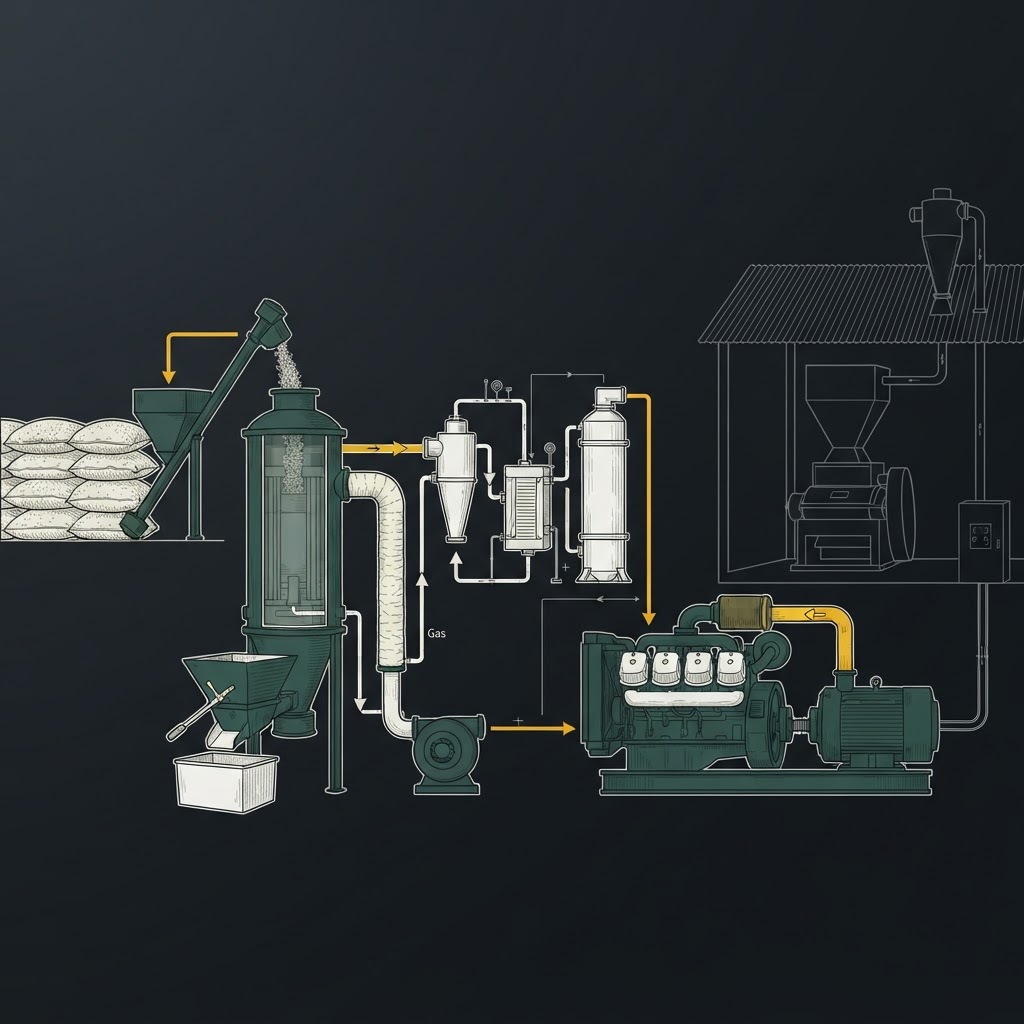
Gasification is partial oxidation. You supply less oxygen than combustion needs, so instead of burning the residue to CO2 and heat you convert it thermochemically into a combustible gas of carbon monoxide, hydrogen and methane, plus a solid carbon residue. That gas can run a reciprocating engine, which is why the route produces electricity rather than only heat. The general mechanism is covered in how biomass gasification works.
The operating window is narrow and well characterised. An Aspen Plus study of three Mediterranean agricultural residues found good gasification performance above 750 C, equivalence ratios between 0.1 and 0.3 depending on the raw material, steam-to-biomass ratios below 0.1, and concluded that a downdraft reactor integrated with a reciprocating engine is the rational configuration for distributed power generation.
Experimental work on a 10 kWth fixed-bed downdraft unit gives the measured version of that window across 45 runs: rice straw reached the highest cold gas efficiency of 63.7 per cent at 850 C and an equivalence ratio of 0.30, syngas lower heating value peaked at 5.7 to 6.1 MJ per normal cubic metre at that same ratio, and sugarcane bagasse produced lower syngas quality despite the highest volatile matter content, because of its elevated ash. Note that the highest-volatile feedstock lost to ash. That is the theme of this whole article.
The gasifying agent moves the answer too. Rice husk gasified under an oxygen and nitrogen mixture rather than air produced a maximum producer gas lower heating value of 10.9 MJ per normal cubic metre at 800 C, with the resulting char reaching a BET surface area of 146 square metres per gram at 900 C. Air dilutes the gas with nitrogen and roughly halves its heating value. Which reactor and agent suit your case is the subject of types of biomass gasifiers.
Ash chemistry decides which residues you can run
Here is the failure mode the modelling papers do not model.
Crop residues, and straws especially, carry potassium. Silica is either in the feedstock or in the reactor bed, usually as cheap sand. Above a certain temperature the two form eutectic mixtures with melting points far below either component. Continuous gasification tests on barley straw documented the mechanism precisely: potassium silicates such as K2O.3SiO2 and K2O.4SiO2 melt at 740 C and 764 C, residual sulphur can pull that down to around 700 C, and the molten phase forms bridges between bed particles that block gas flow, cause a sudden pressure drop and force a full reactor shutdown requiring bed replacement and slag removal. Water leaching of the straw reduced its ash content by 80 per cent in 24 hours, eliminated agglomeration entirely, and raised carbon monoxide production by 31.9 per cent and methane by 37.3 per cent at 850 C.
Read those two numbers together. The eutectic melts at 740 C. The recommended operating temperature is above 750 C. The failure point sits inside the design window, which is why this is a selection problem rather than a tuning problem.
Reading a residue by its ash number
The Aspen Plus comparison also published the composition of its three feedstocks, and the ranking follows the ash column almost exactly:
| Residue | Ash | Moisture | Outcome |
|---|---|---|---|
| Olive stone | 1.35 per cent | 11.00 per cent | Best syngas yield and cold gas efficiency |
| Wheat straw | 5.81 per cent | 7.70 per cent | Highest syngas heating value, mid cold gas efficiency |
| Grapevine waste | 13.30 per cent | 11.16 per cent | Lowest yield, lowest heating value, lowest efficiency |
Grapevine waste lost on every metric while sitting in the same reactor under the same conditions. Rice husk is the instructive edge case: it gasifies well and is abundant at mills, but its ash is silica-rich, and the techno-economic study above explicitly recommends pre-treatment to avoid de-fluidisation of the system for that reason.
A practical screen, in order of how much it tells you:
- Ash percentage. Use the measured range above as the yardstick. A residue near olive stone's 1.35 per cent is comfortable. One near grapevine waste's 13.30 per cent means you are designing an ash management system that happens to contain a gasifier.
- Ash elemental composition. Potassium, sodium, chlorine, sulphur and silicon. This costs a few hundred euros and decides more than any other analysis you will commission.
- Moisture. Every point of moisture is energy spent evaporating water instead of making gas.
- Particle size and consistency. Husks and stones feed themselves. Loose straw bridges in the hopper.
What deployed agricultural gasification actually costs
The residue is usually free or close to it, so capital cost and capacity factor set the price of the electricity. Four studies, four contexts, one consistent conclusion.
A designed off-grid system for Adani in Enugu State, Nigeria, found 3,636 tonnes of rice husk available annually in the study area, a 1.52 MW generation potential producing 13,132.8 MWh a year, and a levelized cost of 3.6 Naira per kWh against the 30.93 Naira per kWh tariff the local distribution company charged its R2S customers. A HOMER model of the Avnash rice mill in northern Ghana, running on 50 tonnes of husk a day through a 1250 kW biomass genset, returned a cost of energy of USD 0.0703 per kWh and a net present cost of USD 712,082, against USD 0.290 per kWh and a net present cost of USD 2.93 million for the 1300 kW diesel baseline, with a 98,158 kWh annual surplus. That comparison assumes the gasification investment itself was already made, which matters, and it is the same arithmetic behind choosing a diesel generator alternative for a business in Nigeria or checking the cost of electricity per kWh in Nigeria before sizing anything.
Feedstock choice moves the number within a single plant. A 95 kWe installation modelled for Badara, Burkina Faso, compared two residues on identical hardware: rice husk produced electricity at 0.34 EUR per kWh against 0.38 for cotton stalk, despite rice husk having the lower electrical efficiency at 11.9 per cent versus 12.6 per cent, with capital cost around 2,285.58 EUR per kWe, and cotton stalk creating more direct employment at 9.58 full-time equivalents a year against 8. System lifetime, investment cost and discount rate drove 42, 26 and 15 per cent of the variance in production cost respectively.
Notice what does not appear in that sensitivity list: fuel price. When the feedstock is a waste, the project is a capital and uptime problem, which is exactly why the quoted equipment number deserves scrutiny and why what a biomass gasifier quote leaves out is worth reading before signing. Our own breakdown sits in biomass gasification cost.
Scale behaves counter-intuitively. The rice husk CHP study cited above compared two configurations: a shared 42,700 tonne per year unit serving five rice processors returned a return on investment of 0.72, a payout time of 1.05 years and 168 EUR of revenue per tonne of husk treated, while a captive 18,300 tonne per year unit at a single company returned 146 EUR per tonne, and the underlying small-scale technology becomes financially viable from as little as 100 tonnes of residue a year depending on type. Aggregation across neighbouring producers beats a captive unit. The threshold for viability is far lower than incineration guidance implies, which is the wider point made in waste to energy for emerging markets.
For the per-tonne yardstick, a Nigerian comparison across three routes on a single tonne of waste found gasification with an internal combustion engine delivered 574.2 kWh per tonne at 0.138 USD per kWh, against 311.4 kWh for combustion with an Organic Rankine Cycle and 169.2 kWh for anaerobic digestion.
The four things that stop an agricultural gasifier
Ash and agglomeration. Covered above, and first because it is the one that ends operation rather than degrading it.
Tar. Condensable hydrocarbons in the raw gas foul filters, pipework and engine valves. The same downdraft experiments found tar minimised at 900 C but still running 4.8 to 6.3 grams per normal cubic metre across all three feedstocks. That is a gas cleaning train and a maintenance schedule, not a rounding error, and it is a recurring operating cost that rarely appears in a feasibility spreadsheet.
Seasonality. Residue arrives in a harvest window and load runs all year. Straw baled in September has to be stored dry until August, and storage is capital, land and fire risk. A residue calendar mapped against the load curve belongs in the model before the reactor is specified.
Aggregation. Not engineering. Contracts, logistics and local politics, and the reason the shared 42,700 tonne configuration outperformed the captive one.
None of this is theoretical. Small agricultural gasifiers run today at North Carolina A&T University on corn cobs and pecan shells, at Blue Marble Acres in California as an 80 kW containerized microgrid, and at the Masarang Foundation in Indonesia on reforestation waste. The technology is deployed. The selection discipline is what is missing.
Pre-treatment is not a preliminary step, it is the project
Every failure mode above is addressed before the residue reaches the reactor. Leaching removes the potassium. Drying removes the moisture. Sizing and densification remove the feeding problem. That is why Energaia's public engineering position is that thermal pre-treatment is non-negotiable in gasification and pyrolysis, for moisture reduction, energy density and feedstock homogenization. Pre-treatment is what converts a variable seasonal crop residue into something a converter can run on continuously, and continuity is the capacity factor that the cost sensitivity above says dominates everything.
It is also why we model first. Energaia built a MATLAB-based simulation suite for volatile organic compound emissions in biomass-to-energy processes, because VOC release during drying and thermal pre-treatment is a compliance exposure that project plans routinely omit. A modelled failure costs weeks. A built one costs the project.
The full route runs further than the generator. Energaia's public five-step process is to collect local biomass and sludge, gasify it at high temperature into clean syngas, convert that to dispatchable electricity and heat, capture biochar and verified CO2 offsets, and operate on site. The char is not a by-product to dispose of. It is measurable stable carbon, which is what turns an avoided-emissions story into a certifiable removal, the market examined in biochar carbon credits. Whether the stack of displaced energy, avoided disposal and carbon revenue closes the case is the question behind whether waste to energy is profitable. Energaia works across the whole chain from Zittau, Saxony: consulting and feasibility, system development for biomass gasification and waste-to-energy, and carbon credit management including certification and MRV.
Qualifying a residue before you specify a gasifier
- Measure available tonnage, not produced tonnage. Subtract feed, bedding, domestic fuel and the fraction that must stay on the field for soil carbon. Then apply a haul radius.
- Commission a proximate and ultimate analysis. Ash, moisture, volatile matter, fixed carbon, and the C, H, N, S and O breakdown.
- Commission an ash elemental analysis. Potassium, sodium, chlorine, sulphur and silicon. This is the cheapest decision-grade number in the whole project.
- Map the harvest calendar against the load curve. Size storage for the longest gap, not the average.
- Design the pre-treatment before the reactor. Drying, sizing and, for high-alkali straws, leaching.
- Model emissions and the mass and energy balance. Including VOC release during drying, before any steel is ordered.
- Price the whole system. Gas cleaning, ash handling, storage, spares and skilled maintenance, not the gasifier line item.
FAQ
Which agricultural residues are best for gasification? Low ash, low alkali and reasonably dry. In the Aspen Plus comparison, olive stone at 1.35 per cent ash gave the best syngas yield and cold gas efficiency, wheat straw at 5.81 per cent gave the highest syngas heating value with mid-range efficiency, and grapevine waste at 13.30 per cent was worst on every metric. Nut shells, fruit stones, palm kernel shell and rice husk are generally the strongest candidates; loose cereal straws are the hardest.
Can you gasify rice straw and wheat straw directly? Technically yes, operationally not for long without ash management. Straws are potassium-rich, and potassium silicates melting between 740 C and 764 C sit inside the normal operating window, causing bed agglomeration and forced shutdowns. Water leaching cut barley straw ash by 80 per cent in 24 hours and eliminated the problem in continuous tests, so the question is whether your project can carry a leaching or additive step rather than whether the straw burns.
How much electricity does one tonne of agricultural waste produce? About 574 kWh per tonne for gasification coupled to an internal combustion engine in the Nigerian comparison, roughly three and a half times the anaerobic digestion figure on the same functional unit. Treat that as an upper reference rather than a design value, because moisture, ash and achieved cold gas efficiency all pull it down.
What is the minimum size for an agricultural waste gasification project? Smaller than incineration guidance suggests. The small-scale on-site technology assessed in the rice husk CHP study becomes financially viable from as low as 100 tonnes of residue a year depending on residue type. The stronger constraint is not tonnage but continuity of supply and someone competent to operate the unit.
Is agricultural waste gasification cheaper than a diesel generator? In the studied cases, substantially. The Ghanaian rice mill model put the biomass route at USD 0.0703 per kWh with a net present cost of USD 712,082 against USD 0.290 per kWh and USD 2.93 million for the diesel baseline. The caveat is real though: that comparison assumed the gasification capital was already committed, and adding it raises the cost of energy.
Does gasification compete with using residues as soil amendment? Partly, and the trade-off should be explicit. Burning residues in the field destroys nearly all the carbon and nitrogen and a quarter of the phosphorus. Gasification with char recovery returns a stable carbon fraction to the soil that the mineral nutrients can be managed around, which is a materially different exchange from either open burning or full removal.