
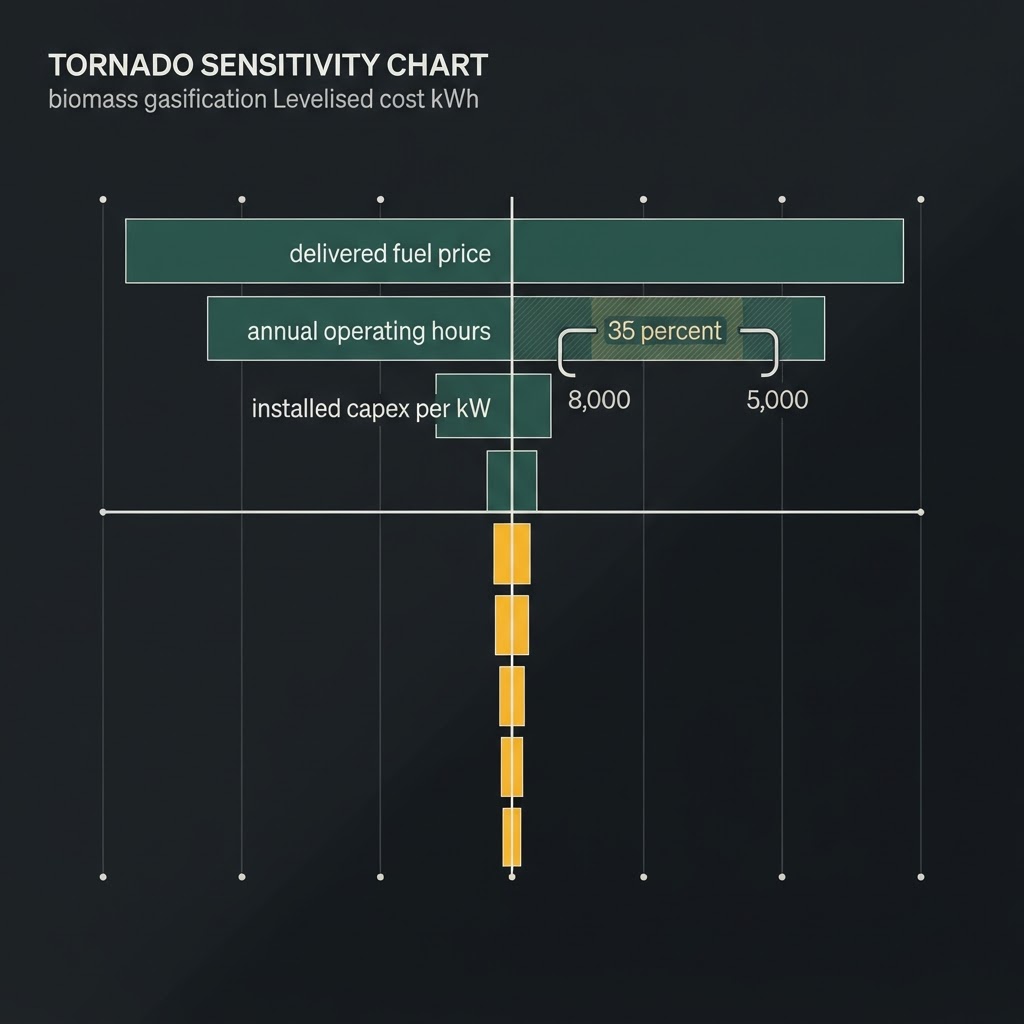
Ask what biomass gasification cost means and you will be given a capex number, because capex is the number everybody has. It is also the input that varies least. Across three independent published assessments the installed capital cost of a gasifier lands in the same band, while the cost of the electricity that comes out of it moves by a factor of two depending on two things that appear in no quotation: what you pay for a delivered tonne of fuel, and how many hours a year the plant actually runs.
This page builds the stack in that order. Equipment price, installed capex per kW, opex, and then the only figure that settles an investment decision, the cost per kWh delivered.
Three numbers get called the cost, and only one of them is yours
A vendor page will quote the reactor. Published equipment bands run 10,000 to 50,000 USD for a fixed bed unit, 50,000 to 200,000 for a fluidised bed and from 200,000 to over a million for entrained flow. Those are ex works prices for a vessel, not for a plant that makes power.
Installed capex is the second number and roughly an order of magnitude above the first. A commercial framework puts modular gasification at 3,500 to 5,500 USD per kW against 3,000 to 5,000 for direct combustion, with total installed costs up 16 percent across 2023 and 2024, and turnkey delivery including civil works and grid connection adding 20 to 40 percent over core equipment prices. That markup is not a margin. It is the scope that turns a machine into a project.
The third number is the delivered cost per kWh, and it is the only one that can be compared against the bill you are trying to replace. Everything below works toward it. If you are comparing across the wider waste to energy field rather than within gasification, fix the denominator first, because per MW, per kW and per annual tonne are not interchangeable.
Capex per kW: the bands worth quoting
The reference survey of gasification economics puts total installed capital for fixed and fluidised bed gasifiers at 1,965 to 5,235 EUR per kW, rising to 5,115 to 6,010 EUR per kW once a CHP system is attached, with electricity-only plants averaging 8,583 EUR per kWe. Attaching the engine roughly doubles the floor of the range. That is the single most common surprise in a first budget.
Two independent modelled cases land in the same territory. A 2 MWe air-blown bubbling fluidised bed plant projected from pilot data comes out at about 6,200 EUR per kWe. An IEA Bioenergy assessment of a Dutch gasification concept puts the first commercial plant at 3,200 and 4,400 USD per kWe for 12.5 and 5 MWth inputs on wet fuel, falling to 2,800 and 3,800 on dry fuel, with 50 to 75 percent of the resulting electricity cost being investment-related.
Three sources, three methods, one band. Capex is the best-known input in this model, which is precisely why it is not where your risk sits. Note also what that IEA figure says about dry fuel: the same technology costs 12 to 14 percent less per kWe when the feedstock arrives dry, before a single kilowatt hour has been produced.
Fuel price is the swing variable, not the reactor
The same IEA assessment prices one plant against two fuel markets. On cheap or contaminated biomass at 0 to 1.5 USD per GJ, electricity production costs come out at 5 to 7 US cents per kWh. On clean wet wood at 2 to 4 USD per GJ, the same plant produces at 8 to 11 cents. Nothing changed but the fuel invoice, and the output price moved by more than half.
India's reference analysis of gasification-based power reaches the same conclusion from a different market, putting capital cost at about Rs 5.5 crore per MW with operating expenses excluding biomass around Rs 0.75 per kWh, and a levelised cost of Rs 2.25 to 4 per kWh depending mainly on the cost of the biomass. The stated driver of a range that nearly doubles is the feedstock, not the technology.
At small scale the sensitivity is measurable rather than rhetorical. In a 60 kW downdraft model built on feedstock at 20 USD per ton, a 15 percent rise in biomass cost cut net present value from 84,550 to 73,063 USD, about 13.5 percent. The mirror case is the one worth chasing: in the 2 MWe study, biomass supplied free rather than at 20 EUR per tonne raises NPV from 3.3 to roughly 6 million EUR, and a negative fuel cost, where you are paid to take the material away, is better still.
That is the whole commercial thesis of waste-fed gasification in one line, and it is why which residues actually work is a cost question rather than a chemistry question.
Operating hours: the input nobody warrants
The second swing variable is availability, and it outranks everything else. A 2025 techno-economic study of a 225 kWel plant built from five 45 kW drying and gasification modules found that raising annual operating hours from 7,500 to 8,000 lowered the levelised cost by only 2 percent, while dropping from 8,000 to 5,000 raised it by 35 percent, making operating hours the most sensitive parameter of all, above biomass cost and above plant size.
The asymmetry is the point. There is almost nothing to win above 7,500 hours and a third of your electricity price to lose below 6,000. The 2 MWe study states the floor outright: the investment is sustainable only if the plant runs at least 6,000 hours a year. And derating counts as lost hours by another name. Dropping the 60 kW downdraft system to 42 kW of real output stretched payback from 7.7 to 9.8 years and cut the internal rate of return from 10.9 to 7.7 percent, on identical capital.
Read that as a purchasing instruction. A quote that assumes 8,000 hours and delivers 5,500 has repriced your electricity by a third, and no discount on the capex recovers it. Ask for guaranteed availability in the contract, with a number attached.
Opex, and why the percentage conventions disagree
Operating cost is usually quoted as a percentage of capex, and the conventions in the literature disagree by a factor of two. The gasification survey uses fixed opex of 3 to 6 percent of initial capex per year plus variable opex around 3.4 EUR per MWh. A 2023 syngas and biochar techno-economic analysis takes opex at 12 percent of capex. The 60 kW case skips percentages entirely and states total operations and maintenance at 0.196 USD per kWh, which on a small plant is a larger line than the fuel.
None of these is wrong. They cover different scopes, different staffing assumptions and different consumable lists, and the gas cleaning train is where the divergence hides: a cyclone costs 500 to 1,500 EUR for a 1,000 cubic metre per hour gas flow while an electrostatic precipitator for the same flow costs 22,000 to 110,000. So do not accept a percentage. Ask for the absolute annual figure, the assumed staffing, and the replacement interval and unit price for filters, bed material and engine consumables.
What it comes to per kWh
Four published levelised costs, all for biomass gasification, none of them comparable without their conditions attached.
The 2 MWe Italian plant models 124 EUR per MWh, with an 11 year payback, a 17.1 percent IRR and biomass bought at 20 EUR per tonne. The IEA Dutch assessment gives 50 to 110 USD per MWh depending on the fuel market. India's reference case gives Rs 2.25 to 4 per kWh. A US feasibility study of a 5 MW modular gasification system priced the whole stack at about 223 USD per MWh, of which 141 was the equipment lease and 40 was fuel at 33 USD per bone dry ton across 7,500 operating hours.
That last figure looks like an outlier until you see the structure. It is built on a five year lease rather than an owned asset, which loads almost two thirds of the cost into capital recovery. Change the financing and the number changes more than any engineering decision in this article would.
So there is no average worth quoting. The recomputation rule is simpler: take a case whose scale, fuel price and operating hours resemble yours, substitute your three numbers, and treat the technology band as fixed. Whether the resulting number is a business is a separate question, answered in where the revenue actually comes from.
The cost that is decided before the reactor
Look back at the two swing variables. Both are set upstream of the gasifier.
Fuel price per useful gigajoule is not the price on the delivery note. It is that price divided by what survives drying, which is why the IEA figures separate wet and dry fuel by 12 to 14 percent of capex before operations begin. Availability is a feedstock property too, because inconsistent moisture and particle size are what take a reactor off its design throughput.
That is where our own engineering position sits. Energaia's published argument is that thermal pre-treatment is non-negotiable in gasification and pyrolysis, for moisture reduction, energy density and feedstock homogenisation, because those three properties decide whether the plant holds its hours. And because drying releases volatile organic compounds that are a permitting exposure rather than a footnote, we built a MATLAB-based VOC simulation suite to model those emissions before any steel is ordered. A pre-treatment scope that is wrong on paper is a change order. The same scope wrong in the ground is a permitting reopening.
If the mechanism is unfamiliar, start with how the process works and with the two routes compared on mechanism before returning to the numbers.
When it pays off depends on which bill it replaces
In DACH the plant is usually competing against a disposal cost and has somewhere to sell its heat. That second point is worth more than it looks: the IEA modelling finds heat sales cut the cost of produced electricity by about 15 percent, equivalent to buying the plant 30 percent cheaper. It is the reason sub-5 MWe systems are viable at all despite their capex per kW. Scale still helps where it can be had, and the syngas and biochar study puts payback at 6.99 years for a 10,000 tonne per year facility against 10.43 years for a 1,000 tonne one. Below a megawatt, though, the industry scales horizontally by adding modules rather than by building a larger reactor, so if that is the route, what putting the plant in a container changes is the question to settle first.
In Nigeria there is no gate fee and the benchmark is diesel. The National Bureau of Statistics put average retail diesel at N3,277.47 per litre in May 2026, up 86.40 percent year on year. Against a fuel bill that reprices upward every quarter, high capex with near-zero fuel cost is a different financial instrument, and we run that comparison in full against the diesel benchmark.
Turning a quote into a cost per kWh
Six questions convert every range above into one site's number.
- What is the delivered fuel price per tonne, at what moisture, and what does that make it per useful gigajoule?
- Is that supply contracted, and for how long, or is it a market price you are exposed to?
- What annual operating hours does the quote assume, and is that availability guaranteed anywhere in the contract?
- What is the net electrical output after parasitic load, not the gross rating on the datasheet?
- Is there a heat offtake, and is the buyer contracted or hypothetical?
- What is the absolute annual opex in currency, with staffing and consumable replacement intervals named?
Answer those six and the published ranges stop being trivia and become bounds on your own number. Skip them and you will be comparing two quotes that describe different plants, which is the most expensive mistake available in this sector and also the most common.
FAQ
How much does a 1 MW biomass gasification plant cost?
Applying the installed bands, the gasifier island for a 1 MWe project sits around 2 to 5.2 million EUR, rising to roughly 5.1 to 6 million once a CHP set is attached, before civil works, grid connection and commissioning. Turnkey delivery typically adds 20 to 40 percent over core equipment prices, so a realistic all-in figure for a 1 MWe plant is mid single-digit millions of euros rather than the equipment quote.
What is the payback period for a biomass gasification plant?
Published cases span roughly 2.7 to 11 years. Scale and feedstock price explain most of the spread. A 20,000 tonne per year syngas and biochar facility models a 2.7 year payback, a 10,000 tonne one about 7 years and a 1,000 tonne one over 10, while a 2 MWe power-only plant buying biomass at 20 EUR per tonne takes 11. A 60 kW rural system on 20 USD per ton feedstock lands at 7.7 years.
Is biomass gasification cheaper than direct combustion?
Not on capital cost: gasification carries a hardware premium per kW over direct combustion. On delivered cost it can win. The cleanest like-for-like available is a feasibility study that priced both routes on the same site with the same fuel and got about 223 USD per MWh for a 5 MW modular gasification system against about 290 for the equivalent modular direct combustion plant.
Does biomass gasification need a subsidy to work?
It depends entirely on the fuel. The IEA Bioenergy assessment found that on clean wood at the 1 to 5 MWe scale, production cost sits above the roughly 7 US cents per kWh available for green electricity in the Netherlands, so the project needs support. Dutch investment schemes effectively reduced the investment by 20 to 25 percent, worth up to 1 cent per kWh. On demolition wood or other contaminated and therefore cheap biomass, the same plant works without it.
How much does selling the heat change the cost per kWh?
By about 15 percent in the IEA modelling, which the authors note is equivalent to accepting a 30 percent higher investment for the same result. Put differently, a CHP configuration with a real heat buyer justifies a materially more expensive plant than an electricity-only configuration, which is why the heat offtake contract deserves as much scrutiny as the power purchase agreement.