
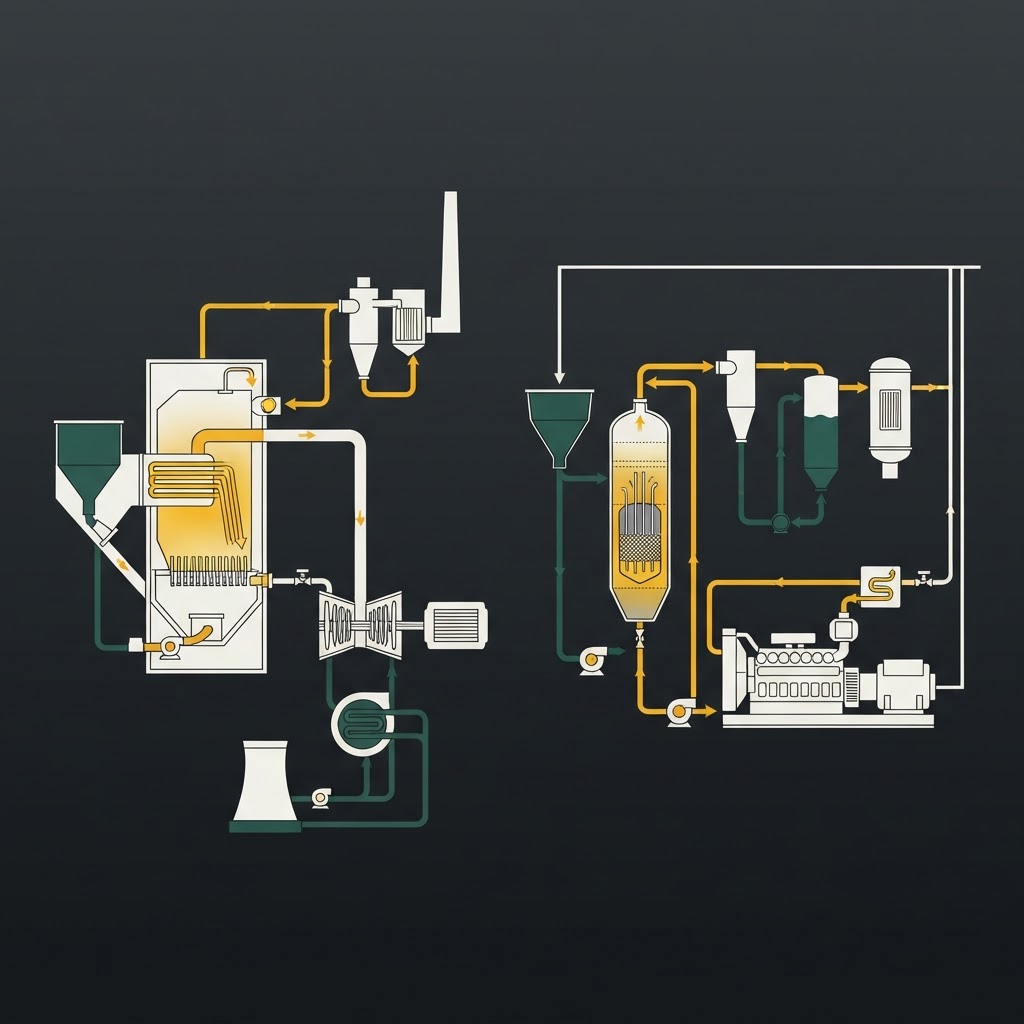
Search for biomass gasification vs combustion and the top results each declare a winner. One modelling paper finds combustion roughly 40% more efficient. A life cycle study finds gasification cleaner. An exergy analysis finds gasification 15 to 20 points ahead. All three are correct, because they measure different things.
This article puts the evidence side by side and turns it into a decision rule. The short version: combustion wins when you sell heat, gasification wins when you sell a molecule, and for electricity the fuel decides.
The difference in one sentence
Combustion burns biomass completely and moves the heat into steam, hot water or hot air. Gasification converts solid biomass into a combustible gas by reacting it with a limited supply of air, oxygen or steam at 700 to 900 degrees C, producing a gas made mainly of carbon monoxide, carbon dioxide, hydrogen and methane (Briones-Hidrovo et al., J. Clean. Prod.).
Everything else follows from that. A boiler cleans a large, hot flue gas after the energy is released. A gasifier produces a fuel that must be cleaned before it is burned in an engine or turbine. If you want the reactor-level picture first, read how biomass gasification works or start with what biomass gasification is.
Efficiency: which number are you comparing?
Most arguments about efficiency are two people quoting different ratios.
Gasifier efficiency usually means how much of the fuel energy ends up in hot gas. The literature puts that at 85% to 90%, which is why gasification looks strong on paper. Boiler efficiency usually means how much heat reaches the working medium: from 65% at the low end to well above 90% for well designed systems. Convert that heat into power through a steam turbine and overall system efficiency is about 25% (Coyote Springs Biomass Power Feasibility Study).
The same feasibility study names the catch for power gasifiers: the producer gas must be filtered, cooled and conditioned before it enters an engine, and that process "gives back much of the potential efficiency advantage over steam generation systems."
The paper that leads the search results shows the effect in numbers. Modelling combined heat and power from residual wood with a gas turbine, it found:
| Route | Electrical | Thermal | System |
|---|---|---|---|
| Wood combustion | 12.32% | 50.33% | 62.65% |
| Wood gasification | 7.42% | 31.48% | 38.89% |
The authors also note that biomass CHP electrical efficiency averages below 20% (Carotenuto et al., IJHT).
Read the layout before the verdict. Both cases drive the same style of externally fired gas turbine, and gasification loses partly because its exhaust has a lower mass flow, so the turbine is smaller. That is a property of the configuration chosen, not a law of the technology. It is still a fair warning: bolt a gasifier onto equipment designed around combustion and it will underperform.
The Portuguese life cycle study reaches the same direction by another route. On eucalypt forest residues in fluidised bed units, combustion delivered a higher energy return on energy invested than gasification.
Where gasification pulls clearly ahead: molecules
The picture flips when the product is a fuel or chemical rather than heat or power. Burning biomass converts high-quality chemical energy into heat, which destroys exergy. In an exergy analysis of Power and Biomass to X processes, gasification-based routes came out around 15 to 20 percentage points more efficient for every product studied. In the detailed methanol model, efficiency was 58% via gasification against 42% via combustion, at an estimated 0.71 EUR per kg against 1.07 EUR per kg (Mucci et al., PMC).
If the plan involves hydrogen, methanol or synthetic fuels, combustion is not a real competitor.
Emissions: NOx is the clear gap, CO2 is not
In the IIETA model, CO2 per kWh of electricity was almost identical: 2.69 kg for combustion against 2.80 kg for gasification. NOx was significantly lower for gasification, which the authors attribute to the lower operating temperature and oxygen deficit inside the gasifier.
Combustion has its own NOx lever, though. Grate boilers run hotter and emit more uncontrolled CO and NOx; fluidised bed boilers run cooler and emit less NOx, at the price of higher capital cost and higher auxiliary power use. Before crediting gasification with a NOx advantage, check which kind of boiler it is being compared against.
Over a full life cycle, gasification performed better than combustion in 5 of 8 impact categories in the Portuguese study. Raising the gasifier efficiency from 53% to 57% improved its environmental performance by 2% to 8%. The authors also found that forest management, not the conversion plant, was the main hotspot for fine particulate matter formation. For many categories the choice of reactor matters less than where the wood comes from.
Feedstock: where each route breaks
This is where the comparison is actually decided on real sites.
Combustion struggles with fuels that have a low ash melting point. Melted ash fouls boiler tube surfaces, which makes certain agricultural residues problematic. Gasification runs cooler and largely avoids that failure, which is why it is the natural route for many agricultural residues.
Gasification struggles with wet fuel and dirty gas. Wood is easy to gasify but the gas is hard to clean for power generation; tars often force the gas to be cooled, losing sensible heat. In some cases the wood must be dried externally or the gas will not sustain combustion, and the dryer adds complexity and capital cost.
That is the point where we part company with most comparison pages. At Energaia we treat thermal pre-treatment as non-negotiable in gasification: reducing moisture, raising energy density and homogenising the feedstock are what let a gasifier reach the efficiency quoted in the literature at all (Energaia on thermal pre-treatment). Drying is not free of side effects either, which is why we built a MATLAB-based simulation suite that models volatile organic compound emissions in biomass-to-energy before any hardware is ordered (Energaia).
Which reactor survives a given fuel is its own question; see which gasifier types tolerate which fuels.
Cost and maturity
Direct combustion on a grate is proven, rugged, efficient and reliable, with relatively low capital and operating costs and a wide choice of vendors. Gasification, in the words of the same study, "does not have the variety of vendors and level of guarantees that are available from boiler vendors."
The study also priced a 5 MW modular gasification plant in the United States. The budgetary capital cost was $26.5 million, excluding delivery and installation. At 7,500 operating hours a year and $33 per bone dry ton of fuel, total cost came to about $223 per MWh. Fuel accounted for $40 of that, and the lease for $141, because the plant was assumed to be leased over only five years. That headline number says more about financing than about gasification.
Scale and fuel price move the result further than the choice of technology. A system analysis of wood-fired combustion and gasification across 0.1 to 300 MWth found scale effects "very significant" for both energy and economic performance. Under Dutch conditions, the systems were not profitable on purchased residual wood, while waste wood at zero cost at the plant gate made profitable operation possible. Among the options studied, biomass integrated gasification combined cycle plants were favourable in both economic and energy terms (Faaij et al., Biomass and Bioenergy).
For capex bands, operating hours and levelised cost in detail, see the full cost stack.
Germany and Nigeria get different answers
The same technology comparison resolves differently in our two core markets.
Where heat can be sold, combustion has the structural edge. In the IIETA model, over half the fuel energy leaves combustion as useful heat. A German municipality or industrial site with a district heating network or a process heat customer can monetise that, and a proven grate boiler with a long vendor list is hard to beat.
Where the product is power and there is no heat customer, the balance shifts. The Coyote Springs study assumed electricity only precisely because no heat customer existed on site, the normal situation for off-grid industrial power in Nigeria. A gasifier with engine generators also solves a practical problem a steam cycle does not: a 5 MW system needs less than 1 gallon of water per minute, mainly for engine cooling. In a remote location, that alone can decide the route.
How to decide: three questions
- What will you sell: heat, electricity or a molecule? Mostly heat favours combustion. Hydrogen, methanol or synthetic fuel favours gasification by a wide margin. Electricity alone is the contested case.
- Can you sell the heat, and at what scale? A reliable heat offtake at medium or large scale makes combustion CHP the default. Small, power-only, water-constrained sites are where gasification earns its complexity.
- What does your fuel do at temperature, and who will guarantee it? Test moisture, ash content and ash melting behaviour on your actual feedstock, then ask each vendor for guarantees on that fuel, not on clean wood chips.
Answer those three and the literature stops contradicting itself. Most failed gasification projects did not pick the wrong technology; they picked it for a fuel and a market it was never going to suit.
FAQ
Does biomass gasification produce less NOx than combustion? In modelled comparisons, yes. The lower temperature and oxygen deficit in a gasifier suppress NOx formation while CO2 per kWh stays about the same. The gap is smallest against fluidised bed boilers, which also run cooler than grate boilers.
What is the difference between a heat gasifier and a power gasifier? A heat gasifier burns the producer gas directly in an external burner, so it needs little or no gas cleaning and is simpler and cheaper. A power gasifier must filter, cool and condition the gas before it enters an engine, which adds cost and gives back part of the efficiency advantage.
Why do gasifiers need drier fuel than boilers? If the fuel is too wet, the producer gas may not sustain combustion, and output quality becomes unstable. Thermal pre-treatment lowers moisture, raises energy density and evens out feedstock variation, which is why it belongs in the design from day one rather than as a later fix.
Which route has more vendors and performance guarantees? Direct combustion. Grate boilers are a mature product sold by many suppliers with standard guarantees. Gasification has fewer vendors and weaker guarantees, so buyers should insist on performance data from continuous operation on a comparable fuel.