
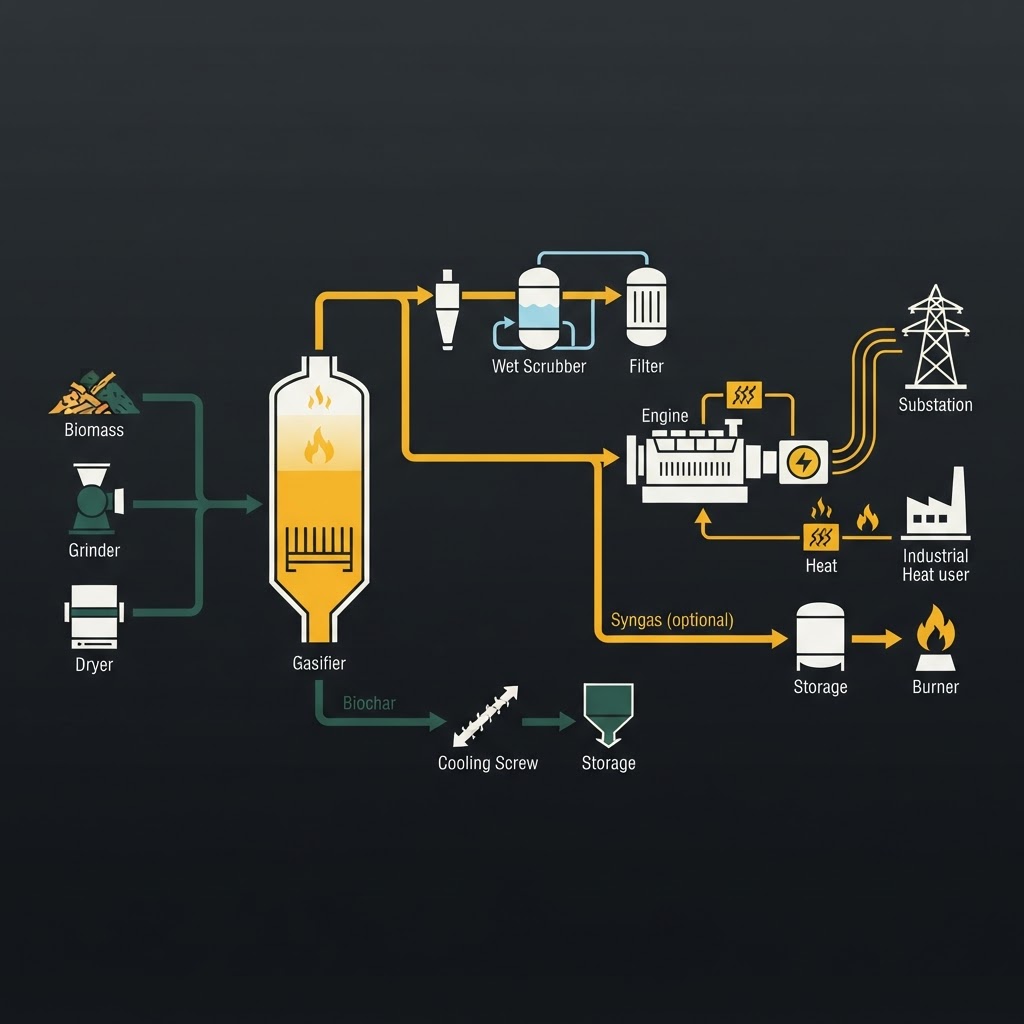
What is biomass gasification? It is a thermochemical process that converts organic material such as wood chips, crop residues or dried sewage sludge into a combustible gas, called syngas or producer gas, by heating it above 700°C with a controlled, limited supply of oxygen or steam, so the material breaks down without fully burning (Wikipedia). The gas carries most of the feedstock's energy and can then be burned in an engine, fed to a turbine, or upgraded into fuels and hydrogen.
That is the one-line answer. The more useful answer, for anyone deciding whether gasification belongs in a municipal sludge strategy in Saxony or an off-grid power plan in Nigeria, is what goes in, what comes out, what the realistic numbers are, and where the process fails. That is what this guide covers.
Biomass gasification in one paragraph
Gasification is partial oxidation. The reactor admits only enough air, oxygen or steam to burn a fraction of the feedstock, and that fraction supplies the heat that breaks the rest down into gas. The World Bioenergy Association puts the operating window at 700 to 1600°C and notes that gasifiers are built at every scale from a few kilowatts to a couple of hundred megawatts (WBA factsheet). A complete plant has four steps: pre-treatment of the feedstock, gasification itself, gas cleaning, and use of the gas in a burner, engine or turbine.
Inside the reactor the feedstock dries, decomposes thermally into char and volatiles, partly oxidises, and is then reduced into carbon monoxide, hydrogen and methane. We cover that sequence zone by zone, with temperatures, in how biomass gasification works stage by stage. Here the focus is on what the process is for.
It is also not new. Gasification was developed in the 1800s to make town gas for lighting and cooking, wood gas ran mine and irrigation pumps before 1900, and small charcoal gasifiers powered vehicles during the fuel shortages of the Second World War.
What goes in: feedstocks
In principle almost any organic material can be gasified. Typical feedstock is cellulosic biomass: wood chips, pellets, wood powder, straw and husks. Beyond clean wood, operators run gasifiers on waste wood, municipal solid waste, refuse-derived fuel, agricultural and industrial wastes, sewage sludge, switchgrass, corn stover and other crop residues.
Each of those behaves differently. Size, shape, bulk density, moisture, energy content, chemical composition and ash melting behaviour all vary by feedstock and change how a gasifier has to be designed and run. That is why "can we gasify this?" is almost always answered with "yes", while "can we gasify this reliably at our site?" requires an engineering study.
For our two core markets the feedstock question looks different:
- Germany and DACH: municipal sewage sludge is the obvious candidate, because disposal is a cost and a regulatory obligation. We explain that route in turning sewage sludge into energy.
- Nigeria and emerging markets: agricultural residues such as husks and stalks are abundant and usually have no local conversion capacity, which makes them a feedstock for dispatchable on-site power.
What comes out: syngas, power, heat and biochar
Syngas and what it is made of
The main product is a gas of carbon monoxide and hydrogen plus carbon dioxide, methane and other light hydrocarbons, carrying contaminants such as tar, char and ash. Its exact makeup depends on feedstock, temperature and the gasifying medium.
The medium matters most. Air-blown gasification yields gas that is about 50% nitrogen by volume, with a low heating value of 4 to 7 MJ/Nm³, against roughly 40 MJ/Nm³ for natural gas. Using oxygen and steam instead removes the nitrogen dilution and raises the heating value to 8 to 12 MJ/Nm³. Strictly, the air-blown product is "producer gas" and the oxygen or steam-blown product is "syngas", though most people use the terms interchangeably.
Electricity and heat
The most common use is combined heat and power. Syngas can supply high temperature heat for cement kilns and brick and ceramic firing, mechanical energy, and electricity through gas engines. The gas suits small-scale cogeneration in particular, and small gasifiers already supply rural electricity in India, where Husk Power Systems has connected 200,000 people in Bihar.
A low heating value sounds like a handicap for engines, but it is less of one than it looks. The International Flame Research Foundation notes that an engine running on producer gas needs a fuel-to-air ratio of about 1:1, compared with 1:9 for natural gas, so the relative power output is far more comparable than the raw heating values suggest (IFRF).
Fuels, hydrogen and chemicals
Clean syngas is a building block. It can run gas turbines or even fuel cells, or be converted into dimethyl ether, methane via the Sabatier reaction, or diesel-like synthetic fuel via Fischer-Tropsch synthesis. Upgraded to near-pure methane, it can be injected into gas grids.
For hydrogen, the US Department of Energy describes biomass gasification as a mature pathway: the carbon monoxide reacts with water in the water-gas shift reaction to form more hydrogen, which is then separated with adsorbers or membranes (DOE). For operators whose feedstock is sludge, our sister company Zero-X compares the routes in hydrogen from sewage sludge.
Biochar and carbon removal
The fourth output is the one most definitional pages leave out. Gasification leaves a carbon-rich solid residue, and when it is captured as biochar it becomes a product in its own right. Energaia's published five-step model runs exactly that way: collect local biomass or sludge, gasify it at high temperature to clean syngas, convert the gas into dispatchable electricity and heat, capture biochar plus verified CO2 offsets, and run the whole system on-site (Energaia). The biochar side turns a power project into a carbon removal project too, which we unpack in how biochar carbon credits work.
How it differs from burning biomass
Biomass can release its energy in three ways: direct combustion, fermentation or digestion, and gasification. Gasification differs from the first two in ways that matter commercially.
Against combustion, the US National Energy Technology Laboratory points out that syngas is much easier and cheaper to clean than the exhaust gases of combustion, which gives gasification better environmental performance and a cheaper route to capturing carbon dioxide (NETL). Combustion is limited to power through a steam cycle, while syngas can be processed into marketable products. The WBA adds that electrical efficiency is higher than with combustion-based technology. The full trade-off, including where combustion still wins, is in biomass gasification compared with combustion.
Against fermentation, gasification is much faster, with conversion measured in minutes, and it can extract the energy held in lignin, the hard structural part of plant material that fermentation cannot convert. That makes it a treatment option for materials that cannot be fermented at all.
The numbers that frame expectations
A few figures are worth knowing before reading any vendor proposal:
| Parameter | Typical value |
|---|---|
| Operating temperature | 700 to 1600°C |
| Plant scale | a few kW to a couple of hundred MW |
| Feedstock energy converted into gas energy | 70 to 80% |
| Cold gas efficiency in some small units | 40 to 50% |
| Heating value, air-blown | 4 to 7 MJ/Nm³ |
| Heating value, oxygen or steam-blown | 8 to 12 MJ/Nm³ |
| Operating pressure | atmospheric up to 2.5 MPa |
All values from the WBA factsheet. Two nuances matter. First, that 70 to 80% figure describes the energy moved into the gas, not the electricity delivered at the meter, which is lower after engine losses. Second, oxygen-blown operation produces better gas but making oxygen is energy intensive, so it cuts overall efficiency and raises operating cost. That is why it is usually reserved for large installations. For what those choices mean in money, see what a biomass gasification project costs.
Where biomass gasification struggles
This is the section most introductions skip, and it is the one that decides whether a plant runs.
Tar. Biomass does not gasify as easily as coal. It produces hydrocarbon compounds in the gas, especially when little oxygen is used, and these usually need an extra catalytic step downstream to reform them into clean syngas. Tar that survives the gas cleaning train can damage a gas engine, which is why gas cleaning is a core part of the plant rather than an accessory.
Moisture and inconsistent feedstock. Wet, uneven feedstock starves the reactor of heat and makes gas quality swing. Energaia's engineering position is that thermal pre-treatment is non-negotiable in gasification and pyrolysis: it reduces moisture, raises energy density and homogenises the feedstock so the reactor sees a consistent input (Energaia). For sludge in particular, drying is not optional, and it brings its own problem.
Emissions from pre-treatment. Drying sludge and other wet biomass releases volatile organic compounds, a compliance risk that is easy to overlook when attention is on the gasifier itself. Energaia developed a MATLAB-based VOC simulation suite to model these emissions in biomass-to-energy systems before anything is built (Energaia).
Reactor choice. There are three main reactor families, fixed bed, fluidised bed and entrained flow, and each suits different scales and feedstocks. Picking the wrong one for a given residue is a common and expensive mistake. We compare them in the main types of biomass gasifiers.
Is it renewable, and is it a fit for your site?
Burning syngas emits the same carbon dioxide as burning the original fuel. The reason biomass gasification counts as renewable is that growing biomass removes the same amount of CO2 from the atmosphere, so the cycle is close to carbon neutral. The DOE adds that net emissions can be low, especially when coupled with carbon capture, utilisation and storage. Capturing biochar goes a step further, because carbon locked into stable char is carbon that does not return to the atmosphere.
Whether it fits a specific site comes down to four questions:
- Is there a steady, local feedstock supply, and what is its moisture and ash behaviour?
- What is the gas for: heat, power, hydrogen or fuels? That choice sets the gasifying medium, reactor type and cleaning train.
- Can the pre-treatment and its emissions be permitted where the plant will stand?
- Is there value in the biochar and carbon credits, not just the energy?
Energaia answers those questions digitally first, modelling feedstock, pre-treatment and emissions before steel is ordered, then moves into system development and carbon credit management. If you are weighing gasification for sludge, residues or off-grid power, that simulation-first feasibility read is the right place to start.
FAQ
Is biomass gasification the same as pyrolysis?
No. Pyrolysis is thermal decomposition without oxygen, and it happens as one stage inside a gasifier. Gasification adds a controlled amount of oxygen and/or steam so the char and volatiles are converted further into a combustible gas.
Is biomass gasification a new technology?
No. It dates to the 1800s, when it produced town gas for lighting and cooking. What is newer is gasifier designs producing practically tar-free gas, which had reached European and American markets by the mid 2010s.
What is the difference between producer gas and syngas?
Producer gas comes from air-blown gasification and is diluted with roughly 50% nitrogen, giving 4 to 7 MJ/Nm³. Syngas usually means the nitrogen-free gas from oxygen or steam gasification, mainly carbon monoxide and hydrogen, at 8 to 12 MJ/Nm³.
Can an engine run on producer gas as well as on natural gas?
Closer than the heating values suggest. Producer gas needs a fuel-to-air ratio of about 1:1 against 1:9 for natural gas, so an engine's power output on producer gas is far more comparable than its lower heating value implies.