
Every guide to waste to energy for emerging markets ends in the same place. It lists the technologies, warns you that projects fail, and tells you to commission a feasibility study. All of that is true and none of it is a decision. This article makes the decision explicit: which conversion route fits the feedstock you actually have, at the scale you actually have, and what has to be true financially before the project is worth developing at all.
The feedstock case is not in dispute. A review of waste management across Sub-Saharan Africa and South Asia found about three quarters of waste openly dumped, an organic fraction averaging 48.70 per cent in Sub-Saharan Africa and 51.16 per cent in South Asia, and a World Bank projection that total waste generation will triple in Sub-Saharan Africa and double in South Asia by 2050. That is an energy resource sitting in the open, growing every year, with a disposal cost attached to it.
The failure case is not in dispute either. The GIZ guide for decision makers in developing and emerging countries is blunt about why: a simple technology transfer of a European plant is often not successful, because the financial requirements, input material composition and local capacities are all different, and income from energy sales cannot be expected to cover capital and operating costs at market prices. Both things are true at once. The work is in the gap between them.
Start with the feedstock, not the technology
The most common mistake in project development is choosing a technology first and then hunting for waste to feed it. The ECN toolkit for development practitioners puts the logic the right way round: the key driver for selecting a conversion process is normally the type of feedstock available, with scale and technology maturity as secondary filters.
A techno-economic study of small-scale agricultural pathways in Nigeria compared three routes on a single functional unit of one tonne of waste processed, which is the only fair way to compare them. Gasification coupled to an internal combustion engine delivered the highest net electricity yield at 574.2 kWh per tonne and the lowest levelized cost at 0.138 USD per kWh; direct combustion with an Organic Rankine Cycle produced 311.4 kWh per tonne but achieved the highest overall energy utilization when useful heat was recovered in combined heat and power mode; anaerobic digestion yielded 169.2 kWh per tonne but showed strong compatibility with wet wastes. Capacity factor and capital cost were the dominant drivers of economic viability, while feedstock moisture and methane fraction drove energy output.
Those numbers resolve into three rules.
Wet, mixed and municipal: anaerobic digestion
If the stream is wet, if it arrives mixed, and if nobody separates it at source, thermal routes will punish you for the moisture and the contamination. Digestion tolerates wet feedstock by design. It does not tolerate contamination: operating a digester on heterogeneous municipal solid waste is a serious challenge because organic waste is routinely mixed with plastics and metals, which is why there are very few successful examples of biogas from municipal waste in developing countries, while small-scale digesters running on agricultural residues and animal manure have a long and successful track record.
Dry, homogeneous and agricultural: gasification
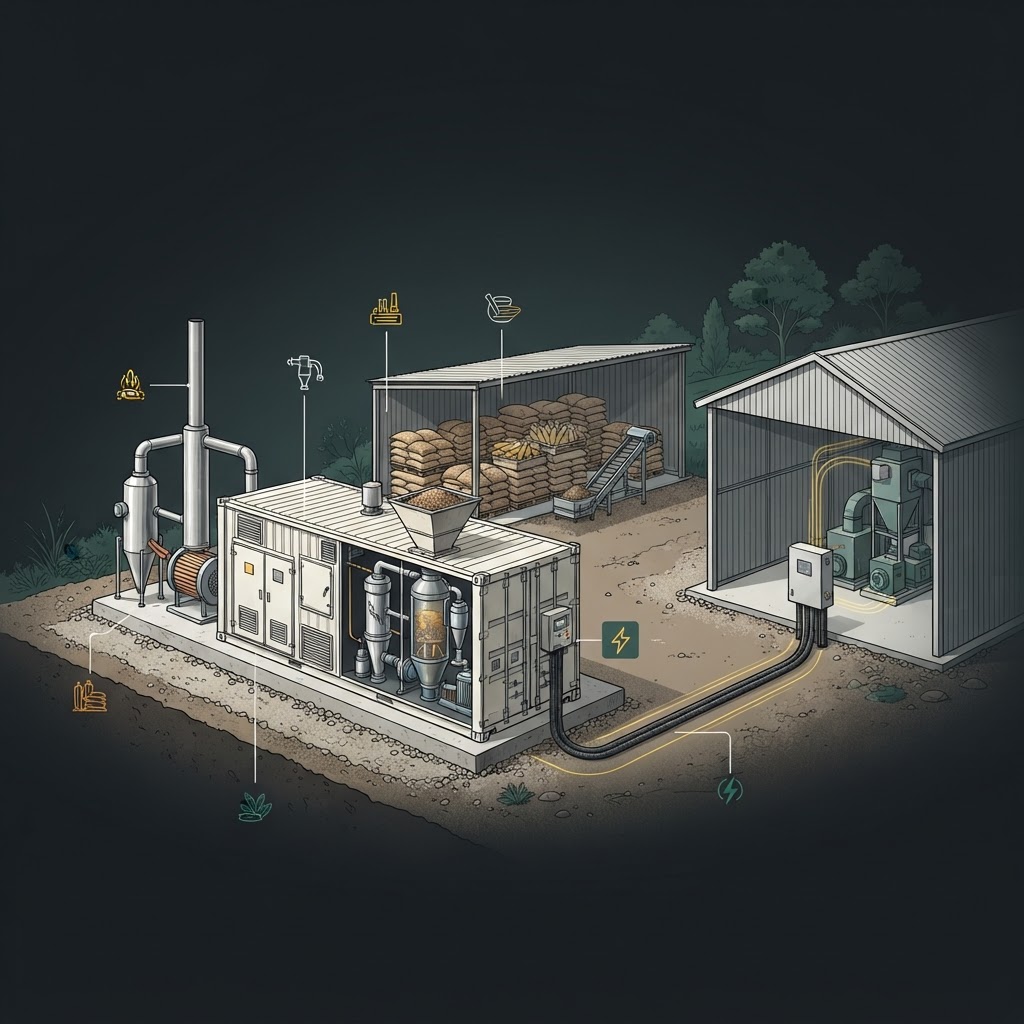
Rice husk, palm kernel shell, sawdust, groundnut shell, coconut waste. A single processing site that generates one residue in predictable volume is the strongest waste to energy case there is, and it is the case the municipal guides ignore. Gasification converts it at high temperature into clean syngas, and the electricity yield above is roughly three and a half times what digestion returns per tonne. This is deployed technology, not modelled technology: small-scale gasifiers are running in rural electrification projects including a UNIDO and Cameroonian Rural Electrification Agency installation under a GEF-funded biomass programme, a conservation microgrid in Namibia and reforestation-waste units in Indonesia. If crop residue is your stream, the detail lives in agricultural waste gasification.
Sewage sludge: its own category
Sludge is neither of the above. It is wet, it is regulated, it carries nutrients worth recovering, and its drying stage releases volatile organic compounds that most project plans never account for. It needs a treatment train designed for it rather than a gasifier borrowed from a biomass project, which is why sewage sludge gasification is a separate discipline.
The economic floor: how small is too small
Ask what a plant costs and you get a number with no denominator. The useful benchmark is capital cost per yearly tonne of capacity, and ISWA collected it from its members: roughly 300 to 500 USD per yearly tonne in low income countries, 400 to 600 USD in middle income countries, against 600 to 900 USD or higher in Europe and North America, with the gap driven by construction, land and labour rather than by equipment, which costs roughly the same everywhere. For a power-producing mass-burn line the minimum capacity should be approximately 10 tonnes of waste throughput per hour before investment in the turbine and generator is financially viable. Chinese experience puts a similar floor from the other direction: a plant handling under 300 tonnes a day struggles to show reasonable economic benefit.
Ten tonnes an hour is 240 tonnes a day. Most emerging-market projects do not have that, and the honest reading of the guideline literature is that those projects should not proceed. That reading is wrong, because it assumes incineration is the only route. Below the floor you do not build a smaller incinerator. You change route.
Two projects show what that looks like. A decentralized digester study in Chittagong, Bangladesh, modelled 536 cubic metres of biogas a day feeding a 50 kW gas engine and supplying 44 households, on an initial cost of USD 98,640, returning a 38.4 per cent pre-tax internal rate of return with a two-year simple payback. At the other end, a hybrid gasification and solar plant modelled for Lobito, Angola, produced 62 GWh a year with the gasifier contributing 42 GWh, at a levelized cost of 0.1792 USD per kWh and a payback of 11 years once the uneconomic hydrogen stage was excluded, while avoiding 42,000 tonnes of CO2 a year. The small decentralized project pays back in two years. The utility-scale hybrid takes eleven. Scale is not automatically your friend here. For the parallel comparison on capital, see what a waste to energy plant costs.
The four failure modes
Projects in this sector rarely fail on the conversion step. They fail on four things, all of which are knowable in advance.
Feedstock aggregation. The ECN toolkit describes a five-stage value chain and identifies the first stage, establishing the mechanism that brings enough biomass waste to a central point, as usually the most challenging. Conversion is engineering. Aggregation is contracts, logistics and local politics, and it is where the schedule goes. The compensating upside is that certain waste biomass can sometimes be procured at negative cost, because someone is currently paying to dispose of it.
Foreign currency and spares. Only a limited number of manufacturers of waste to energy technology exist globally, so access to foreign currency is a necessity not only for the capital purchase but for spare parts and skilled maintenance throughout the plant's operating life. A project financed in local currency against equipment and service costs denominated in euros or dollars carries an exposure that nobody wrote down.
Operating cost, not capital cost. UNEP's decision-making guidance notes that in developing countries operational costs can account for at least 50 per cent of total plant cost, and that low-cost plants now appearing in low income countries omit backup pumps, control systems, a second furnace and appropriate flue gas filter systems, which raises breakdown risk and shortens operable life. The cheap plant is not cheap. It is expensive later, on someone else's balance sheet.
A gate fee that pushes waste back to the dump. If the tipping fee needed to make the plant work sits far above what the local landfill charges, waste generators will find another way to dispose of it, usually illegally, and the feedstock assumption collapses. Where an unreliable grid is the real driver, the honest comparison is against what power costs today, which is the ground covered in off-grid power solutions in Nigeria and priced in the cost of electricity per kWh in Nigeria.
The third revenue line
If energy sales cannot carry the plant, something else has to. Climate finance is the obvious candidate and the numbers are stranger than most developers expect. Human-driven methane is responsible for nearly 45 per cent of current net global warming, with waste contributing around 20 per cent of it, yet 94 per cent of methane abatement finance in the waste sector in 2021/22, some USD 4.08 billion, went to waste-to-energy incinerators, and only 1 per cent, about USD 20 million, went to organic waste management.
Read that as market structure rather than as grievance. The organic side of the waste sector is chronically underfinanced, which means less competition for the capital that does flow there, provided a project can present measurable abatement rather than a narrative.
Gasification and pyrolysis have an advantage here that combustion routes do not. They leave a stable solid carbon fraction, biochar, whose mass can be measured and whose durability is defensible to an auditor. That converts a soft avoided-emissions story into a removal with a unit and a certificate behind it. The mechanics of that market, and where its credibility problems sit, are covered in biochar carbon credits. Whether the stack of energy, disposal and carbon revenue closes the business case is the question behind whether waste to energy is profitable.
De-risk before you order steel
Every failure mode above is cheaper to find in a model than on a site. That is the whole of the argument for simulation-first engineering, and it is how Energaia works: a MATLAB-based simulation suite for volatile organic compound emissions in biomass-to-energy processes, built because VOC release during sludge drying and thermal pre-treatment is a compliance risk that project plans routinely miss. The same engineering position holds that thermal pre-treatment is non-negotiable in gasification and pyrolysis, for moisture reduction, energy density and feedstock homogenization. Pre-treatment is what turns a variable local waste stream into something a converter can run on continuously, which is the difference between a design capacity and an actual capacity factor.
The full path is a five-step process: collect local biomass and sludge, gasify it at high temperature into clean syngas, convert that into dispatchable electricity and heat, capture biochar and verified CO2 offsets, and run the whole thing on site. Note where it ends. Not at the generator, at the offsets, because in this market the third revenue line is often what makes the first two work. Energaia works across all three stages from its base in Zittau, Saxony: consulting and feasibility, system development, and carbon credit management including certification and MRV.
From waste stream to bankable project
- Characterise the feedstock before anything else. Tonnes per day, moisture, calorific value, seasonality, and who currently owns it. Every later number depends on these five.
- Test against the economic floor. If you are under roughly 10 tonnes an hour, incineration is out. That is a route change, not a verdict on the project.
- Pick the route the feedstock dictates. Dry and homogeneous goes to gasification, wet and mixed to digestion, and heat with a buyer next door to combined heat and power.
- Model before you build. Emissions, pre-treatment, mass and energy balance. A modelled failure costs a few weeks. A built one costs the project.
- Stack the revenue. Energy sold or displaced, disposal cost avoided, carbon removed and certified. A project resting on energy sales alone is resting on the one leg the literature says will not hold.
FAQ
Which waste to energy technology is best for developing countries? There is no single answer, and a vendor who gives you one is selling. The route follows the feedstock. Dry homogeneous residues favour gasification, which returned the highest yield and lowest levelized cost in the Nigerian comparison. Wet and manure streams favour anaerobic digestion. Where a neighbouring process can take the heat, combustion with an Organic Rankine Cycle achieves the best total energy utilization even though its electrical yield is lower.
How much does a waste to energy plant cost in a low income country? Ask in USD per yearly tonne of capacity rather than in total. ISWA's member data gives roughly 300 to 500 USD per yearly tonne in low income countries and 400 to 600 in middle income countries, against 600 to 900 or more in Europe and North America. Equipment costs roughly the same everywhere, so the difference is construction, land, labour and how stringent the local emission standards are.
Can a small waste to energy project be profitable? Yes, if it does not try to be a small incinerator. The Chittagong digester study modelled a two-year simple payback and a 38.4 per cent pre-tax IRR on a plant supplying 44 households, while a mass-burn line needs roughly 240 tonnes a day before its turbine investment makes sense at all. Small works when the route is chosen for small.
Do carbon credits make waste to energy bankable in emerging markets? They are a third revenue line, not a rescue. Waste-sector climate finance is heavily concentrated in incineration, which leaves the organic side underfunded but also less contested. A biochar-producing route gives you a removal with measurable mass rather than an avoided-emissions claim, which is a materially easier thing to certify and sell.
What is the single biggest cause of project failure? Feedstock. Not the gasifier, not the engine, not the permit. Projects assume a tonnage and a quality that the collection system never delivers, and every downstream number, capacity factor, revenue and payback, was calculated on that assumption. Verify the stream with measurements before you specify the plant.