
Search for a diesel generator alternative for your business in Nigeria and every page on the first screen will tell you the same thing: buy solar. That is not a conspiracy. It is who writes the pages. Solar installers publish the comparisons, so the comparison always has two columns and the second one is always theirs.
Solar is a genuinely good answer for a large share of Nigerian sites. It is not the only one, and for some load profiles it is not the first one. This article lays out five alternatives that actually exist in the Nigerian market in 2026, what each one costs against the same diesel baseline, and the licensing threshold that decides how much of any of them you may build without going to the regulator.
We are a German waste-to-energy engineering institute. We have no panels to sell you, which is the only reason this list has five entries instead of one.
Start with the load, not the machine
The reason your generator exists is structural, not seasonal. Nigeria's electricity value chain carries an over 80 per cent generation shortage against 12.5 GW of installed capacity, a 5.3 GW transmission ceiling, and average annual generation below 4 GW, working out at roughly 126 kWh per capita per year. Even premium tariff districts do not escape it. The World Bank estimates that the resulting shadow economy of diesel generators costs Nigerian businesses up to $30 billion a year in lost productivity and fuel, and the same reporting notes that Victoria Island, in the regulator's premium Band A category and theoretically entitled to twenty hours of daily supply, still deals with voltage drops and unexpected outages.
What makes that expensive is the fuel price. The National Bureau of Statistics put the national average retail price of automotive gas oil at N3,277.47 per litre in May 2026, up 86.40 per cent year on year and 32.44 per cent in a single month. Set against that, a standalone diesel system needs US$0.54 to US$0.62 per kWh just to break even across the country. We work that arithmetic through a full five-year model in our breakdown of solar vs diesel generator cost in Nigeria.
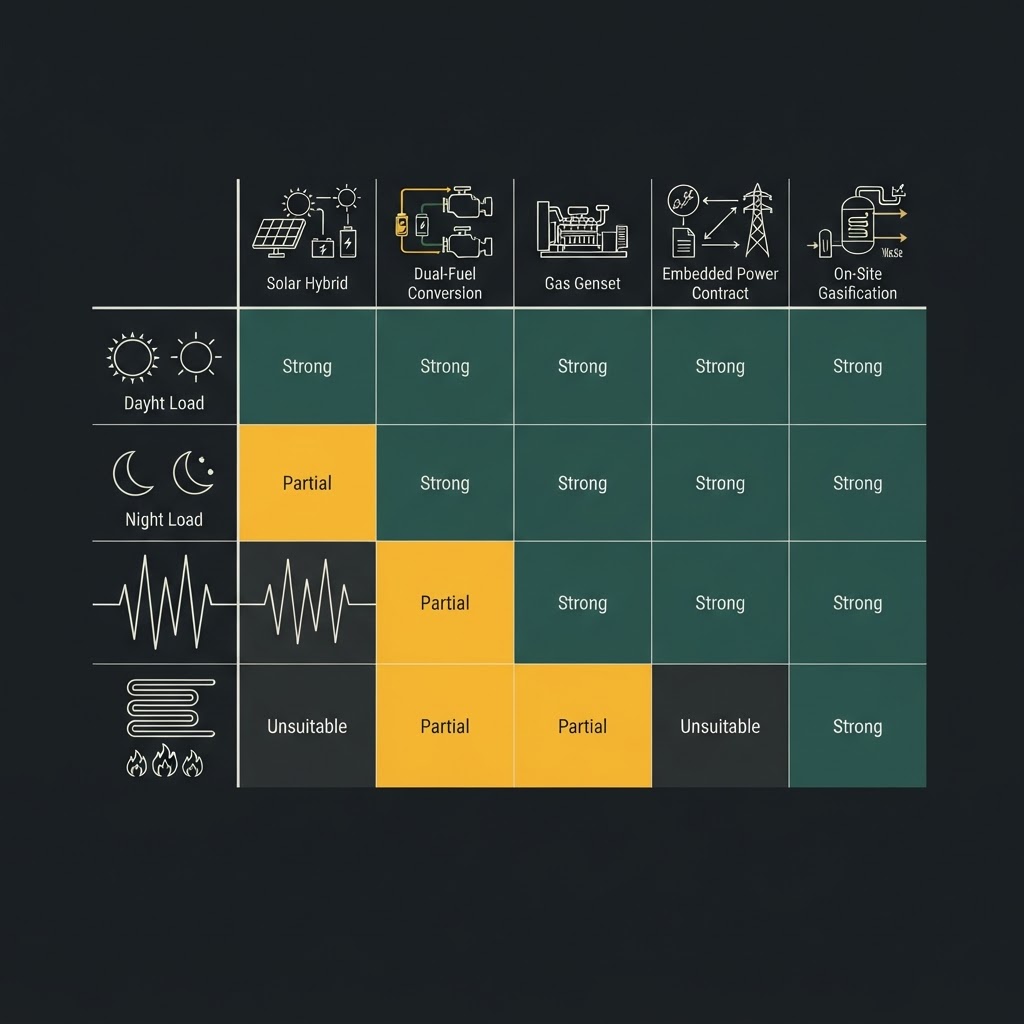
Here is the framing that makes the rest of this article usable. Your site does not have one power problem. It has four, and they price differently:
- Daylight base load. Lights, offices, refrigeration, most production hours. Cheap to displace.
- Night load. The second shift, the cold room, the 24 hour line. Expensive to displace.
- Surge load. Grinding mills, compressors, borehole pumps, large motors on startup.
- Process heat and cooling. Boilers, dryers, chillers. Not an electricity problem at all, but usually on the same fuel bill.
Every alternative below is strong on some of those buckets and weak on others. Choose by bucket, not by brochure.
Alternative 1: solar hybrid, sized to displace most of your litres
This is the SERP's answer and it deserves its place. The best-argued version of it does not tell you to remove the generator. It tells you to aim at 70 to 85 per cent diesel displacement, which drops a hard-worked set from around 3,700 running hours a year to 200 to 400. The generator stops being your power plant and becomes your insurance policy, gets serviced twice a year instead of fifteen times, and lasts accordingly.
The reason the target is 85 per cent and not 100 is that the last slice of load is where the cost curve turns vertical. Full grid defection needs battery capacity in the 200 to 600 kWh range and above, against 100 to 400 kWh for a hybrid that keeps a backup. You buy that capacity to cover conditions that occur a few times a year.
The same source is the clearest on how businesses pay for it, which matters more than the engineering for most SMEs. Four routes exist: cash, naira project finance at 20 to 28 per cent interest over 5 to 7 year tenors with 30 to 40 per cent equity, a lease or OPEX model where the developer owns the system and you pay a monthly fee, and development finance debt for larger projects. Note also that selling surplus back to a DisCo requires a generation licence and a bilateral power purchase agreement taking 12 to 18 months, which is why nearly every commercial and industrial solar project in Nigeria is deliberately sized to consume everything on site.
Best for: daylight base load, sites with roof or ground area, businesses that can convert capex into a monthly fee. Weak on: heavy night load, high surge load, process heat, and sites with no space.
Alternative 2: keep the engine, change the fuel
This is the option the solar pages never mention, and for a business with a serviceable generator and a constrained balance sheet it is often the fastest saving available.
Start with the physics, because vendors blur it. A diesel engine cannot run on 100 per cent CNG: compression ignition needs diesel as the pilot fuel, so a dual-fuel conversion substitutes 30 to 50 per cent of the diesel on a vehicle and 60 to 70 per cent on a generator, because gensets run at a constant speed and calibrate more easily. The same source puts an industrial generator conversion at roughly N1.2m to N3m depending on kVA, with a 6 to 12 month payback, CNG priced at N380 per standard cubic metre, and a federal Pi-CNG programme covering up to 50 per cent of conversion cost for registered commercial operators.
There is a measured Nigerian case rather than a brochure claim. Gentec Energy and EnerGas converted a Caterpillar 3412 at 810 kVA to run on up to 45 per cent pipeline natural gas across facilities in Lagos and Ogun, cutting diesel consumption 45 per cent, saving about 41.4 litres an hour and roughly N26,413 an hour, and removing around 322 tonnes of CO2 a year.
Three honest caveats. Dual-fuel reduces your diesel bill, it does not end it. Access is geographic: no pipeline gas or CNG route near you means no conversion. And it is high-pressure gas work, so it belongs to certified technicians with tested vessels, not to whoever services your set.
Best for: existing sets with years of life left, sites near gas, businesses that need savings this quarter rather than in year three. Weak on: eliminating fuel exposure entirely, and anywhere the gas logistics do not reach.
Alternative 3: a dedicated gas genset instead of a diesel one
If you are replacing rather than retrofitting, the engine can be built for gas from the start. Cummins Power Generation Nigeria did exactly this for Nigerian Bottling Company: nine 1750 kW QSV91 gas gensets plus one 2000 kW unit across Ikeja, Owerri and Port Harcourt, generating 120 million kWh and delivering a 50 per cent saving per kWh against diesel-fired generation, with CNG trucked to Owerri by virtual pipeline achieving 99.46 per cent power availability. The installations are trigeneration, capturing waste heat for steam and cooling, which is the fourth load bucket handled by the same asset.
Engine plants also suit the Nigerian operating environment in ways worth knowing before you specify a turbine: they hold efficiency at partial load, start and ramp within minutes, give unit-level redundancy so one failure costs a fraction of capacity rather than all of it, and tolerate the gas pressure fluctuations that have historically forced turbines offline.
Best for: 24 hour industrial load, sites with steam or chilling demand, operations where downtime cost dominates fuel cost. Weak on: capital efficiency at small scale, and any site without a secure gas supply contract.
Alternative 4: buy the power instead of building the plant
The option nobody lists as an alternative because it is not a purchase of hardware. In defined commercial clusters, you can now connect to a privately built plant and buy electricity under contract.
Elektron Energy is commissioning a 40 MW plant in Victoria Island as a dedicated alternative to diesel generators, licensed by the Lagos State Electricity Regulatory Commission, backed by ARM-Harith, the Nigeria Sovereign Investment Authority, InfraCredit and the Bank of Industry, with businesses in the district able to register interest. Pricing and a commissioning date were not disclosed at the launch event, which is the honest state of the option today: real, funded, and not yet quotable.
The commercial structures matter more than the megawatts. Captive and embedded developers now offer power purchase and energy service agreements and lease-to-own models that cut the upfront cost, with claimed savings of 40 to 60 per cent depending on model, fuel mix and location. Treat that band as the developers' own number, not a measured one, and make any contract quote its tariff in naira per kWh so you can set it beside what you pay now.
Best for: businesses inside a served cluster that want energy as an operating expense with no engineering responsibility. Weak on: everywhere else. This is the most geographically constrained option on the list.
Alternative 5: when your waste is already the fuel
The four options above all buy a fuel: sunlight, gas, or somebody else's electricity. There is a fifth case, and it applies to more Nigerian businesses than most realise. If you are an agro-processor, a sawmill, a rice or cassava mill, a poultry operation, a brewery or a food factory, you are already paying to remove a biomass stream. That stream has an energy content, and it is priced in local currency rather than on a global commodity market.
A 2026 techno-economic assessment of small-scale agricultural waste-to-energy pathways in Nigeria compared the routes and found gasification coupled to an internal combustion engine gave the highest net yield at 574.2 kWh per tonne and the lowest levelised cost at US$0.138 per kWh. Be precise about what that number is: a modelled result from an academic study, not a delivered project price.
The same paper names the condition it depends on, and it is the condition that decides whether a real plant matches the model. Capacity factor is the most influential economic parameter across every pathway, a 20 per cent reduction raises levelised cost by 16 to 20 per cent, and the practical causes are producer gas quality problems, tar and particulate contamination that damage engines and drive downtime.
That is why our engineering position is that thermal pre-treatment is non-negotiable in gasification and pyrolysis. Moisture reduction, energy density and feedstock homogenization decide what the downstream engine sees, and downstream is where your capacity factor lives. Our public five-step process is to collect local biomass or sludge, gasify it into clean syngas, convert that into dispatchable electricity and heat, capture biochar and verified CO2 offsets, and run it all on site. We scope feasibility and policy consulting, system development and carbon credit certification with MRV as one engagement rather than three, and we model the plant before anyone orders steel. The mechanism is set out in full in our guide to how waste to energy works, the feedstock question in agricultural waste gasification, and the wider thesis in waste to energy for emerging markets.
Best for: sites with a continuous, characterised organic waste stream and a 24 hour load, especially where process heat is also needed. Weak on: sites with no feedstock, seasonal feedstock, or no appetite for operating a thermal process.
The regulatory gate: how much you may build before you need a licence
This decides the size of whatever you choose, and it is the same threshold for solar, gas and gasification alike.
Under the Electricity Act 2023, section 63(2) permits you to construct, own or operate generation not exceeding 1 MW in aggregate at a site, and distribution not exceeding 100 kW, without a licence. Section 63(1) makes operating without a required licence punishable by at least ten times the relevant application and licence fees, up to five years imprisonment, or permanent forfeiture of the undertaking. The Act also directs the regulator to promote embedded, hybridised and co-generation and renewable sources including biomass, which is the legal footing under which option five sits.
Above 1 MW for your own consumption you need a captive generation permit, and the fee schedule is modest against the project: N200,000 for 1 to 10 MW, rising to N700,000 above 100 MW. If you intend to supply more than your own premises, you are in mini-grid territory. The Mini-Grid Regulations 2026 allow isolated mini-grids up to 5 MW per site and interconnected mini-grids up to 10 MW, with projects at or below 100 kW requiring simple registration rather than a permit, and defined approval timelines of up to 30 business days.
Read that alongside the export restriction noted earlier and the design rule falls out on its own: size to your own consumption, stay under 1 MW per site if you can, and treat any surplus as an engineering mistake rather than a revenue line.
Five questions that pick your alternative
- What share of your kilowatt-hours are delivered after dark? Under a third, solar hybrid first. Over half, gas or waste-derived power should lead and solar should support.
- What does your surge profile look like? Large motors starting against a battery inverter are the most common cause of a disappointing solar retrofit. Sets and gas engines absorb surge more gracefully.
- Is there pipeline gas, a CNG route, or an embedded network at your address? This is a phone call, not an analysis, and it eliminates or unlocks two of the five options in an afternoon.
- Do you pay to remove an organic waste stream? If yes, get its tonnage and moisture measured before you price anything else. A disposal cost and an energy cost that cancel each other change the whole comparison.
- Can you write the cheque, or does the cost need to stay monthly? This decides between owning and contracting far more often than any technical factor does.
Most sites end up with a combination rather than a winner. The daylight is solarised, the night is carried by gas or by a fuel the site produces, and the old set stays in the yard doing almost nothing. What deserves your engineering attention is not the easy 75 per cent, which any competent installer will handle. It is the residual load, because that is where the naira quietly stays. The same logic runs through our survey of off grid power solutions in Nigeria and our regional breakdown of the cost of electricity per kWh in Nigeria.
FAQ
Can a Nigerian business legally generate its own electricity without a NERC licence?
Yes, up to 1 MW of generation in aggregate at a site and up to 100 kW of distribution, under section 63(2) of the Electricity Act 2023. Above that you need a captive generation permit or a full licence depending on whether the power leaves your premises. Operating without a required licence carries a penalty of at least ten times the relevant fees, up to five years imprisonment, or forfeiture of the undertaking, so the threshold is worth designing around rather than discovering later.
Can a diesel generator be converted to run on gas in Nigeria?
Not to 100 per cent gas. A compression-ignition engine needs diesel as its pilot fuel, so the correct route is a dual-fuel conversion. On a generator, which runs at constant speed and is therefore easier to calibrate, substitution reaches 60 to 70 per cent, against 30 to 50 per cent on a road vehicle. Budget roughly N1.2m to N3m for an industrial unit and expect payback within 6 to 12 months if your set runs daily. Check whether you qualify for the federal conversion subsidy before you pay a naira.
What is the cheapest alternative to a diesel generator for a Nigerian factory?
Cheapest per kilowatt-hour and cheapest to start are two different questions, and factories usually care about both. Over a decade, solar hybrid wins on daytime energy. In the first quarter after signing, a dual-fuel conversion on an existing set usually returns cash faster because the capital outlay is a fraction of a solar installation. For a plant with its own biomass stream and a 24 hour load, on-site gasification can beat both, but only if the feedstock is continuous and characterised.
Do these alternatives work for a small business, or only for large factories?
The economics scale down but the options narrow. Solar hybrid and gas conversion both work at small scale. Dedicated gas gensets, embedded power contracts and gasification generally do not, because each carries fixed engineering and contracting cost that a small load cannot spread. A small business with a modest generator and a daytime load profile should look at a hybrid inverter retrofit first and stop there.
How do I compare quotes from vendors selling different technologies?
Force every quote onto one line: delivered naira per kilowatt-hour over the same number of years, including fuel, servicing, replacement reserve and financing cost. Then ask each vendor which of your four load buckets their number covers and which it does not. Most proposals price the easy daylight kilowatt-hours and stay quiet about the rest, and the difference between two quotes is usually a difference in what they left out.