
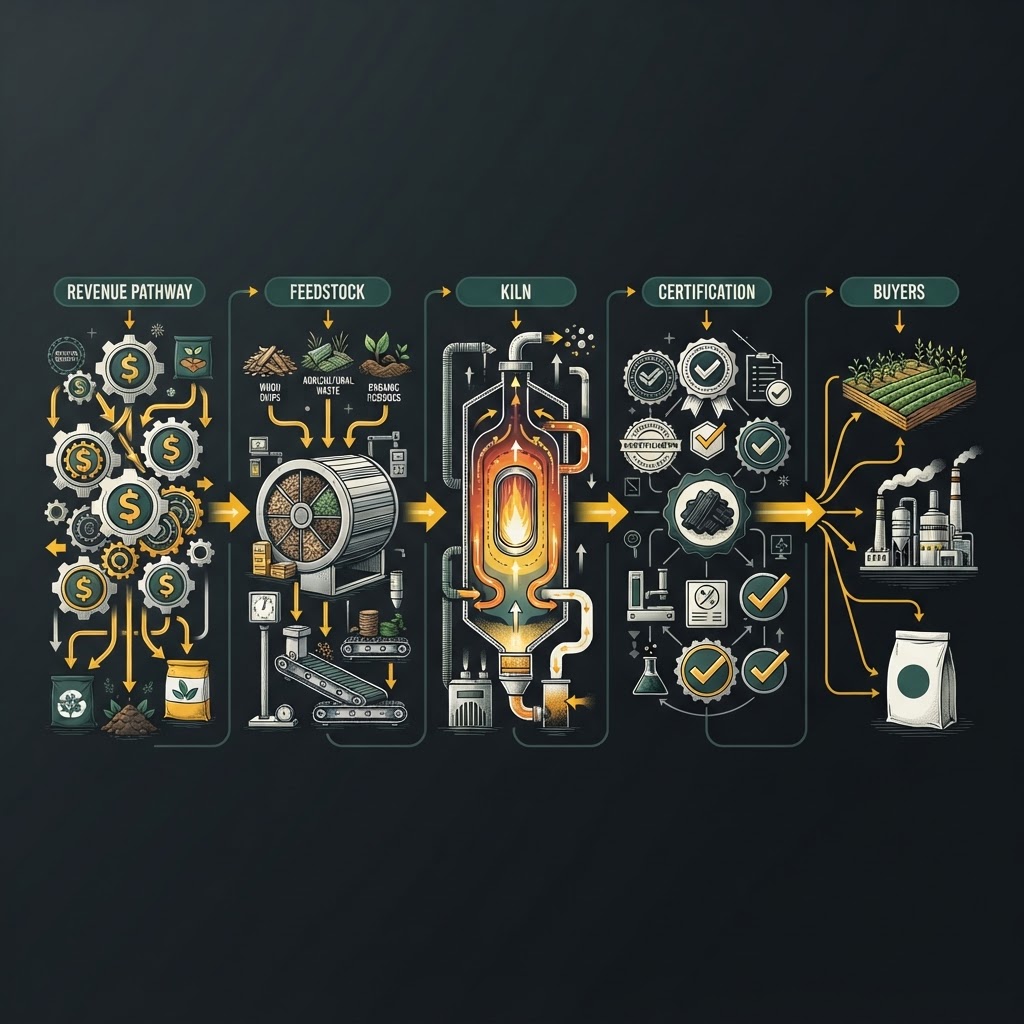
Starting a biochar business looks like a hardware problem. It is not. The first decision is what you will sell: bags of char, certified carbon removal, heat, or all three. That choice fixes the kiln you can use, the feedstock you are allowed to burn and the paperwork you must keep for every batch. Founders who buy the kiln first often discover that the machine they own cannot produce the product their buyers will pay for.
The timing is good. Global biochar production reached 520,810 tonnes in 2025, up from 180,150 tonnes in 2023, according to the International Biochar Initiative's market report. The same survey names the traps: 46% of respondents cite low awareness, 39% insufficient demand for physical biochar and 35% limited access to capital. Growth is real, but a producer without a buyer is just a person with a pile of charcoal.
This guide sequences the decisions in the order that avoids stranded capital. It is written from the carbon credit and process engineering side, which is where we work.
Step 1: Choose your revenue pathway
There are three things a biochar producer can sell. Most viable businesses sell at least two.
Physical biochar
Char sold by the tonne into soil, horticulture, feed or filtration. Published 2026 reference ranges put bulk agricultural biochar at USD 400 to 700 per tonne, premium horticultural grades at USD 800 to 1,500 and activated or specialty char at USD 1,500 to 3,000. Treat those as list prices. Across commercial producers in the IBI survey, implied revenue per tonne was USD 543 in 2025. The gap between the price sheet and the invoice is where naive business plans break.
Carbon removal credits
Here you sell the durable storage of carbon, certified by a standard such as Puro.earth or the EBC C-Sink. Biochar removal credits trade in a USD 100 to 250 per tonne of CO2 range, and long-term offtakes of three to ten years typically sit at the lower end. This is no longer a niche add-on: the share of producers reporting no credit revenue fell from 58% to 35% between the 2023 and 2025 IBI surveys. Before you model this line, read what a biochar carbon credit fetches per tonne and how biochar carbon credits work.
Heat and energy
Pyrolysis gas carries a large share of the feedstock's energy. Pure DC's developer guide notes that in high-cost energy markets such as Europe, heat sales often represent an important factor in a project's economic viability. It also flags the catch: it is very rare to find one buyer willing to pay for all of a project's outputs, and location decides whether anyone nearby needs your heat.
Decision rule: if your business depends on credits, certification requirements now govern every step below. If it depends on soil sales alone, your cost ceiling is set by what local farmers will pay.
Step 2: Secure feedstock before you buy anything
Feedstock is the lifeblood of the business and one of its most volatile costs. The Pure DC guide ranks feedstock purchase and transport among the most significant operating costs and recommends long-term partnerships with forestry, agriculture or waste companies, ideally with the pyrolyser co-located at the source: sawmills, asphalt plants or wastewater treatment facilities.
Three questions to answer in writing:
- Is it allowed? The European Biochar Certificate guidelines only accept biomass on the EBC positive list. Forest wood needs proof of sustainable management through PEFC, FSC or EU-RED. Manure and digestate chars must reach an H/Corg ratio below 0.4. For soil-grade classes, plastic and rubber contamination may not exceed 1% by mass.
- Is it consistent? An EBC batch may not vary its feedstock mix by more than 20%. A supplier who sends straw one month and pallet offcuts the next can break your certification.
- Is it dry? Moisture is the hidden cost. As we have argued before, thermal pre-treatment is non-negotiable in pyrolysis and gasification: drying raises energy density and homogenises the feedstock, which is exactly what a stable, certifiable char needs.
Step 3: Match the kiln to the pathway
Once you know what you sell and what you burn, the hardware choice narrows fast. A published kiln comparison gives a clear ladder:
| Kiln class | Batch or throughput | Capex (EUR) | Certifiable for CDR? |
|---|---|---|---|
| Kontiki cone | 50 to 300 kg per batch | 200 to 800 | With monitoring; challenging |
| TLUD gasifier | 5 to 500 kg per batch | 50 to 10,000 | With monitoring; feasible |
| Batch retort | 200 kg to 5 t per batch | 10,000 to 250,000 | Yes, with EBC certification |
| Industrial continuous feed | 5 to 50 t per day | 500,000 to 5,000,000+ | Yes, Puro.earth and others |
Source: The Gr0ve's kiln design comparison. The same analysis notes an industrial continuous system needs 400 to 2,000 tonnes of dry feedstock a year to run economically, while a Kontiki runs on whatever a farm generates from seasonal pruning.
The practical reading: a cone is a soil business, a retort is the entry ticket to credits, and continuous plants only make sense with a contracted feedstock chain. For a deeper look at the machines themselves, including gasifiers, see this guide to biochar production equipment compared by price tier.
Step 4: Build certification into the design
Certification is not a sticker you apply after launch. EBC rules shape the plant.
What EBC requires of the plant
- Gas combustion. Pyrolysis gases must not be released without passing a dedicated combustion chamber. Open kilns that vent smoke do not qualify.
- Energy efficiency. At least 60% of the energy in the biomass and process inputs must be recovered as char, oil, chemicals, usable heat or electricity. A transitional exemption of up to three years exists, but you must develop a heat use in that time.
- Stable operation. Pyrolysis temperature may not vary by more than 20% within a batch, and a batch lasts at most 365 days.
- Early sampling. Your first registered batch needs representative sampling by an endorsed sampler within two months.
The efficiency rule is why heat matters even to a founder who only cares about credits. If there is no use for your surplus heat, a certified business case gets hard.
The paperwork per batch
Certification schemes expect temperature logs, feedstock provenance, char yield and third party lab analysis. The Gr0ve estimates documentation at 30 to 60 minutes per batch for a well-organised operator, and notes that Puro.earth registration requires EBC or equivalent as a prerequisite. On small batches that overhead, plus verification fees, lands on very few tonnes. This is why certification cost does not scale down gracefully, and why many small producers pool through aggregators instead.
This is also where most credit projects stall in practice. Measurement, reporting and verification (MRV) has to be designed before the first batch, not reconstructed afterwards. Buyers are scrutinising exactly this, as we explain in whether biochar carbon credits are reliable.
Step 5: Sign buyers before you scale
Offtake is what turns production into a business, and for credits it is also what makes a project financeable. Pure DC lists what a bankable offtake contract needs: fixed delivery volumes, schedules and payment timelines, no vague "agree to agree" clauses, compliance with the standard you certify under, and audit rights for the buyer. Long-term heat contracts can support project financing in the same way.
A sensible sequence is a pilot with a documented mass balance, then a small signed offtake, then scale. Our guide on how to sell biochar carbon credits covers the routes from direct buyers to marketplaces.
Three starting models, from farm to plant
| Model | Kiln | Sells | Watch out for |
|---|---|---|---|
| Farm or community producer | Kontiki or TLUD | Local soil char | Demand and price, heavy labour |
| Certified small producer | Batch retort | Char plus removal credits | Documentation, 60% energy rule |
| Waste-fed energy plant | Continuous pyrolysis or gasification | Power, heat, char and credits | Feedstock contracts, capital |
The third model is the one Energaia engineers. Local biomass or sewage sludge is gasified to clean syngas, converted into dispatchable electricity and heat, and biochar with verified CO2 offsets is captured as a co-product, all on site. In markets like Nigeria, where the grid is unreliable and waste is abundant, the energy pays for the plant and the char becomes upside rather than the whole case. In Germany, where sludge disposal is expensive, the gate fee plays that role.
Whichever model you choose, the order holds: market, feedstock, kiln, certification, buyers. Get that order right and starting a biochar business becomes an engineering project rather than a gamble.
FAQ
How much does it cost to start a biochar business?
Hardware alone ranges from EUR 200 to 800 for a Kontiki cone, EUR 10,000 to 250,000 for a batch retort, and EUR 500,000 to over 5 million for an industrial continuous system. Feedstock, permits, lab analysis and certification come on top.
Can I sell carbon credits from a small biochar kiln?
In principle, yes, with monitoring. In practice the per tonne cost of documentation and verification is high at small volumes, and EBC requires combustion of pyrolysis gases and at least 60% energy recovery, which rules out simple open kilns.
Do I need a permit to make biochar?
Almost certainly, though rules differ by country. EBC certification itself requires compliance with nationally defined emission limit values, so check air emission rules with your local authority before choosing equipment.