
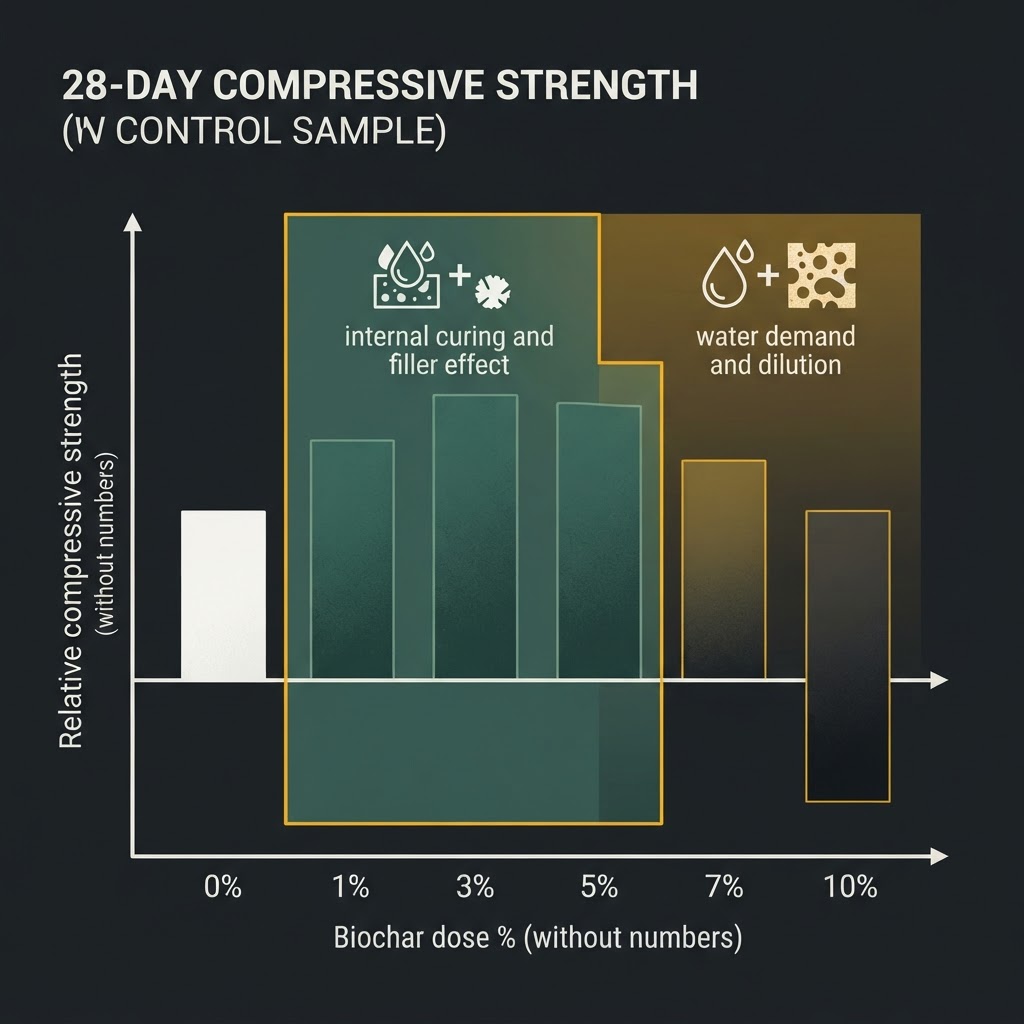
Biochar in concrete does two jobs at once. At 1 to 5 percent of cement mass it acts as a micro-filler and internal curing agent that can raise early strength and cut water penetration. At the same time it locks biogenic carbon inside a material that is poured by the billions of tonnes and almost never dug up again. This article gives the dosage window the research actually supports, what happens to strength above it, how much CO2 a slab stores, which registries credit it, and what changes when the char comes from sewage sludge or a gasifier rather than clean wood.
We design waste-to-energy plants whose by-product is exactly that kind of char, so the last question is the one we get asked most.
Why Concrete Is a Serious Place to Put Biochar
Start with the scale of the problem. Chatham House counts more than 4 billion tonnes of cement produced every year, around 8 percent of global CO2 emissions, with more than half of the sector's emissions coming from the calcination of limestone itself. A kilogram of ordinary Portland cement carries about 0.93 kg of CO2. The reference point regulators now use, cited by the Global Cement and Concrete Association from IEA work, is 850 kg CO2e per tonne for a best-available CEM I plant, with the near-zero label starting at 125 kg.
Biochar pulls two levers against that number. Every kilogram of cement it displaces avoids roughly a kilogram of CO2. And the carbon in the char itself, which is biogenic and would otherwise have returned to the atmosphere as the biomass rotted or burned, is removed from the carbon cycle for as long as the structure stands. Isometric's built-environment module recognises four ways to get it into a mix: as a supplementary cementitious material, as a filler replacing cement, as an admixture, or as an aggregate substitute, plus aggregate or modifier roles in asphalt. Which role you pick decides both the engineering and the credit.
The Dosage Window: 1 to 5 Percent of Cement
What low doses do: internal curing, nucleation, water tightness
The foundational work came from Gupta and Kua at the National University of Singapore. Adding sawdust biochar at 1 to 8 percent of cement mass, they found that 1 to 2 wt percent was the optimum for 7-day strength, that dry char held 7.50 to 8.78 grams of water per gram, and that a 1 percent dose cut water absorption and penetration depth by up to 58 and 66 percent against the control. Flexural strength, drying shrinkage and modulus were unchanged. Flow only suffered at 5 to 8 percent. The university's summary of the programme put it in builder's terms: concrete up to 20 percent stronger at early age and 50 percent more watertight, which allows formwork to come off sooner.
The mechanism is water management. Porous char soaks up mixing water and then releases it slowly into the hardening paste, so hydration continues after the surface has dried. A 2025 review in Buildings collects the typical effect sizes: early strength up 12 to 18 percent at 2 to 3 wt percent, early-age shrinkage down about 30 percent, and initial and final setting time shortened 11 and 16 percent at a 3 percent dose. The fine particles also act as nucleation sites for calcium silicate hydrate, which densifies the matrix.
Density shows up in durability. A dose-response study across 0, 1, 3, 5 and 10 wt percent found that 1 to 3 wt percent reduced both accelerated carbonation depth and the chloride diffusion coefficient, that a fineness around 73 microns gave the largest strength gain, and that 3 percent increased the degree of cement hydration. Chloride and carbonation are what corrode rebar, so this is the property a structural engineer cares about.
Where strength falls off, and why
Above roughly 5 percent the same porosity turns against you. A 2026 study in Scientific Reports that ran wood biochar as a cement replacement through 300 freeze-thaw cycles found that 5 percent still met the 24 MPa design strength while 7 percent lost up to 35.5 percent; the 5 percent mix kept a durability factor of 96.8 percent and cut the growth in surface scaling and void count by about 74 and 72 percent, and life-cycle GWP fell 27.7 percent at 7 percent replacement. The authors land on 3 to 5 percent as the optimum, and most of the literature agrees.
The reason is not the carbon. It is water demand and dilution: more char means more pores competing for mixing water and less binder to form hydrates. A 2024 paper in Biochar used machine learning across a wide set of chars to isolate the properties that decide whether a 10 percent replacement holds strength, and found three controlling variables: the initial saturation of the char, its oxygen-to-carbon ratio and its soluble silicon. Pre-saturate the char and pick one with the right chemistry, and 10 percent is achievable without loss. Skip those steps and strength drops at 2 to 5 percent. The thresholds a char must meet before any of this is tested are set out in our guide to biochar quality standards.
Pushing past 5 percent
High-volume substitution is a trade, not a free lunch. A 2025 review of the high-dose studies reports that replacing 30 percent of cement with biochar cut compressive strength 22.3 percent while cutting CO2 emissions 46.3 percent, and that replacing sand instead costs about 7 percent of strength for every 1 percent of sand swapped. A 40 percent sand replacement lost 41.9 percent of strength for a 20 percent emissions saving, and the authors recommend keeping sand substitution within 10 percent. The practical reading: for structural concrete, stay in the 1 to 5 percent cement-replacement window. For non-structural products such as pavers, blocks and screed, higher doses buy more carbon per cubic metre at a strength cost the application can absorb.
How Much Carbon a Slab Actually Stores
The arithmetic per tonne of biochar
The storage value of a mix is the mass of biochar times its organic carbon content times 3.67, minus whatever the registry discounts. Two field projects show the range.
Two real pours: Oakland and Mecklenburg
In May 2025 Bioforcetech's OurCarbon, a char made from biosolids, went into two structural mixes at a school in Oakland. Each mix carried 76.5 pounds of char per cubic yard; the baseline GWPs of 248 and 209 kg CO2e per cubic yard fell 12.3 and 26.1 percent, and the roughly 55 cubic yards stored 2.13 tonnes of CO2e, with monitoring, reporting and verification by CarbonPilot and the production plant under 40 miles away. That is roughly 40 kg of CO2e per cubic yard, a figure that reflects both a low dose and a biosolids char with modest carbon content.
In northern Germany, Novocarbo and Hansa Asphalt added fine biochar at a 3 percent ratio to the top layer of a test road at the Carbon Removal Park Baltic Sea, about 7 tonnes in all, which stored around 75 kg CO2e per tonne of asphalt and 17.5 tonnes across the site, certified as carbon removal credits. Divide the two stated figures and that pilot's wood char carried about 2.5 tonnes of CO2e per tonne of biochar, which is our derivation from their numbers, not a figure they publish.
The spread between the two projects is feedstock. Woolf and colleagues' compilation puts the organic carbon content of char anywhere from 7 percent for gasified biosolids to 79 percent for wood pyrolysed above 600 C. A tonne of one is worth more than ten times the CO2 of a tonne of the other. Both can be excellent concrete additives. Only one is a large carbon sink. We cover the permanence side of the same question in how long biochar stores carbon.
Who Credits It: Isometric, Verra, Puro and the EU
Concrete is the storage medium where biochar's permanence is least argued, because the char is sealed in an alkaline mineral matrix rather than left in a living soil. The registries have responded with explicit rules.
Isometric's Biochar Storage in the Built Environment module assigns the stable fraction a durability above 1,000 years and models reversal with a geochemical weathering simulation: 2 percent of the concrete mass is assumed lost over 1,000 years, so 2 percent of the biochar is treated as exposed, the labile share of that exposed char is deducted, and a safety factor of 3 is applied to cover crushing at demolition. For asphalt the module is stricter: the reversal factor is set at 100 percent, so the labile fraction earns nothing. The module also notes that published dosage limits run from 0.5 to 40 percent, with up to 20 percent in concrete and 15 percent in asphalt typical, and it requires that the biochar-amended product meet the same performance standards as the conventional one, with no extra admixtures or maintenance. Early evidence that biochar-cement composites absorb additional CO2 from the air is acknowledged but not yet credited.
Verra's VM0044 is the broad-market route. Version 1.2 has been active since 27 June 2025, covers non-soil uses including biochar-amended concrete and building materials, and added an investment-analysis step to demonstrate additionality. Puro.earth's Edition 2025 methodology lists bricks, concrete and asphalt among eligible biochar applications and requires that a non-agricultural use deliver a benefit to the product itself, not just a place to hide carbon. In the EU, the Carbon Removals and Carbon Farming Regulation's biochar methodology defines biochar carbon removal as storage through application to soils or incorporation into materials, with conditions set per use in its annex. We unpack those conditions in CRCF permanent carbon removal credits.
Two things follow for a producer. The engineering file and the carbon file are the same file: the registry wants the mix design, the wt percent of char, the standard strength tests and the list of any admixtures the char made necessary. And the carbon is credited on the char's measured organic carbon and H/Corg, not on the tonnage poured. For how a verified tonne becomes a saleable unit, see how biochar carbon credits work and the current biochar carbon credit price per ton.
Sludge and Gasification Char in Concrete: The Operator's View
Most concrete studies use clean wood char. The char that comes out of a municipal waste-to-energy plant is different: made from sewage sludge or mixed residues, high in ash, low in carbon. Does it still work in a mix?
The evidence says yes, at low dose. Onuaguluchi and colleagues added 0.5 to 2 wt percent sewage sludge biochar to mortar and measured compressive strength up 17 to 34 percent and tensile strength up 10 to 18 percent, with pre-wetted char performing best and GWP per unit of 28-day strength 16 to 29 percent below plain mortar. A University of Technology Sydney team using water treatment sludge biochar as a cementitious material found that 1, 2 and 5 percent gave slightly higher 28-day strength than the reference, 10 percent was only 5.5 percent lower with no statistical difference, and the biochar outperformed the same dose of raw sludge by 37 and 46 percent. A 2025 study in Innovative Infrastructure Solutions ran sludge biochar from 5 to 20 percent of cement and found that 5 percent delivered 32 MPa against a 33.5 MPa control and a 30 MPa target, cut GWP by about 33 percent, while 20 percent dropped to 22.5 MPa.
Why does an ash-rich char hold up? Pyrolysis or gasification burns off the organics that make raw sludge useless in cement, and what remains, mineral ash with some silica and a porous carbon skeleton, behaves like a filler with a mild pozzolanic streak. The mineral content that drags down the carbon credit is part of what makes the mortar work.
That is the honest trade for a plant like ours. Our five-step process gasifies local sludge and biomass for dispatchable power and heat, with biochar and verified CO2 offsets as the fourth output. Concrete is an attractive home for that char: it is local, it is permanent, and it adds value to the product. But the carbon credit per tonne will be a fraction of what a wood pyrolysis char earns, and the two revenue lines must be modelled separately before anyone promises a municipality a number. The specifics of making the char in the first place are in biochar from sewage sludge.
Consistency is the second constraint. A concrete producer qualifies a mix once and expects every delivery to behave the same way, and a registry wants H/Corg and carbon content per batch. Both depend on a uniform feed. We have argued that thermal pre-treatment is non-negotiable for moisture, energy density and homogenisation. In a concrete supply chain that is also what keeps the char within the saturation, oxygen-to-carbon and silicon ranges that the strength models say matter.
A Checklist Before You Pour
- Dose by trial, starting at 1 to 3 percent of cement mass and not exceeding 5 percent for structural work. The gains are real in that window and reverse quickly above it.
- Account for the water. Char holds 7 to 9 times its mass in water. Pre-wet it or adjust the water-to-cement ratio, otherwise it steals mixing water and strength falls.
- Specify fineness. Tens of microns beats millimetres for strength and durability. Coarse char is an aggregate substitute with a different, lower-strength role.
- Run the standard tests the registry will ask for. Compressive and flexural strength, chloride and carbonation resistance, and a freeze-thaw series if the climate demands it. The same data proves equivalence to the conventional product.
- Record carbon content and H/Corg for every batch, and keep the mix design. The credit is calculated on those numbers, and a built-environment claim is only as good as the chain of custody from reactor to truck.
Done this way, biochar in concrete is one of the few carbon removal pathways where the storage medium is already standardised, already audited and already being poured. The task is matching the right char to the right mix and keeping two ledgers honest.
FAQ
Does biochar replace cement or sand in concrete?
Either, depending on the goal. Registries accept biochar as a supplementary cementitious material, a filler replacing cement, an admixture or an aggregate substitute. Replacing cement earns the avoided clinker emissions on top of the stored carbon, but strength limits the dose to a few percent. Replacing sand allows larger volumes of char, at a cost of roughly 7 percent of compressive strength per 1 percent of sand swapped, which suits non-structural products.
Does biochar concrete need special curing?
No special regime, but the char must be pre-wetted or the mix water adjusted. Dry biochar absorbs 7 to 9 times its own mass in water and will take it from the paste, lowering the effective water-to-cement ratio and the strength. Pre-soaked char does the opposite: it becomes an internal curing reservoir that releases water as the paste dries, which is why sealed and air-cured biochar mixes lose less strength than plain ones.
Is biochar in asphalt credited the same way as in concrete?
Not quite. Under Isometric's built-environment module, biochar in concrete is assessed with a 1,000-year weathering model that assumes 2 percent of the material is exposed and discounts only the labile fraction of that share, with a safety factor of 3. For asphalt the reversal factor is set at 100 percent, so the labile fraction of the char is excluded entirely and only the stable fraction is credited.
Can biochar from sewage sludge be used in concrete?
Yes, at low dose. Studies with 0.5 to 5 percent sludge biochar report compressive strength equal to or up to 34 percent above plain mortar, because pyrolysis removes the organics that make raw sludge unusable in cement. The limitation is carbon: sludge and gasification chars can hold as little as 7 percent organic carbon, so the carbon credit per tonne is small even though the concrete benefit is real.