
CRCF permanent carbon removal credits are the EU's own certified unit for carbon dioxide removal that lasts for centuries. Since May 2026, biochar is one of only three permanent removal methods with a legally binding EU methodology behind it. That changes the question a biochar developer has to answer. It is no longer "is my credit high quality?" but "does my reactor, my feedstock and my offtake meet the annex of a delegated regulation?"
This guide reads that annex the way an engineer would. It covers what the units are, what the biochar methodology demands line by line, why gasification sits comfortably inside the rules, and an honest timeline for when the first unit can actually be sold.
What CRCF permanent carbon removal credits actually are
The Carbon Removals and Carbon Farming Regulation, Regulation (EU) 2024/3012, is a voluntary EU framework that entered into force on 26 December 2024. Voluntary matters: no company is forced to buy these units and no existing standard is forced to adopt the rules. What the regulation does is define quality.
Four unit types, one of them permanent
The framework issues four kinds of certified unit:
- Permanent carbon removal units, from DACCS, BioCCS and biochar, storing carbon for centuries. They do not expire.
- Carbon farming sequestration units, from soils and biomass, temporary, at least 5 years.
- Soil emission reduction units.
- Carbon storage in products units, at least 35 years.
The line between the first and the last is durability. Permanent removal means storage for several centuries, while products need only 35 years. Every unit must pass the same headline criteria, known as QU.A.L.ITY: quantification, additionality, long-term storage and sustainability, with a greenhouse gas lifecycle assessment deducting any emissions the activity causes.
A government label on a voluntary market
Latham & Watkins describe CRCF as, to their knowledge, the first government-issued label for voluntary credits, comparable in function to existing labels but backed by EU law. Buyers should also know the limits. According to the Commission, certified units cannot be used for third-party NDCs or CORSIA, and no corresponding adjustment is required for voluntary climate claims. If you need the background on how any credit gets audited, start with how carbon credits are verified.
The 2026 delegated act: DACCS, BioCCS and biochar
The regulation sets principles. The detailed rules come as delegated acts, one per group of activities. The first, Delegated Regulation (EU) 2026/285, was adopted on 3 February 2026, published in the Official Journal on 17 April 2026 and entered into force on 7 May 2026, after neither Parliament nor Council objected (EPRS). It covers direct air capture with storage, biogenic emissions capture with storage, and biochar carbon removal.
Biochar earned its place because, in the regulation's own words, BCR activities produce a quantifiable fraction of stable biochar expected to store carbon for at least several centuries. The word "fraction" matters: not all carbon in the char is credited, only the stable share. We unpack what drives that share in how long biochar stores carbon.
Two changes between the draft and the final text hit biochar directly, according to the Parliament's research service. The BCR activity period was cut from 10 years to 5. And both the biochar production facility and the place the biochar is stored must be located in the EU.
What the biochar methodology demands of a plant
This is the part most coverage skips. The annex turns "permanent" into concrete design constraints.
Eligibility: 350 C, methane and heat
Under the annex, a biochar production process must do three things. It must heat biomass to at least 350 C, be designed to fully capture or destroy any methane produced, and use the co-produced heat for drying or another economically justifiable heat demand. Mobile units are exempt from the heat rule where using the heat would be impractical.
Read those three together and a pattern appears: the EU is excluding the low-tech kiln that vents its pyrolysis gases and wastes its heat. A plant that flares or burns its gas and puts the heat to work passes. A plant that treats heat as waste does not.
Where the biochar may go
Soil application is eligible on agricultural soils, forest soils and in greenhouses, applied directly, mixed into a compliant soil amendment, or via animal feed and recovered manure. Total application is capped at 50 tonnes per hectare cumulatively, counting uncertified applications too. Where application is not directly supervised, operators must grant site access for at least one year afterwards (EUR-Lex recital 6). Biochar can also be incorporated into materials, the second route named in the definition of BCR (EPRS).
The H/Corg 0.7 cut-off
The single most important number for reactor operators: no units are issued for any batch with a hydrogen to organic carbon molar ratio above 0.7. H/Corg is the lab proxy for how aromatic, and therefore how stable, the char is. It is controlled mostly by peak temperature and residence time. A batch that misses it earns nothing, so batch definition and lab sampling become revenue-critical, not paperwork.
Feedstock and the 50 percent energy rule
The CCSA summary flags a feedstock rule that decides which business models qualify: if biochar makes up 50 percent or more of a facility's total energy outputs, the operator may use only waste or residual feedstocks. In plain terms, a plant built mainly to make char must run on residues. A plant whose main output is energy has more feedstock latitude, within the regulation's general sustainability criteria.
Activity period, baseline and uncertainty
Three more parameters from the same annex, via CCSA:
- Activity period of 5 years maximum for BCR, against 15 years for DACCS and BioCCS. Expect a new activity plan and recertification cycle every five years.
- Standardised baseline of zero, so no counterfactual modelling is needed.
- A 20 percent uncertainty limit across all pathways: if overall measurement uncertainty exceeds it, zero units are issued.
That last rule rewards plants that measure well. Feedstock mass, moisture, char yield and carbon content all feed the uncertainty budget.
Why gasification fits the CRCF rules well
Energaia's engineering work sits in this exact space. Our public five-step process runs local biomass or sludge through high-temperature gasification to clean syngas, converts that to dispatchable electricity and heat, and captures biochar plus verified CO2 offsets on site.
Map that against the annex:
- Temperature. Gasification runs well above the 350 C floor by design.
- Methane. Syngas is the product, not a by-product. It is cleaned and burned in an engine or boiler rather than vented, which is what "designed to fully capture or destroy" asks for.
- Heat use. A combined heat and power set-up produces heat that goes to feedstock drying and local demand. Thermal pre-treatment of wet sludge or residues is a natural heat sink.
- The 50 percent rule. In a power-led gasifier, electricity and heat dominate the energy outputs and biochar is the smaller stream, which keeps the plant away from the residue-only trigger. The calculation still has to be done per facility.
The trade-off is char stability and yield. Gasification char is produced under different conditions from slow pyrolysis char, so H/Corg has to be proven batch by batch, not assumed. This is where simulating the process before steel is ordered pays off: operating windows that keep H/Corg safely below 0.7 while holding syngas quality can be found on a model first.
Timeline: when can you actually buy or sell a CRCF unit?
A methodology in force does not mean units exist. The chain has three more links.
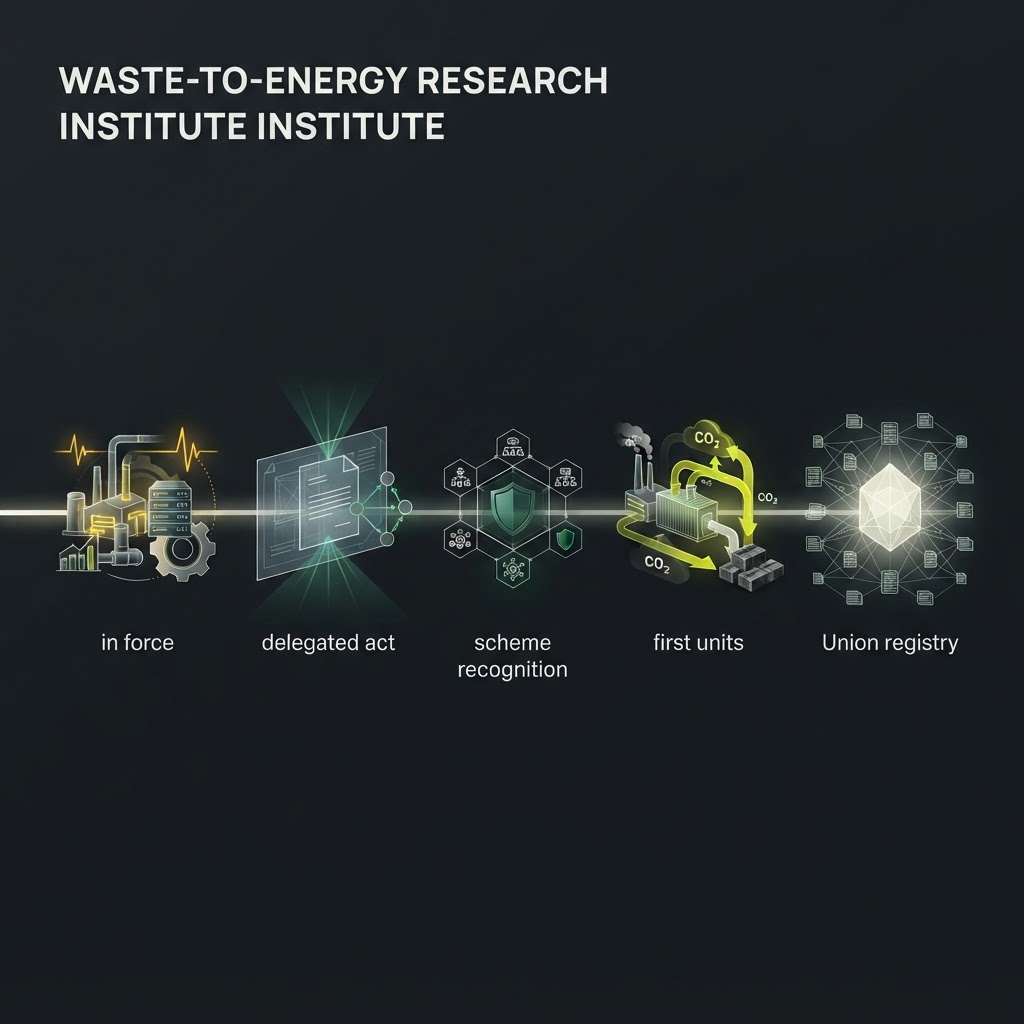
Certification schemes. Projects are certified by Commission-recognised schemes, under technical rules set by Implementing Regulation (EU) 2025/2358, adopted in November 2025. DG CLIMA's indicative plan had the call for schemes open in April 2026, assessment through Q2 and Q3, and recognition decisions in Q4. Recognition is typically granted for five years (Commission FAQ). The CRCF Projects tracker lists five applicants, Isometric, Puro.earth, Rainbow Standard, Oncra and Planet First Registry, all still under assessment and none formally recognised.
Accredited verifiers. Auditors must be accredited for the CRCF scope, and that accreditation is only starting.
The registry. The Union CRCF registry is due by 27 December 2028. Until then, schemes publish certification data in their own registries.
The result: first certified units are expected from the end of 2026 into 2027. Demand is already forming. On 26 March 2026, ClimeFi announced the first public transaction agreement for CRCF units, with Nasdaq and Adyen buying BioCCS removals from Stockholm Exergi's BECCS Stockholm (EPRS). For what buyers pay for biochar removal today, see biochar carbon credit prices per tonne.
CRCF and the EU ETS: where biochar stands
The larger prize is compliance demand. On 17 July 2026 the Commission proposed integrating permanent removals into the EU ETS: 250 million allowances over 2031 to 2040, auctioned to centrally buy CRCF-certified BioCCS and DACCS units (CRCF Projects). Biochar is left out of that programme for now, even though the Commission's impact assessment calls it the removal solution most ready for near-term deployment. The stated reasons are thin long-term decay research and the risk that cheaper biochar units would move the ETS market too much.
It is a proposal, heading to Parliament and Council, and the biochar exclusion is likely to be contested. Separately, the Commission has announced an EU buyers' club to aggregate voluntary demand for CRCF credits (EPRS). For now, biochar's CRCF market is the voluntary one, which is why the difference between avoidance and removal credits still drives price.
What to do now if you run or plan a biochar plant
- Test H/Corg on every production batch you already make. If you are near 0.7, fix temperature and residence time before certification, not after.
- Write down where your heat goes. Drying, district heat or process heat. An unused heat stream is an eligibility problem.
- Calculate your energy output split. If biochar is 50 percent or more of energy outputs, lock in residue-only feedstock contracts.
- Map your application sites. Track cumulative tonnes per hectare, including uncertified char, and plan site access for unsupervised applications.
- Pick a scheme now. Working with one of the five applicants means your monitoring is built to its rules before recognition, which is likely the shortest path to a CRCF unit.
- Budget for five-year cycles. The short activity period means recurring audit costs in the business case.
If you are new to the mechanics behind all this, our explainer on how biochar carbon credits work covers the basics from feedstock to retirement.
FAQ
Do CRCF permanent carbon removal units expire?
No. Permanent removal units do not expire. Carbon farming sequestration units are temporary, with a minimum of 5 years.
Can a biochar plant outside the EU issue CRCF units?
Not under the current methodology. Both the biochar production facility and the storage of the biochar must be located in the EU.
Can CRCF units be used for CORSIA or another country's NDC?
No. They can back voluntary climate claims, but the Commission rules out their use toward third-party NDCs or international compliance schemes such as CORSIA.
Is biochar used in concrete or other materials eligible?
Yes in principle. The BCR definition covers storage through application to soils or incorporation into materials, with detailed conditions for each use in the annex.