
Biochar carbon credit buyers are more numerous than buyers of any other carbon removal method, and far more concentrated than that number suggests. CDR.fyi counted 290 unique purchasers of biochar removal since 2022, almost five times the next method, while Microsoft alone accounts for 46 percent of all tonnes contracted. Both facts matter to anyone building a plant. The long tail means a buyer exists for almost any credible project. The concentration means a small number of procurement teams set the quality bar everyone else follows.
This guide reads the buyer data from the supplier's side: who the buyers are, how they contract, what they pay, and what gets a project rejected before price is ever discussed. If you want the mechanics of registration and sales routes, start with how to sell biochar carbon credits and come back here.
Who Buys Biochar Carbon Credits
The same CDR.fyi snapshot gives the shape of demand. Between 2022 and the first half of 2025, buyers contracted 3.04 million tonnes of biochar carbon removal, 1.6 million of them in H1 2025 alone. Four companies, Microsoft, Google, BCG and JPMorgan, account for 57 percent of purchases. At the other end, more than half of all purchasers have bought fewer than 100 tonnes, and the median order in 2025 was 73 tonnes.
CDR.fyi's reading is that biochar is where companies try carbon removal first. It lists three reasons buyers give: fast time from contract to delivery, lower prices than other durable methods, and the option to start with a small purchase. For a supplier, that means two different markets share one name. One is a handful of multi year offtakers buying hundreds of thousands of tonnes. The other is hundreds of small buyers testing the category.
The Five Kinds of Buyer
Treating "buyers" as one group is the most common mistake in supplier pitch decks. They buy for different reasons, at different sizes, through different channels.
Anchor offtakers
These are the buyers who finance capacity. Microsoft signed a 10 year agreement with Exomad Green to remove at least 1.24 million tonnes of CO2, with digital MRV contractually embedded and certification under the Puro.earth biochar methodology, building on an earlier 32,000 tonne purchase. Google committed to 100,000 tonnes each from Varaha and Charm Industrial by 2030.
Two details from Microsoft's own carbon removal portfolio disclosure matter to suppliers. Microsoft classes biochar as medium durability, hundreds of years to 1,000 years, not as its highest tier. And it states that it often contracts two to five years before a project operates, and that some contracts are terminated or amended when projects miss performance. An anchor offtake is a financing instrument with delivery obligations, not a guaranteed sale.
Portfolio diversifiers
Most large corporates do not buy biochar alone. CDR.fyi notes that for Microsoft, Google, BCG and JPMorgan biochar is no more than 35 percent of their durable removal portfolio. Boeing's purchase is typical of the newer entrants: 20,000 tonnes through Supercritical, screened from more than 200 projects and split across six suppliers in Brazil, Bolivia, Namibia and India, mixing biochar with enhanced rock weathering. Fastmarkets lists the wider 2025 roster: 1.6 million tonnes of biochar offtakes in H1 2025 from buyers including Microsoft, Google, Shopify, KIRKBI, Supercritical and SAP.
For a supplier, a diversifier buys a slice. You compete to be one of six, not to be the whole programme.
Biochar-only buyers
A smaller group buys almost nothing else. CDR.fyi identifies Swiss Re (99 percent biochar), SEB, Tide and Nasdaq (100 percent each). Their stated reasons are consistent: trusted MRV, insurance options, durability of at least 100 years and co-benefits. Swiss Re deliberately spreads purchases across projects in Europe, the Americas, Asia and Africa. These buyers reward geographic and supplier diversity, which is an opening for a first project in a new region.
Intermediaries that buy to resell
Between the producer and the end buyer sits a layer of marketplaces, brokers and traders. The Nitidae biochar market study separates them: marketplaces connect producers and buyers, brokers match projects to buyers, and traders purchase credits to resell them, with many firms doing all three. It also explains why they are growing: buyers struggle to compare projects on their own, so intermediaries act as filters.
Carbonfuture describes the producer's trade off plainly: direct deals can carry a wide range of prices, terms and technical requirements, while some intermediaries purchase credits directly and resell them, reducing uncertainty for both sides. For a first plant, an intermediary is often the realistic first buyer.
Value chain and hard-to-abate buyers
This is the segment the headlines miss, and the one most relevant to agricultural regions such as Nigeria. Nitidae names commodity traders such as ECOM, ETG and OFI, whose supply chains produce residues like cashew shells, cocoa pods and coffee husk, as candidates to finance biochar inside their own value chains to address Scope 3 emissions. It adds aviation and shipping, partly because some biochar standards are accepted under CORSIA, and fertiliser and building materials producers who may finance projects to secure biochar supply itself.
These buyers want a supply relationship as well as a certificate. The pitch is a plant inside their sourcing region, not a credit from anywhere.
2026: Buyers Moved From Spot to Offtake
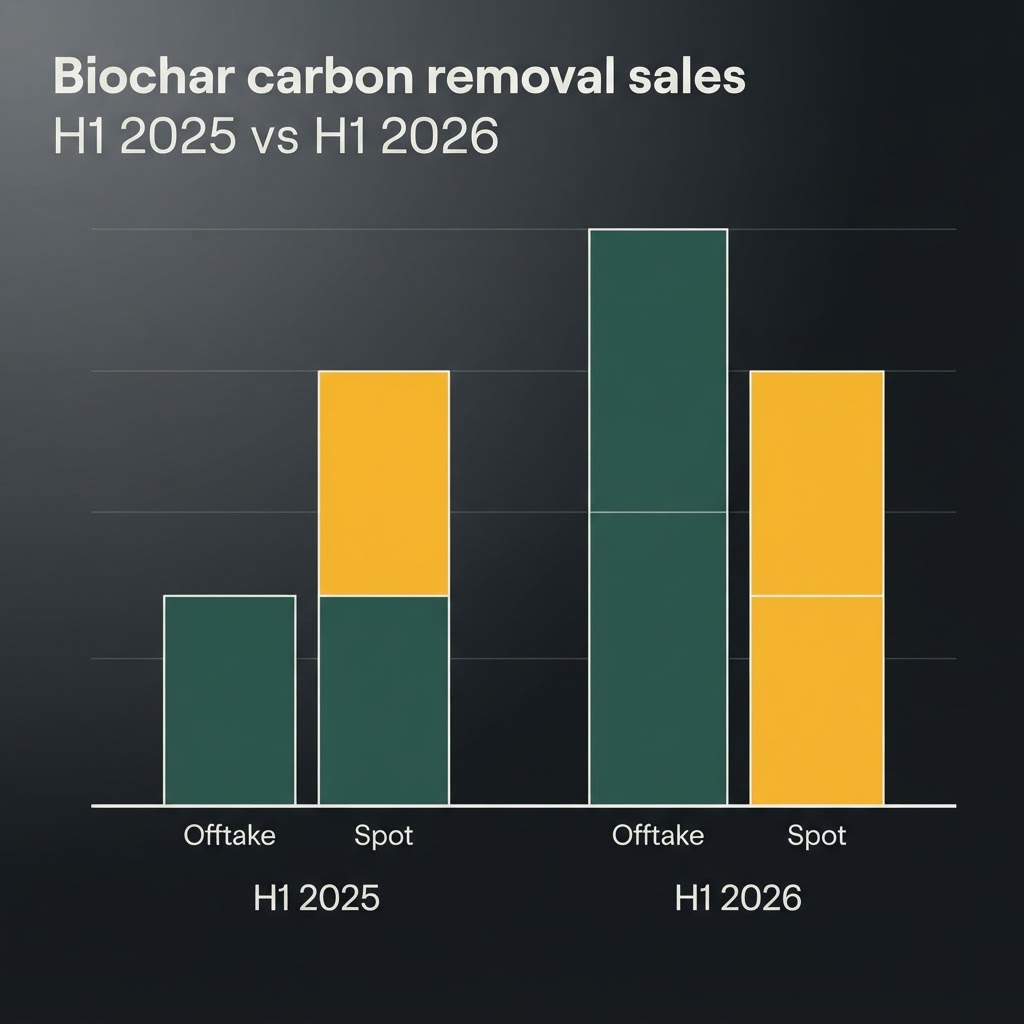
The biggest change this year is how buyers contract. Supercritical's market report shows biochar sales of 2.99 million tonnes across 280 deals in H1 2026, against 1.59 million tonnes across 624 deals a year earlier. Offtake volume rose from 1.42 to 2.91 million tonnes. Spot volume fell from 174,000 to 81,000 tonnes.
The growth is no longer just Microsoft. Excluding it, the market grew from 350,000 to 1.89 million tonnes, and non-Microsoft offtake rose tenfold. By July 2026, 81 percent of high quality supply was committed, a threshold not reached until October in 2025. Supercritical says buyers in pharma, finance, aviation and consulting have open RFPs that could take 70 percent of what remains. Its press release adds that average deal size has more than quadrupled.
The supplier reading: fewer, larger contracts signed earlier in the year. A project that only becomes visible to buyers in Q4 is selling into the most crowded part of the market. In Q4 2025, 994 spot transactions competed for 125,000 tonnes.
What Buyers Pay
Price depends on origin, production type and timing. S&P Global Platts assessed current year biochar removal credits at 150 USD per tonne for US origin and 140 USD for India origin, with industrial biochar from India heard at 140 to 160 USD and artisanal at 100 to 120 USD. Nitidae reports the Puro biochar index at 148 USD in March 2025. Supercritical gives the seasonal effect for one project: 155 USD for a forward purchase in July 2025, 185 USD spot in November.
So industrial production earns a premium over artisanal, and buyers who commit early pay less than buyers who wait. For the full price history and what drives it, see biochar carbon credit prices per tonne.
What Gets a Project Onto a Buyer's Shortlist
Registry certification is the entry ticket, not the decision. Supercritical's climate science team says it has evaluated more than 400 biochar projects and passed thirteen. Its published failure examples read like a design review:
- Additionality: an existing facility seeking credits after a minor modification. Retrofits are hard to defend.
- MRV: open pit production across several sites with no methane monitoring. Methane can cancel the removal.
- Delivery: a single kiln making about 800 tonnes a year with no multi year delivery history.
- Health and safety: a site visit found weak controls and an unreported burn incident.
Carbonfuture lists the questions an advance buyer asks: is feedstock secure and free of contaminants, is the technology proven or certified, will end users track the biochar, are there co-benefits, and is the project on a path to scale. It notes that major corporate buyers prefer projects heading toward 100,000 tonnes a year over ones capped at 10,000.
Almost every item on both lists is settled at the engineering stage, before the first credit exists. Feedstock contracts, methane and temperature monitoring, continuous reactor design and end use tracking are what a buyer's due diligence team checks first. They also map onto the biochar quality standards registries already apply. This is why Energaia runs carbon credit management, covering certification, trading strategy and MRV, alongside system development: the plant is the product a buyer is really vetting.
Which Buyer Fits Which Plant
Match the plant to the buyer, not the other way round.
Industrial plant in Germany or the EU. Thousands of tonnes a year, continuous production, full monitoring. This profile fits portfolio diversifiers and biochar-only buyers, directly or through a vetted intermediary, and it is the profile best placed for permanent carbon removal credits under the CRCF as EU rules come in. European demand has its own drivers, covered in carbon credit buyers in Europe.
Agricultural residue plant in Nigeria or West Africa. CDR.fyi found the top four suppliers by tonnes sold are all in the Global South, together 74 percent of tonnes sold, so origin is not a barrier. The natural first buyers are intermediaries and value chain buyers sourcing the same crops, with anchor offtakers later, once a delivery record exists.
Small or distributed production. The long tail of buyers under 100 tonnes exists, but vetted procurement rejects sub-scale single sites. Aggregation into a monitored network is how small producers reach the buyers that pay industrial prices.
FAQ
Who is the largest buyer of biochar carbon credits?
Microsoft. It holds 46 percent of all biochar removal contracted through H1 2025, anchored by the 1.24 million tonne Exomad Green agreement. Google, BCG and JPMorgan follow among the largest buyers.
Can a small biochar producer find a buyer?
Yes, but usually not a large one directly. Over half of buyers purchase under 100 tonnes, yet vetted procurement routinely fails single kiln projects without a delivery record. Aggregation or an intermediary is the usual first route.
Do buyers pay upfront for biochar credits?
Sometimes. Carbonfuture reports that in advance purchase agreements a buyer may pay 10 to 25 percent of the total price upfront, and that a well structured contract can support bank financing for the project.
Why do buyers choose biochar over other carbon removal?
Buyers cite fast delivery after contracting, lower prices than other durable methods and the ability to start with a small order. Biochar has also delivered more than twice the volume of all other permanent removal pathways combined, according to Supercritical.