
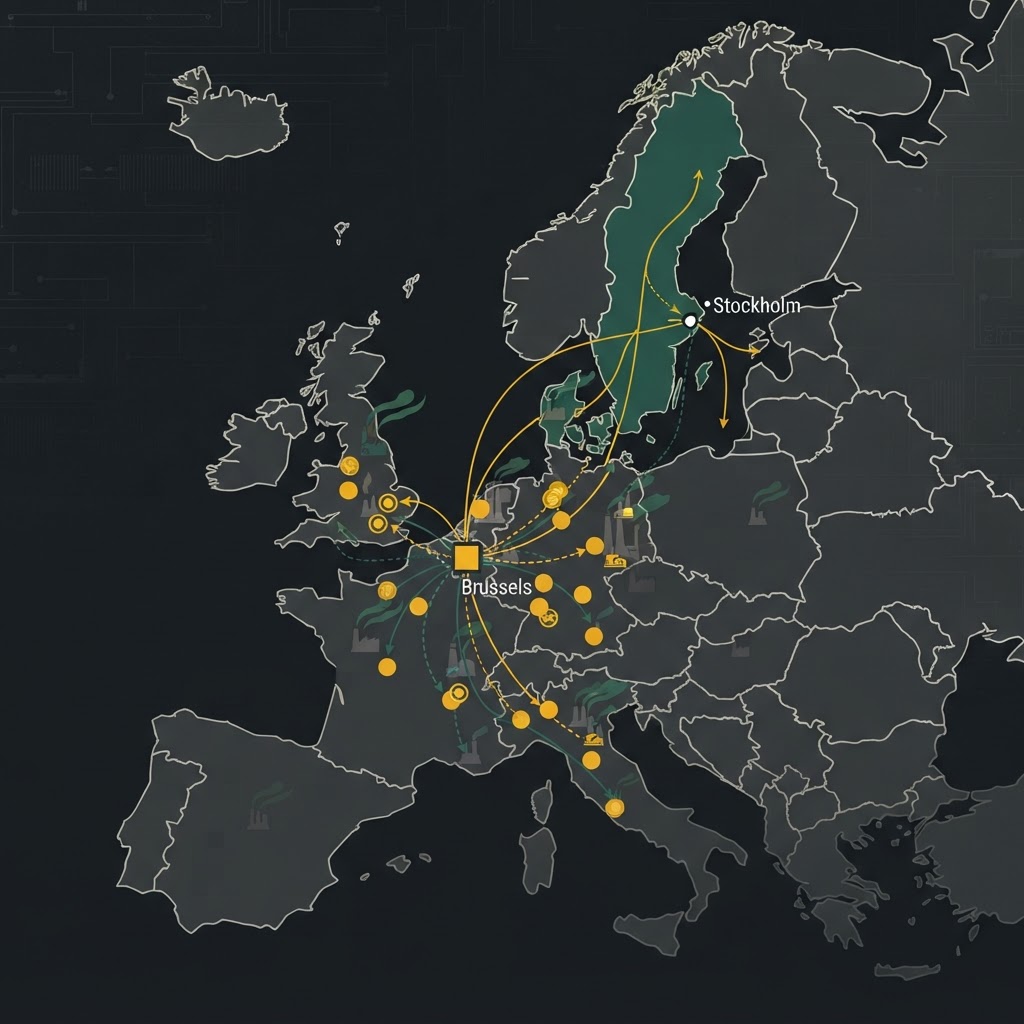
Europe is the largest source of demand on the voluntary carbon market. Carbon credit buyers in Europe account for around 25 percent of retired credits, rising to 45 percent once UK buyers are included. Europe is also where much of the durable supply is being built: 60 percent of 2023 to 2024 carbon removal offtakes were allocated to European projects, even though most issuances that year came from the Americas.
"Europe" is not one buyer, though. Demand here comes from four groups, and each answers to a different rule: corporates buying voluntarily, Nordic governments and cities buying for national targets, the new EU CRCF Buyers Club, and the EU Emissions Trading System. The ETS is the biggest carbon price in Europe, yet today its emitters are not buyers of credits at all.
This guide maps the four groups with their 2026 numbers and ends with an engineer's view: which of them a biochar or gasification plant can realistically sell to.
Who the carbon credit buyers in Europe are
| Buyer group | What drives it | What it buys | Open to biochar? |
|---|---|---|---|
| Corporates (voluntary) | Net-zero targets, CSRD disclosure | Avoidance, nature-based and durable removals | Yes |
| Nordic states and cities | National and municipal climate targets | Mostly BECCS, one biochar scheme | Partly |
| EU CRCF Buyers Club | Building a certified EU market | DACCS, BioCCS, biochar | Yes |
| EU ETS operators | Compliance obligation | Nothing from the credit market today | No |
The rest of this article takes each row in turn.
Corporate buyers on the voluntary market
Nordic companies with net-zero targets
The Nordics have the best documented corporate demand in Europe. A Nefco study lists Equinor, H&M, IKEA, Fortum and Posti among Nordic companies with validated SBTi targets that purchase carbon credits as part of long-term net-zero strategies, and Klarna, Spotify and H&M as buyers that fund carbon removal specifically to grow the market. The same study notes that the classic buyer, a company offsetting a product to call it carbon neutral, was historically the largest source of Nordic demand. That group is shrinking under EU consumer law (see below).
Equinor stands out by volume. It was the third largest durable removal buyer worldwide in 2024 at 0.3 Mt, behind Microsoft and Frontier, buying from Ørsted's Danish BECCS project.
Buyer collectives and the first CRCF deal
Smaller European companies increasingly buy through collectives that share due diligence costs. In April 2026 ClimeFi structured the first publicly announced transaction for EU CRCF carbon removal units: a buyers' collective including Adyen and Nasdaq will receive units from Beccs Stockholm. The collective model matters for sellers because it turns many small buyers into one counterparty with standard terms.
Non-European buyers of European removals
Some of the largest contracts for European supply are signed by buyers headquartered elsewhere. Microsoft agreed a decade-long offtake of 3.3 Mt from Stockholm Exergi and added 1 Mt to its Ørsted agreement, per the Timber Finance review cited above. Frontier, whose members include Stripe, Alphabet and H&M Group, committed $48.6M for Stockholm Exergi's removals between 2028 and 2030. For a European seller, the buyer's passport matters less than whether the project passes its screening.
Public buyers: Nordic states and cities
Public money is the most distinctly European part of the demand side. The Nordic schemes are built as subsidies per tonne stored rather than credit purchases, but they set the floor under project economics.
Sweden
Sweden runs a reverse auction for bio-CCS with SEK 36 billion over 15 years, according to the Timber Finance review. The second round closed in October 2026: the Swedish Energy Agency granted SEK 9.3 billion to Renova, SYSAV and Öresundskraft to store 5.75 million tonnes of biogenic CO2. Only three companies applied. Biochar is not part of this scheme.
Denmark
Denmark has two instruments, and the difference is important for anyone producing biochar. The NECCS fund of DKK 2.61 billion for 2025 to 2032 explicitly excludes biochar from pyrolysis; it pays only for geological storage of biogenic or atmospheric CO2.
The second is a dedicated biochar scheme: DKK 10.2 billion from 2027 to 2045 for carbon stored in biochar applied to Danish agricultural soils, with an expected bid cap of DKK 1,750 per tonne of CO2 and a minimum of 400 tonnes of CO2 per year per operator. It is the largest public biochar demand signal in Europe. It is also delayed: in September 2026 the government postponed the tender, which had been due to open in December 2026, without a new timeline, and moved DKK 192 million from the pyrolysis pool to other uses.
Stockholm
Cities are a newer buyer category. Stockholm signed for 750,000 tonnes of removals over fifteen years from Stockholm Exergi, 50,000 tonnes a year, making it the world's fifth largest buyer of permanent removal. Its climate plan requires the city to remove more CO2 than it emits by 2030.
A caveat for sellers: subsidy and credit income are not simply additive. In both Sweden and Denmark, 90 percent of carbon credit revenue above the amount assumed in the bid is deducted from the support. Selling credits on top of a subsidy is allowed, but most of the upside goes back to the state.
The EU CRCF Buyers Club
The European Commission announced the EU CRCF Buyers Club in November 2025 as a voluntary marketplace that pools demand for units certified under the Carbon Removals and Carbon Farming Regulation. Its first purchases of permanent removals are targeted for December 2026, limited to the three approved methods: DACCS, BioCCS and biochar carbon removal. Projects that already receive EU or Member State funding are preferred.
Two details from the CCSA briefing temper expectations. The first round targets purchases from up to five Innovation Fund projects, and the Commission does not pay for the units itself: members do their own due diligence, negotiate and sign. A small biochar plant without public funding is unlikely to be in round one. The Club is still the clearest signal that European buyers will ask for CRCF certification by name. Our guide to CRCF permanent carbon removal credits covers what the biochar methodology demands of a plant.
Why EU ETS emitters are not buyers (yet)
The EU ETS puts a price on the emissions of power plants, heavy industry and aviation in Europe, so it is natural to assume those operators buy carbon credits. They do not. CRCF units bought voluntarily cannot be used for ETS compliance, and the Commission's July 2026 ETS proposal instead envisages central Commission purchasing of permanent removals from 2031, leaving direct operator use open for later, per the CCSA briefing.
Until then, an ETS company that buys removals does so voluntarily, for its net-zero claims, not to reduce its allowance bill. The policy pressure is rising: the EU's target is 5 MtCO2 of permanent removals per year by 2030, above today's pace according to Carbon Gap.
The rules shaping what European buyers want
Three rules decide what a European buyer will sign for.
CSRD disclosure. Companies reporting under ESRS E1-7 must disclose the carbon credits they cancel and plan to cancel, the quality standards behind them, and any removals in their own value chain, separately. Every tonne bought ends up in a public report, which pushes buyers toward credits they can defend line by line.
The end of product-level neutrality claims. The EU has banned product-level offset claims based on carbon credits, with national transposition due by the end of 2026, per the Nefco study. That removes the "carbon neutral product" buyer and leaves buyers who use credits for net-zero, contribution or market-building claims.
The shift to removals. Removal credits traded at an average of EUR 17.94 per tonne in 2024, 79 percent more than reduction credits, according to the i4ce study, and durable removals trade at roughly ten times the price of afforestation credits. The difference between avoidance and removal credits is now the first question a European buyer asks.
Which European buyer fits a biochar plant
| Buyer group | Fit for a biochar seller in 2026 | Why |
|---|---|---|
| Corporate collectives and net-zero buyers | Strong | Want durable, auditable removals at lower prices than BECCS or DAC |
| EU CRCF Buyers Club | Medium, later | Biochar eligible, but round one favours publicly funded projects |
| Danish biochar scheme | On hold | Delayed tender; biochar must go on Danish farmland |
| Swedish and Danish CCS schemes | None | Geological storage only |
| EU ETS operators | None until at least 2031 | No compliance use for credits |
For a plant in Germany or elsewhere in the EU, the practical buyer today is a corporate or a collective, and certification decides whether you make the shortlist. That is the logic of Energaia's own five-step process: gasify local biomass or sludge, sell dispatchable power and heat, and capture biochar plus verified CO2 offsets as a second revenue line. Our carbon credit management service covers the certification, trading strategy and MRV that turn that biochar into units a European buyer can disclose under CSRD.
Two companion guides go deeper: biochar carbon credit buyers profiles the buyer types and prices for biochar worldwide, and how to sell biochar carbon credits walks through the sale itself. For the global picture beyond Europe, see who buys carbon credits.
FAQ
Can companies covered by the EU ETS use carbon credits for compliance?
No. ETS operators cannot surrender carbon credits, including CRCF units, against their obligations. The Commission has proposed that it buy permanent removals centrally from 2031, with direct operator use left open for later.
Can a subsidised project still sell credits to European buyers?
Yes. Sweden's bio-CCS auction and Denmark's NECCS fund both allow it, but 90 percent of credit revenue above what was assumed in the bid is deducted from the subsidy, so most of the extra income returns to the state.
How does a company join the EU CRCF Buyers Club?
Through the European Commission's dedicated EU survey on the Buyers Club page. Members identify projects, run their own due diligence and sign their own contracts; the Commission provides the framework and standard tools, not the money.