
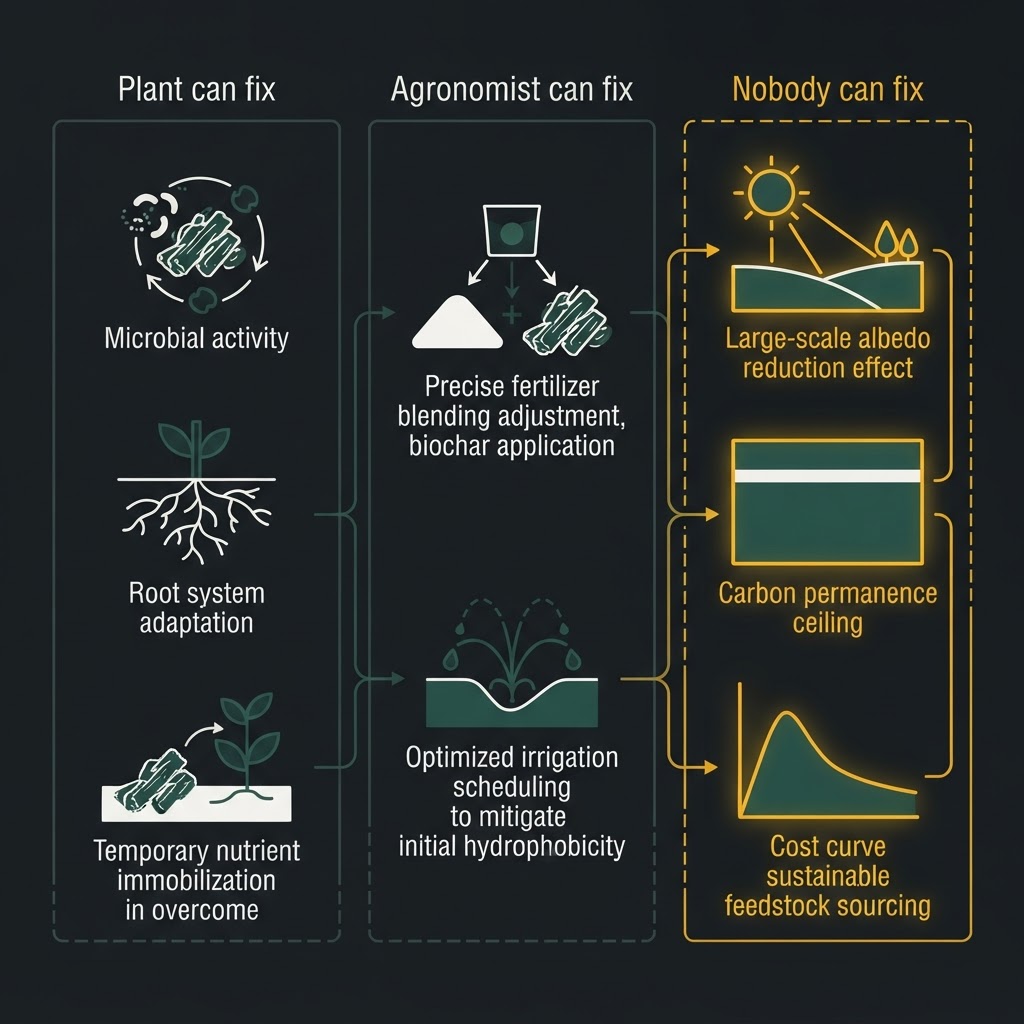
Biochar disadvantages are usually presented in one of two ways. Academic risk reviews list every pollutant and ecotoxicity result ever recorded, and gardening blogs offer a vague paragraph on cost and dust. Neither tells a project developer the thing that matters: which of these limits disappear with a well designed plant, which disappear with sensible dosing, and which never go away.
This article sorts the evidence that way. We design gasification and waste-to-energy plants in which biochar is a co-product of power and heat, and we run certification and MRV for the carbon it stores. So every limit below is a constraint we price into our own projects. Nature Reviews Materials put the frame well in 2023: biochar needs proper risk management and is not a magic bullet for green technologies. What follows is the detail behind that sentence.
The Short Answer: Eight Limits, Three of Them Structural
The eight disadvantages fall into four groups: agronomic, contaminant, climate accounting and economic. Five of them can be engineered or managed away. Three cannot: the albedo penalty, the permanence ceiling and feedstock scarcity. A biochar business case that survives only if those three are ignored is not a business case.
Agronomic Disadvantages: Biochar Can Lower Yields
Temperate soils gain little or lose
The yield promise comes from tropical soils. A 2019 trade-offs review in Land found that highly weathered acidic soils with low cation exchange capacity see an average yield increase of 25 percent, while biochar has no, very little, or even negative effects in temperate soil. For a German farm with a well buffered loam and full fertiliser inputs, the agronomic upside is close to zero before any cost is counted.
The downside is real. The 2014 Soil Research paper that first compiled the negative results reports yield reductions relative to controls of 27 percent for rice, 11 percent for wheat, 36 percent for maize, 74 percent for lettuce and 2 percent for tomato, and gaseous emissions from amended soils enhanced by up to 61 percent for CO2, 152 percent for methane and 14 percent for N2O. Those are worst cases from pot and incubation studies at application rates up to 20 percent by weight, not typical field outcomes, but they are the reason no serious agronomist promises a yield gain without a local trial.
Nitrogen immobilisation in the first year
The mechanism behind most temperate yield losses is nitrogen. A north-west European trial of willow and pine biochars made at 450 to 650 C found that biochar decreased soil nitrate availability and nitrogen use efficiency and reduced biomass yields compared to the control, with the reduction increasing with pyrolysis temperature. Note the direction: the hotter, more durable char that a carbon registry prefers is the one that ties up more nitrogen in the first season. A 2016 review in Environment International adds that 75 percent of soil fertility, remediation and crop production studies using biochar were not successful without amending fertilisers, and that pyrolysis is currently unprofitable with a cost-benefit ratio below 1.
Alkalinity, salinity and water in the wrong soil
Most biochar is alkaline. A 2025 review in Water reports that applications typically raise soil pH by 0.5 to 1.5 units and cut nitrate leaching by 15 to 70 percent in acidic soils, but in alkaline soils the buffering effect may be minimal or even adverse. The largest critical review of adverse soil effects, covering 259 studies, names the unfavourable combinations: high doses in clay soils are likely to decrease available water, surface application to sandy soils likely increases erosion and particulate emissions, and biochar may raise soil salinity and lower fertility in alkaline soils through nutrient precipitation. The same review records adverse effects on earthworm reproduction, growth and DNA integrity, and a shift in the fungi-to-bacteria ratio.
Verdict: every agronomic disadvantage is fixable by dose and siting, and none is fixable by the plant. Match the char to an acidic, nutrient-poor soil, keep rates moderate, and trial before scaling. In a temperate market, do not build the economics on soil benefit at all.
Contaminant Disadvantages: PAHs, Heavy Metals and Dioxins
Endogenous pollutants come from the feedstock
A 2025 review in the journal Biochar screened thousands of papers down to 164 and split the risk cleanly into endogenous pollutants, which arrive with the feedstock or form in the reactor, and exogenous ones, which the char adsorbs later. Its numbers are sobering: Collembola larvae fell by about 70 percent in soil with 25 percent pine biochar, exchangeable and reducible zinc reached 84.9 percent in food waste biochar made at 300 C, and a standardised method for assessing biochar risk is still lacking. Its remedy is the one a plant controls: unpolluted, high-lignin feedstock, controlled pyrolysis temperature to volatilise or stabilise pollutants, and no excessively fine particles.
Exogenous pollutants: biochar immobilises, it does not destroy
The same review makes a point the marketing material skips. Biochar does not remove pollutants from the environment; it reduces their mobility. Between 40.83 and 78.99 percent of cadmium adsorbed by biochar remained bioavailable in one study, and tetracycline adsorbed on high-temperature char was more bioavailable than on low-temperature char. As the char ages in soil its sorption capacity weakens and previously bound pollutants can be released. A remediation project that treats biochar as a permanent sink for metals is making a claim the literature does not support.
The sewage sludge case
This is where our own feedstock sits. A 2022 review in Energies summarises the pattern: sludge biochar contains more heavy metals and plant-derived biochar more PAHs, feedstock with high salt content can yield significant dioxins, and sewage sludge char made at 500 C was more toxic to Aliivibrio fischeri than char made at 600 C and 700 C, while dissolved organic matter from sludge char produced above 500 C showed no obvious risk. The same review notes that even a clean maize-cob biochar cut soil microbial biomass at 5 tonnes per hectare.
Temperature is therefore the lever, and consistency of the feed decides whether the lever holds. We have argued that thermal pre-treatment is non-negotiable for moisture reduction, energy density and homogenisation, and we built a MATLAB simulation suite for volatile organic compound emissions precisely because the drying and pre-treatment step is where overlooked emissions appear. The thresholds a batch is tested against are collected in our guide to biochar quality standards, and the sludge-specific trade-offs in biochar from sewage sludge.
Verdict: contaminant disadvantages are fixable, and fixing them is the plant's job. Feedstock selection, high and stable reactor temperature, particle size control and batch testing remove most of the risk. What no plant fixes is the exogenous problem: biochar in a contaminated soil is a holding pattern, not a cure.
Climate Accounting Disadvantages: The Tonne Is Smaller Than It Looks
Process emissions and the kiln problem
A comment in Nature Sustainability in January 2026 laid out the arithmetic that the industry prefers not to. Certified facilities produce roughly 350,000 tonnes of biochar a year worldwide; making it in modern slow-pyrolysis units that burn their own syngas emits around 3 kgCO2 per kilogram of char, crediting the roughly 70 percent stable fraction sequesters about 0.90 MtCO2 a year, and the net balance is at best a few hundred thousand tonnes negative, three orders of magnitude below the 0.3 GtCO2 a year once envisaged under realistic carbon prices.
Low-tech production is worse. Washington State University's 2023 assessment notes that the old slow-pyrolysis methods release significant quantities of methane and soot, making them unacceptable from the climate and air-quality perspectives. The benchmark these kilns are often compared against is open burning, which releases 4 to 9 grams of PM2.5 and 57 to 105 grams of carbon monoxide per kilogram of residue, and contributed 5 percent of global anthropogenic methane between 2000 and 2017. Beating open burning is a low bar. An RWTH Aachen supply-chain study excluded retort and top-lit updraft kilns from its analysis outright because of their high greenhouse gas process emissions.
Albedo: darker soil, warmer surface
Black char on a field lowers the surface albedo, so the soil absorbs more sunlight. The Land review estimates that this change reduces the climate benefit of biochar by about 13 to 30 percent. No methodology we know of deducts it, and no reactor design changes it. It is a structural cost of putting the char in soil rather than in concrete or another enclosed material.
Permanence is centuries, not forever
The November 2025 policy commentary by fourteen leading biochar researchers states that no carbonaceous material is completely inert and that persistence should be estimated on the order of centuries rather than millennia. That is still an excellent durability class. But it means a share of fresh char, on the order of the low tens of percent for mid-temperature material, is gone within decades, and every registry excludes it. Pushing for more durability costs energy: a 2025 paper in Environmental Research Letters finds that raising pyrolysis temperature by 100 C increases the energy requirement by about 20 percent, and that the standard single-parameter H/C model explains only 32 percent of the variance in durability. We unpack the three competing horizons in how long biochar stores carbon.
Low-carbon char from ash-rich feedstock
The disadvantage nobody on the SERP mentions is the one that matters most to a gasification operator. Woolf and colleagues' 2021 compilation shows organic carbon in char ranging from as low as 7 percent for gasification of biosolids to 79 percent for wood pyrolysed above 600 C. A sewage sludge char can be extremely durable per unit of carbon and still carry very little carbon per tonne, because most of its mass is ash. Durability and quantity are separate questions and a credit needs both. The upstream carbon balance is covered in how biochar removes CO2 from the air.
The counter-example shows what a clean plant achieves. An industrial techno-economic study of a 6.5 tonne-per-hour plant found that approximately 2.68 tCO2e are permanently removed per tonne of biochar after accounting for the full process footprint. That is the number to demand from any vendor, with the life-cycle boundary written down.
Verdict: process emissions are fixable by plant design and are the clearest line between a credible project and a kiln in a field. Albedo and the permanence ceiling are not fixable; they are deductions to carry honestly. The carbon fraction of ash-rich char is not fixable either, only measurable, which is why it has to be measured before offset volumes are promised.
Economic Disadvantages: Feedstock Eats the Margin
Cost per tonne spans an order of magnitude
The RWTH Aachen study puts total production cost at 113 to over 1,500 euros per tonne depending on region, with median costs below 300 euros per tonne in Sub-Saharan Africa, Latin America and South Asia because labour and biomass are cheap there. A forest-residue study for the US Pacific Northwest found a minimum selling price of 528 to 1,909 dollars per tonne applied to the field, with a global warming impact of 306 to 1,016 kgCO2eq per tonne depending on the conversion technology. A UK feasibility study spans minus 148 to 389 pounds per tonne produced, delivered and spread, the negative end only where the feedstock is a waste someone pays to remove. For the full cost stack see biochar production cost per ton.
Feedstock competition and the straw-removal limit
The Nature Sustainability comment identifies the structural cause: feedstock costs can comprise up to 75 percent of production expenses, systems are viable only with free residues or monetised carbon credits, and adoption remains uneconomical for smallholders without subsidies. Residues are not free in the agronomic sense either. The UK study assumes less than 50 percent of straw can be removed from a field without pushing soil organic carbon below a sustainable level. Scale a biochar industry on crop residue and you are competing with the soil you claim to improve.
The industrial study above is instructive on what makes the numbers close. Its internal rate of return of 22.35 percent required a price stack of 110 euros per tonne of CO2e removal plus 350 euros per tonne of biochar with feedstock at 45 euros per tonne, and a removal-only plant needed 206 euros per tonne CO2e just to reach profitability. One revenue line is not enough. This is why our public five-step process treats biochar plus verified offsets as one output of a plant whose first job is dispatchable electricity and heat from local biomass or sludge. The due-diligence side of the same question is in whether biochar carbon credits are reliable.
Verdict: partly fixable. A plant that sells power and heat, takes a disposal fee for the feedstock and sells the char and the credit on top can carry the cost. A plant that buys clean biomass to make char alone is exposed to the single disadvantage that has sunk the most projects.
Which Disadvantages a Plant Can Fix, and Which It Cannot
| Disadvantage | Fixed by | Owner |
|---|---|---|
| PAHs, heavy metals, dioxins | Feedstock selection, reactor temperature, particle size, batch testing | Plant |
| Process emissions, methane, soot | Closed reactor, syngas combustion, no open kilns | Plant |
| Inconsistent carbon fraction | Thermal pre-treatment, homogenised feed, measurement | Plant |
| Yield loss, nitrogen tie-up | Acidic nutrient-poor soils, moderate rates, local trials | Agronomist |
| Water, salinity, dust | Soil matching, incorporation not surface spreading | Agronomist |
| Albedo penalty | Nothing in soil; avoided only in enclosed uses such as concrete | Nobody |
| Permanence ceiling | Nothing; credit the stable fraction and say centuries | Nobody |
| Feedstock scarcity and cost | Nothing where biomass must be bought; mitigated by waste feedstock and co-products | Market |
The pattern is clear. The disadvantages the plant can fix are the ones a buyer can audit from the design and the lab report. The ones nobody can fix are the ones a developer should deduct up front. End markets for the char that avoid the soil questions entirely are the subject of our planned comparison of biochar vs activated carbon.
So what are the biochar disadvantages that should change a decision? Not the toxicity headlines, which good engineering removes. The three structural ones: the albedo cost of soil application, the centuries-not-forever permanence claim, and the price of feedstock. A project that has priced those three honestly is one we would build.
FAQ
Can biochar be harmful to soil?
Yes, in specific combinations. High doses in clay soils reduce plant-available water, surface application on sandy soils increases erosion and dust, and alkaline soils can see nutrient precipitation and rising salinity. Effects on earthworm reproduction and shifts in the soil microbiome are documented. Acidic, nutrient-poor soils at moderate rates show the opposite pattern.
Why does biochar reduce crop yield in some trials?
Mostly through nitrogen. Fresh char immobilises nitrate and lowers nitrogen use efficiency in the first season, and the effect is stronger for high-temperature chars. Soils that were already well buffered and well fertilised have little to gain from the pH and retention benefits, so the nitrogen penalty shows up as a net yield loss.
Is biochar toxic?
It can be, depending on feedstock and temperature. Sludge-derived char carries more heavy metals, plant-derived char more PAHs, and salty feedstock can produce dioxins. Higher and well controlled pyrolysis temperatures reduce all three, which is why certification schemes set contaminant thresholds and require batch analysis.
Does making biochar release CO2?
Yes. Modern slow pyrolysis that burns its own syngas emits about 3 kgCO2 per kilogram of char, and traditional kilns add methane and soot on top. A well designed industrial plant still removes about 2.68 tCO2e net per tonne of char, so the question for any project is the life-cycle boundary behind its number.
Is biochar a scam?
No. The chemistry and the durability class are real and well evidenced. The scale claims were not: certified global output is around 350,000 tonnes a year and net removal is a few hundred thousand tonnes of CO2, three orders of magnitude below early projections. Judge individual projects on their measured carbon fraction, process emissions and feedstock source, not on the sector's headlines.