
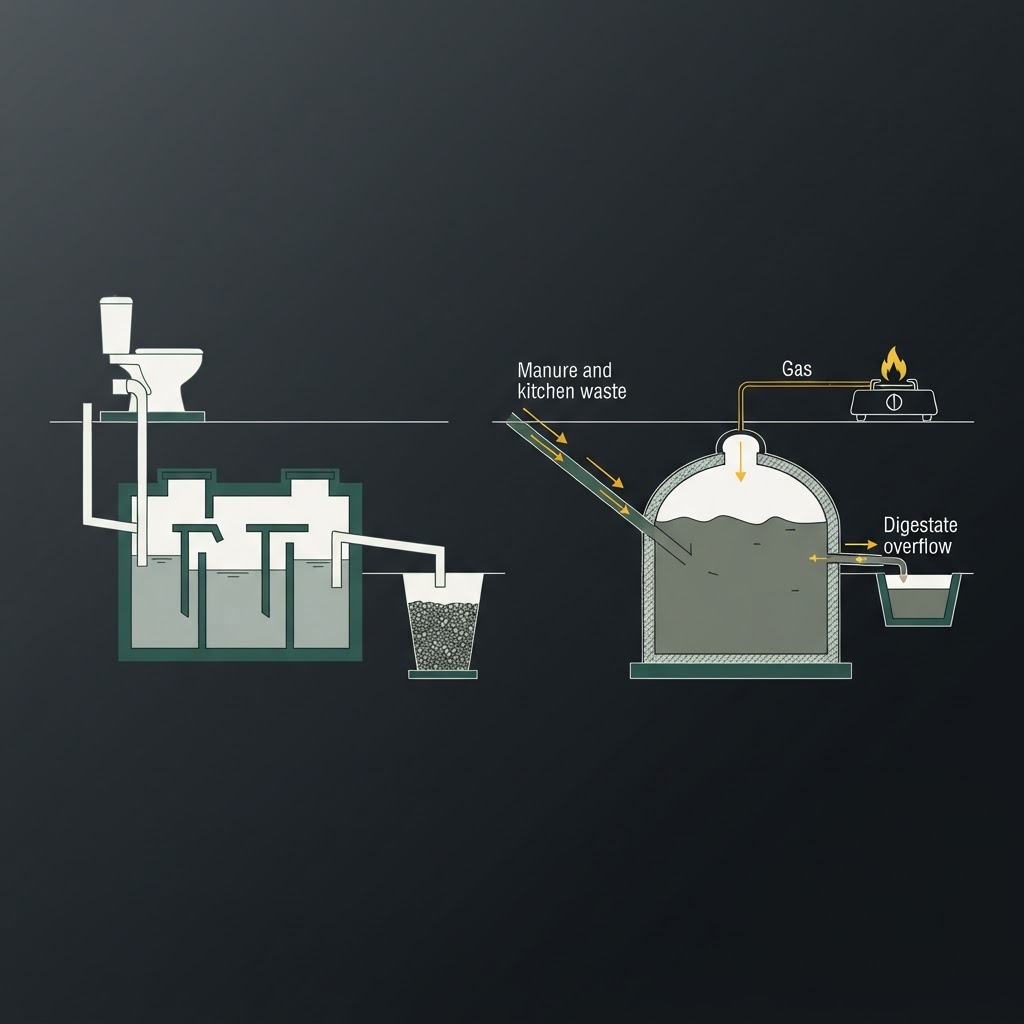
Biodigester vs biogas digester is not a question of brand names. In Nigeria the two words describe two different machines that happen to use the same microbes. A biodigester, as the term is used by Nigerian builders, is an on-site sewage treatment tank that replaces the septic tank. A biogas digester is an energy plant built to capture methane for cooking or power. A 2026 Nairaland thread puts the working distinction plainly: a standard biodigester is not primarily designed to collect gas, while a biogas digester is built with gas storage and collection.
That short answer is where most explanations stop. The useful part is why the two differ, because it decides whether the tank you are paying for will ever give you a cooking flame.
The short answer
| Biodigester (sanitation) | Biogas digester (energy) | |
|---|---|---|
| Design goal | Clean effluent, fewer desludgings | Maximum gas per kg of feed |
| Typical feed | Toilet wastewater (blackwater) | Manure, food waste, crop residues |
| Gas handling | Usually none, gas vents | Gas holder, outlet pipe, stove or engine |
| Main output | Treated effluent to soakaway or ET bed | Biogas plus digestate fertiliser |
| Sized by | Number of users and flush water | Kilograms of organic feed per day |
Both are anaerobic: bacteria break down organic matter without oxygen, and both produce some biogas whether you want it or not. What separates them is what the engineer optimised for.
Same microbes, different design target
What a biodigester is built to do
The German development agency's technology review of biogas sanitation draws the line clearly. Anaerobic wastewater treatment and biogas production use the same biological process, but the goal of wastewater treatment is to purify wastewater, rather than to produce biogas. A well designed biogas septic tank removes about 65% of solids, up to 60% of biochemical oxygen demand and roughly 90% of E. coli (a 1-log reduction). That is a septic tank upgrade, not a fuel plant.
The sanitation reference library SSWM describes the reactor in the same terms: it is often used as an alternative to a septic tank, offering a similar level of treatment. Household units start around 1,000 litres and institutional ones reach 100,000 litres.
The commercial benefit a Nigerian homeowner actually notices is maintenance. A training manual for biogas sanitation reports that these systems cut desludging from 6 to 12 times a year for toilet pits to once or twice a year, and produce up to 20 times less sludge than aerobic treatment.
What a biogas digester is built to do
An energy digester is designed backwards from gas demand. The feed is concentrated organic matter, the dome or bag is sized to hold gas, and there is a pipe to a stove, lamp or generator. A 2026 Nigerian farm design shows the logic: a 30 m3 fixed dome digester fed about 235 kg of mixed manure a day, sized to produce 13.15 m3 of biogas and 22.35 kWh of electricity daily. Every dimension in that design follows from the kilograms of feed, not from the number of toilets.
Why a toilet biodigester makes so little gas
This is the point Nigerian quotes blur most often. Gas comes from organic matter, and toilet wastewater is mostly water.
- Flush water dilutes the feed. The GTZ review states that a flush toilet produces wastewater unsuitable for a small biogas plant unless animal manure is added, and that toilet blackwater alone cannot produce enough biogas to cover a household's cooking or lighting.
- Human excreta alone is a weak substrate. The WHO sanitation fact sheet on toilets with biogas reactors notes that significant gas production would not be achieved from human excreta alone; co-digesting manure is what makes the numbers work.
- Greywater makes it worse. Shower and sink water shortens the time the waste spends in the tank, which SSWM warns substantially reduces treatment and gas output. Gas production is also limited below 15 degrees C, which matters less in Nigeria than in highland climates.
The scale gap is stark. In community biogas sanitation installations of 4 to 10 m3, the same digester served around 50 to 400 families for sanitation but only 7 to 20 families for cooking, according to the Gates Open Research manual. A tank that comfortably handles a whole compound's toilets may cook for one or two households.
For context on energy value, biogas carries about 6 kWh per m3, roughly half a litre of diesel, per the GTZ review. The sludge side of the question, how much gas municipal sewage solids actually yield, is covered in MFC Energy's measured biogas yields from sewage sludge.
Where the gas goes when nobody collects it
A biodigester without a gas outlet still makes methane. It just does not keep it. The Gates manual notes that in conventional septic tanks, Imhoff tanks and anaerobic lagoons, the biogas is vented, creating climate-critical emissions because of its methane content. The WHO fact sheet adds that even in a gas-tight reactor, gas that is not burned builds pressure, pushes digestate out and eventually escapes through the outlet.
From an engineering standpoint, that is the real cost of calling a sanitation tank a "biodigester" and leaving it there. The methane is a greenhouse gas when vented and a fuel when captured. Energaia's work sits on the capture side: our five-step process takes local biomass or sludge to syngas, dispatchable power and heat, biochar and verified CO2 offsets. At building scale the lesson is simpler. If a tank produces gas, decide at design stage whether it will be burned, flared or knowingly vented.
Can one tank do both?
Yes, if it is designed as a biogas plant that also takes toilet waste, not as a sanitation tank that is hoped to produce gas. The established form is the bio-latrine: toilets feed a fixed dome digester, often with kitchen waste or manure added. Practical Action's bio-latrines in four primary schools in Kitale, Kenya served 2,780 children and supplied gas to school kitchens. Even there, the same brief notes that bio-latrines place more emphasis on sanitation than on energy.
Two design details show the difference in priorities:
- Retention time. For human excreta the brief gives a retention time of 100 days, with fixed domes built for about 120 days as a safety factor so the waste leaves the system well treated. An energy digester on manure is sized for gas, and still needs its digestate handled with care.
- Chemistry. Antibiotics and disinfectants inhibit the bacteria. A household that pours bleach down the toilet will lose gas output first.
The WHO fact sheet is explicit that the digestate is not pathogen free and should not go directly onto crops without further treatment, whichever design you choose.
How to tell which one you are being quoted
Nigerian quotes use "biodigester" for both machines, so read the specification, not the name. A Lagos facilities firm prices household biodigesters at N500,000 to N1,500,000 while describing renewable energy and fertiliser benefits. An energy digester price list from a Nigerian builder starts at about N350,000 for a 1,000 litre unit giving roughly two hours of gas a day, rising to N2.8 million for 4 m3 and about eight hours. Similar money, different machines.
Ask the installer five questions:
- Is there a gas outlet and a gas holder? No outlet means a sanitation tank.
- What is the feed? Toilets only means little gas. Manure or kitchen waste means real gas.
- Where does the effluent go? A soakaway or ET bed points to sanitation design.
- How is it sized? By users and flush volume, or by kilograms of feed and cubic metres of gas per day?
- What gas output is promised, in m3 per day or hours of cooking? An installer who cannot answer is selling a septic replacement.
If the answer shows you actually need energy, compare the full numbers in our guide to what a biogas plant costs in Nigeria, and see where feedstock sits in our overview of biogas production in Nigeria. For estates and plants with sewage at scale, sewage sludge to energy covers the routes beyond digestion, and off-grid power options in Nigeria sets biogas against solar and diesel. Before committing steel, Energaia runs feasibility studies and process simulation so the tank is designed for the output you need.
FAQ
Can I cook with gas from my toilet biodigester?
Only a little, and only if it was built with a gas outlet and holder. Toilet blackwater alone cannot cover a household's cooking needs. Adding kitchen waste or animal manure raises output substantially.
Is a biodigester better than a septic tank?
It treats to a similar level but needs emptying far less often, typically once or twice a year instead of several times. Neither produces effluent safe to discharge directly into streams or onto crops.
Can I put toilet paper or bleach into a biodigester?
Toilet paper is not recommended because cellulose breaks down slowly and can block the system. Bleach, disinfectants and antibiotics inhibit the bacteria that do the treatment.
How long does a biodigester last?
A properly built and maintained unit lasts 15 to 20 years, according to one Lagos installer. Material quality, maintenance and feed composition shorten or extend that.