
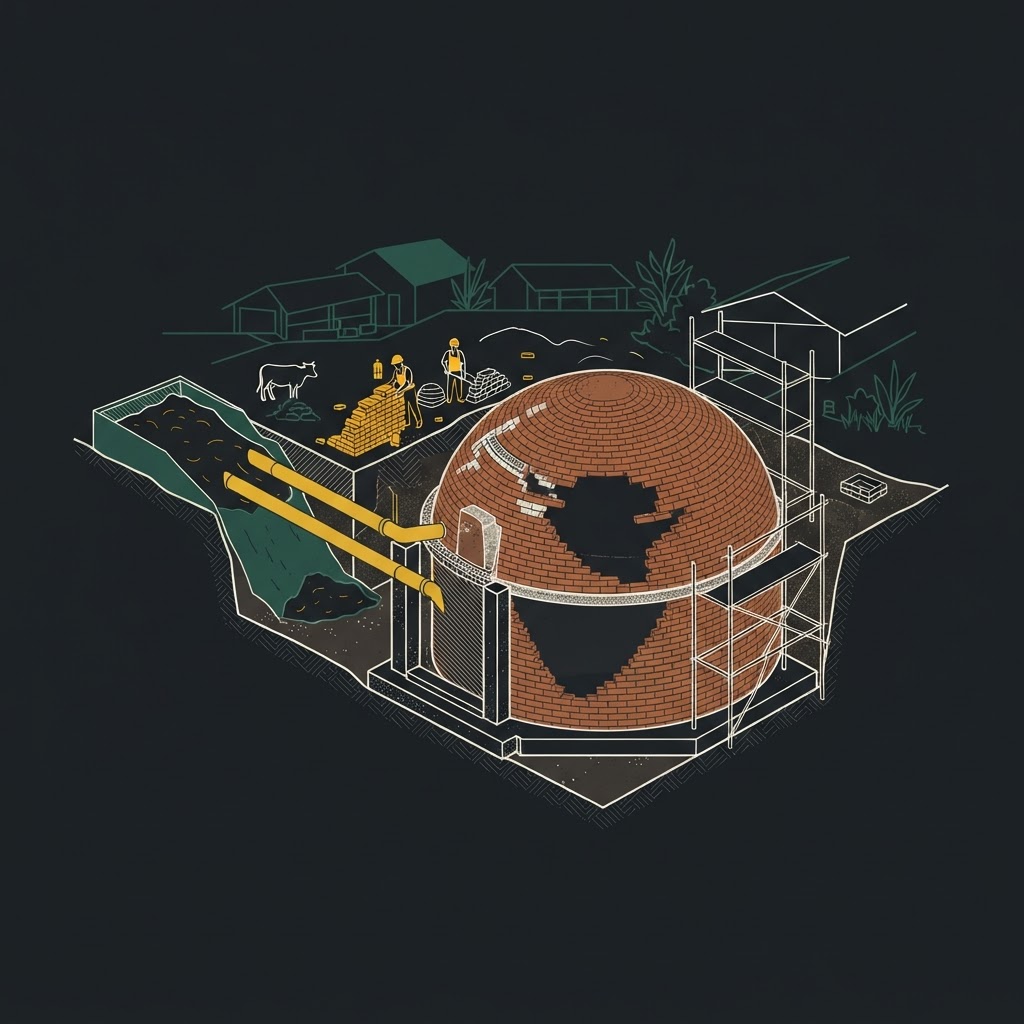
The cost of a biogas plant in Nigeria runs from a few hundred thousand naira to several billion, and the spread is not vendor noise. It reflects four different machines that share one name. A 1,000 litre kitchen unit is quoted at about N350,000. The one operating commercial digester in Lagos with published accounts, at the Oko Oba abattoir, cost N43,650,000 up front. A study of three community power plants in Anambra State priced them at 3.9 billion naira each.
This guide puts every tier on one ladder, each number traced to a Nigerian source, and then explains the part most price lists leave out: why the size of the tank tells you far less about payback than what you feed it and what you sell.
The short answer: four cost tiers
| Tier | Typical capex | What you get | Source |
|---|---|---|---|
| Household cooking | N350,000 to N2.8 million | 1,000 L to 4 m3, two to eight hours of cooking gas a day | nigerianhouseplans.com |
| Farm power | Payback reported at 5.5 months | 30 m3 digester running a 3.7 kW load up to six hours a day | AJSTEA 2026 |
| Commercial (abattoir) | N43.65 million | 330 kg of waste a day, on-site power and process heat | RMI 2024 |
| Municipal | USD 256,500 total investment | 80 tonnes of municipal waste a month into cooking gas | JEPT 2023 |
Read the tiers as different products, not as small, medium and large versions of one product. The household digester replaces LPG or firewood. The farm and commercial plants replace generator diesel and charcoal. The municipal plant sells gas or power to third parties. Each earns its money differently, which is why their payback periods differ by a factor of twenty.
Household and small farm digesters
What the naira buys at each size
A Nigerian builder's published price list gives the clearest household ladder: a 1,000 litre unit taking about 30 kg of waste for roughly two hours of gas a day at N350,000, then 1 m3 at N1.2 million, 2 m3 at N1.8 million, and 4 m3 taking 120 kg of waste for about eight hours of gas at N2.8 million. A Lagos facilities firm puts household units at N500,000 to N1,500,000, but read its page carefully: in Lagos the word "biodigester" usually means an on-site sewage treatment system that replaces a septic tank. Gas is a side effect, not the design goal. We unpack that difference in biodigester vs biogas digester.
For a dedicated family energy digester, a peer-reviewed benefit to cost study gives USD 1,400 to 1,900 for a 10 m3 digester in Nigeria, against USD 870 to 1,500 in Rwanda. The same study found an 8 m3 unit paid back in about three years without subsidy, with a benefit to cost ratio of about 3.91. The fixed dome design dominates Nigerian installations and needs at least a mason and a plumber to build.
Why old price quotes mislead
Search results still surface quotes that are no longer usable. In 2019 the National Biotechnology Development Agency described its biodigesters as costing N75,000 to N150,000. A 2014 Kano survey modelled a fixed dome plant at N80,000, then USD 500. Both figures were real at the time. Neither survives naira depreciation and post-2023 materials inflation, and a budget built on them will stall at the foundation. Use any quote older than about two years as a structural reference, never as a price.
Farm biogas for electricity
This is where the economics changed most, and where the fuel subsidy removal matters more than the digester itself. A 2026 design study of a mixed farm with 10 cattle, 20 pigs and 500 birds found that fuelling a standard 5 kVA generator rose from about N1,500 a day to over N8,000 a day after the 2023 subsidy removal. Its proposed system is a 30 m3 fixed dome digester fed about 235 kg of mixed manure daily, producing 13.15 m3 of biogas and 22.35 kWh of electricity a day, enough to run a 3.7 kW load for up to six hours.
The result the authors report: monthly energy spend falling from N319,000 to N14,000, plus an estimated N168,000 a month from selling digestate as fertiliser, for a payback of 5.5 months. The study builds with locally sourced burnt bricks and cement and cites fixed dome lifetimes beyond 20 years. Treat the payback as a modelled figure for a well-run farm, not a guarantee, but note the mechanism: the more expensive the fuel you displace, the faster any digester pays for itself. Our breakdown of what diesel generator power really costs shows why that displaced fuel is now the biggest line in the business case.
A real pilot sets a floor for what a funded demonstration costs. At Animal Care's poultry farm in Lagos, Lumos Labs built a pilot digester on GBP 25,000 of seed funding with the potential to turn 200 kg of raw poultry manure into 62.5 kWh of electricity a day. The farm produces about 25 tonnes of manure daily, and the pilot handles roughly 10% of it. That gap between waste available and waste used is typical, and it is where the next investment decision sits.
Commercial scale: the Oko Oba abattoir numbers
The RMI case study of the Oko Oba abattoir is the most useful document in this search space because it describes a plant that actually ran. Before storm damage in 2022, the digester processed about 300 kg of animal waste and 30 kg of market food waste a day, against a design capacity of 500 kg. About 30% of the gas ran a generator covering all office power; the rest heated water for cleaning 50 animal skins a day, displacing part of the charcoal previously burned.
The numbers:
- Up-front capex: N43,650,000, about USD 103,000, most of it equipment.
- Return at current scale: an IRR of 6% and a payback of roughly 12 years.
- Full fuel switch: replacing all the charcoal lifts IRR to 14% but needs roughly USD 129,000 (N45,798,000) more capex in the expansion year.
- Policy lever: a 30% investment tax credit adds about 2 percentage points of IRR and shortens payback by six months.
- Resilience cost: the owner puts the full repair after the storm at N36 million.
Two lessons carry to any commercial project. First, a digester sized well below the site's fuel demand earns little, because the expensive part of the plant is fixed while the savings scale with gas. Second, budget for weather, maintenance and repair from day one; the repair bill here approaches the original capex. For wider sizing options, see our upcoming guide to biogas plants for industrial use.
Municipal and utility scale
At municipal scale, the cost stack widens beyond the digester. A techno-economic study for a residential estate in Ibadan priced the biogas plant itself at USD 120,000, using USD 1,500 per tonne of monthly feedstock for 80 tonnes of municipal solid waste. Land for five acres added USD 90,000, buildings USD 24,000, and working capital brought total investment to USD 256,500, with USD 22,500 of annual operating cost. Selling upgraded gas for cooking at USD 0.50 per m3 produced a 16% annual ROI and a payback of four to seven years.
A Lagos feasibility study for a sewage plant reached the opposite verdict. Using a midrange of about USD 1,300 per m3 of digester volume, a 1,000 m3 plant came to USD 1.3 million, operating costs were set at 3% of capex, and gas sales alone could not cover a levelised cost of USD 0.78 per m3 against cheap natural gas. The project only turned profitable once it also charged for septic tank evacuation.
The Anambra study quoted above shows the scale effect directly: its most viable option worked out at USD 2,892 per kW, and the international comparison it cites found a 1,000 kW plant breaking even in 4 years against 10 years for a 100 kW plant. The same review is blunt that backyard systems "are hardly profitable". Bigger plants cost more in total and less per unit of output, provided the feedstock is actually there. Our overview of biogas production in Nigeria maps where that feedstock sits.
What actually drives the cost
Feedstock tonnage, not digester volume
Every viable project above starts from a measured waste stream: 235 kg a day on a mixed farm, 330 kg at an abattoir, 80 tonnes a month from an estate. Digester volume follows from feedstock and retention time. Sizing the tank first and hunting for waste afterwards is how plants end up running at a fraction of capacity.
End use decides revenue
The same gas is worth very different amounts depending on what it replaces. Displacing generator diesel at post-subsidy prices produced the 5.5 month payback. Competing with pipeline natural gas in Lagos produced a negative NPV. Before choosing a digester, work out what each cubic metre is worth to you, and compare it against the cost of electricity per kWh in Nigeria on your feeder.
Hidden line items
Equipment dominated the Oko Oba capex. Land and buildings added more than the plant itself in Ibadan. Operators, water, desludging and repairs recur every year. A quote that covers only the dome and the piping covers perhaps half the project.
When biogas is the wrong tool
Anaerobic digestion is the right process for wet, easily degraded waste: manure, abattoir slurry, food waste, sewage. It is the wrong process for dry, woody or fibrous residues such as rice husk, maize cobs, sawdust or dried sludge, which digest slowly or not at all. For those, thermal conversion is the better fit. Energaia's own five-step process gasifies local biomass or sludge at high temperature into clean syngas, converts it to dispatchable electricity and heat, and captures biochar and verified CO2 offsets on site.
Many Nigerian sites have both streams. If yours does, compare the two routes on the same basis: biomass gasification cost covers the thermal side, and our wider waste-to-energy plant cost guide puts both in one frame.
How to price your own plant
- Weigh your waste for two weeks. Daily tonnage and moisture decide the technology and the size.
- Name the fuel you will displace and its current price. That is your savings line.
- Stack the revenue: gas or power, digestate as fertiliser, waste handling fees, and carbon credits where methane is avoided.
- Cost the full project, including land, buildings, operators and a repair reserve.
- Model before you buy steel. Energaia runs feasibility studies and simulation of the process before a project is built, because a wrong feedstock assumption is cheapest to fix on paper.
FAQ
How much does a small biogas plant cost in Nigeria?
Published household prices run from about N350,000 for a 1,000 litre unit to N2.8 million for a 4 m3 digester. Check whether the quote is for an energy digester or a sanitation biodigester, since the two are built for different jobs.
How long does a biogas plant take to pay back in Nigeria?
Anywhere from months to over a decade. A farm system displacing generator diesel was modelled at 5.5 months, while the Oko Oba abattoir, displacing only part of its charcoal, sits near 12 years. The price of the fuel you replace is the biggest variable.
Can a biogas plant replace a generator on a Nigerian farm?
Partly. A 30 m3 digester on a farm with 10 cattle, 20 pigs and 500 birds was designed to run a 3.7 kW load for up to six hours a day. Round-the-clock supply needs more feedstock, a larger digester, or a hybrid with solar or the grid.
Is it cheaper to build a bigger biogas plant?
Per unit of output, yes, if the feedstock exists. Larger plants reach breakeven faster, but a large digester without the waste to fill it is the most expensive option of all.