
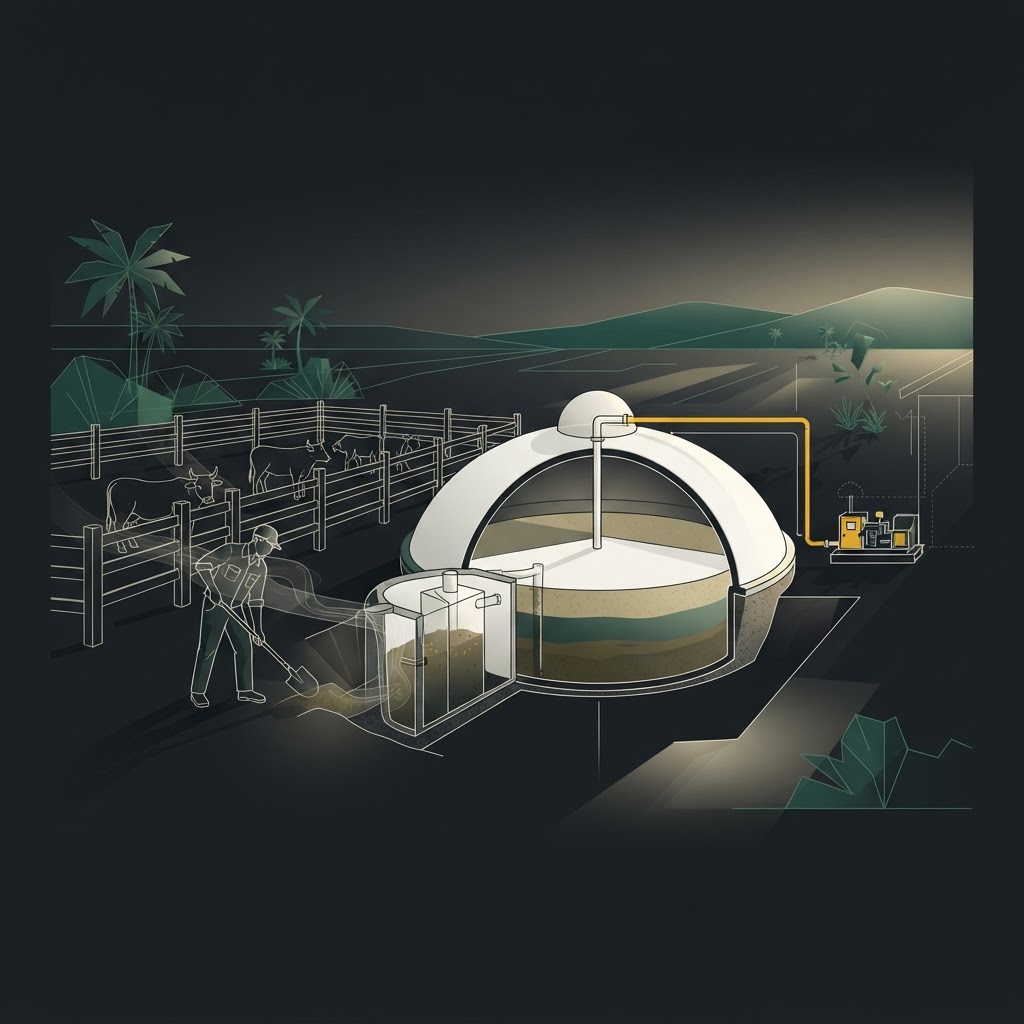
Biogas production in Nigeria is a story of two very different numbers. One study puts the country's organic waste at about 591 million tonnes a year, enough for 32.29 billion m3 of biogas, or roughly 178.9 million MWh of energy. The best documented commercial digester in the country, at the Oko Oba abattoir in Lagos, was fed about 330 kg of waste a day before a storm stopped it in 2022.
That gap, between a national potential measured in billions of cubic metres and operating plants measured in hundreds of kilograms, is the real subject of this guide. We map the feedstock Nigeria actually has, list the projects with published output, and then work through the four reasons production has stayed small. Every number is traced to its source, and computed potentials are labelled as what they are: estimates, not measured gas.
What biogas production in Nigeria looks like today
Anaerobic digestion is the most studied waste-to-energy route in the country. A review of Nigerian work from 1997 to 2020 found that agricultural, municipal and industrial wastes all have viable biogas potential, and that researchers favour digestion for its simplicity and low cost. The same review concludes that most of that waste is underused because nobody has quantified it at the site where it is produced.
So the picture is this: a large, mostly rural feedstock base, decades of laboratory and pilot work, a short list of plants that have run for real, and a national policy that only recently began to name biogas at all. The sections below take those four pieces in turn.
The feedstock: what Nigeria has to digest
Livestock and abattoir waste
The arithmetic starts with the animal. A 2026 design study for a Nigerian mixed farm uses 10 kg of dung per cow per day, 3 kg per pig and 0.15 kg per bird. Ten cattle, twenty pigs and five hundred birds therefore produce about 235 kg of feedstock daily, which the study's 30 m3 fixed-dome digester turns into 13.15 m3 of biogas and 22.35 kWh of electricity a day. A 2024 policy review gives the herd-scale version of the same sum: 100 cows produce 6.25 tonnes of waste every day, and the microbes in a digester convert only 20 to 30 percent of the volatile compounds into gas. The rest leaves as digestate.
Abattoirs matter because they concentrate this waste in one place with a buyer for the energy on site. Oko Oba in Lagos co-digested cow and goat dung with food waste from a neighbouring market. The Karu abattoir study in Anambra State sized a 273 kW plant on slaughterhouse waste alone.
Crop residues
Crop residues are the largest single stream and the one most often misread. An inventory built on 2008 to 2018 production data found a technical crop residue potential of 84 million tonnes a year, equivalent to 15,014 million m3 of biogas, or about 13 million tonnes of oil equivalent. The caveat is in the chemistry. Straws, stalks, cobs and husks are dry and lignocellulosic. They digest slowly, and the inventory's own method has to model a pre-treatment scheme to unlock the figure, a step few Nigerian sites have. We return to this in the section on process choice, because for much of this stream thermal conversion is the better tool.
Municipal and sewage waste
Cities add food waste and sewage. The estimate quoted in the introduction counts human excreta, abattoir waste, poultry and cattle manure, crop residue and municipal waste together to reach its 591 million tonne figure, and argues that the resulting gas could replace kerosene for domestic cooking and cut fuelwood consumption by 70 percent, in a country that burns more than 50 million tonnes of fuelwood a year.
Sewage works are a specific opportunity because the waste is already collected. A BioWin simulation of the two treatment plants in Owerri predicted 1,550 m3 of biogas a day between them, at 60.5 percent methane, enough for about 3,120 kWh of electricity daily or 1.14 GWh a year. That would cover 39.5 percent of the plants' own demand and, at a tariff of N120 per kWh, save about N136.7 million a year. The authors are clear that this is a modelled result, not an operating plant.
Real Nigerian biogas projects and what they actually produce
Oko Oba abattoir, Lagos
The RMI case study of Oko Oba is the most useful operating record in the public domain. Before the 2022 storm, the privately owned digester processed about 300 kg of animal waste and 30 kg of market food waste a day, against a design capacity of 500 kg. Roughly 30 percent of the gas ran a generator that covered all office and personal electricity on site. The rest heated water for cleaning the skins of 50 animals a day, displacing part of the charcoal the abattoir previously burned. At that scale the project returned an IRR of about 6 percent. Expanding to displace all the charcoal lifts the IRR to about 14 percent, but needs an additional 125 percent of the original capex in the expansion year, and shortens the payback only from 11.2 to 10.5 years. Our breakdown of the cost of a biogas plant in Nigeria puts these numbers next to the household, farm and municipal tiers.
Farm scale: the 3.7 kW design and the Lagos poultry pilot
The mixed farm design cited above is modelled, but it is modelled on Nigerian inputs: a 27 degree ambient temperature in the rainforest zone, locally built fixed-dome construction, and generator fuel priced after the 2023 subsidy removal. Its digester runs a 3.7 kW load for up to six hours a day and cuts the farm's monthly energy spend by about 95 percent.
A real pilot sits beside it. At the Animal Care poultry farm in Lagos, Lumos Labs built a digester with the potential to turn 200 kg of raw poultry manure into 62.5 kWh of electricity a day. The farm produces about 25 tonnes of manure daily. The pilot handles roughly 10 percent of it. That ratio, a digester sized far below the waste stream beside it, is the single most common shape of a Nigerian biogas project.
Municipal and community scale
Larger plants exist mostly on paper, but the paper is detailed. A techno-economic study for a residential estate in Ibadan sized a plant on 80 tonnes of municipal solid waste a month, costing USD 120,000 for the digester and USD 256,500 in total with land, buildings and working capital, and found a 16 percent annual return with a payback of four to seven years when the upgraded gas was sold for cooking. The Anambra study of three community power plants reached the scale conclusion that every developer should carry: a 1,000 kW plant breaks even in about four years against ten years for a 100 kW plant, and backyard systems are hardly profitable at all.
Why so few plants scale
Policy names no biogas instrument
The 2024 review of more than 70 scientific articles identifies policy as the main factor limiting biogas penetration in Nigeria, and its central finding is specific: the national energy policy promotes biomass in general but lists no technology or programme to aggregate and deploy biogas. Social acceptance, awareness and feedstock availability follow as secondary barriers.
Newer documents have started to fill the gap, modestly. The National Clean Cooking Policy targets universal clean cooking access by 2030 with LPG carrying 54 percent of delivered energy, efficient biomass stoves 13 percent, and biogas 3 percent, alongside 5 percent each for liquid biofuels and briquettes. The Energy Transition Plan expects cooking emissions to fall by about 98 percent through a shift to LPG first, then to electric cooking and biogas, the latter mainly in rural homes after 2030. Biogas is now in the plan. It is still the smallest line in it, and there is no feed-in, grant or digester programme attached to the number.
Feedstock logistics
Every project above started with a waste stream and most ran well below it. Oko Oba operated at about two thirds of design capacity. The poultry pilot used a tenth of the manure on the farm. The reasons are mundane: collecting, sorting and feeding waste every day is labour, moisture and contamination vary with the season, and a digester starved for a week loses its biology. National potential figures assume collection of everything. Real plants collect what one operator can move with a wheelbarrow.
End use decides the economics
The same cubic metre of gas is worth very different amounts depending on what it replaces. Oko Oba displaced charcoal and part of a generator's fuel and earned a 6 percent IRR. The mixed farm design displaces post-subsidy generator fuel and models a 95 percent cut in energy spend. A sewage works displacing grid power at N120 per kWh models nine-figure naira savings. Before sizing a digester, a developer should price the fuel it will replace, which is why our guides to diesel generator alternatives for Nigerian businesses and off-grid power solutions in Nigeria start from the displaced cost rather than the technology.
Resilience and maintenance
Oko Oba was economically viable while it ran. A storm stopped it in 2022, and it had not restarted when RMI assessed it, with the owner still seeking funds to repair and resume. The one documented failure in this article was mechanical, not biological: a broken plant, not a broken process. A project plan without a maintenance and weather reserve is a pilot, whatever its nameplate says.
Digestion or gasification: matching the process to the waste
Anaerobic digestion is the right process for wet, readily degradable waste: manure, abattoir slurry, food waste, sewage sludge. Every real Nigerian success in this article ran on one of those. It is the wrong process for dry, woody or fibrous residues such as rice husk, maize cobs, sawdust or dried sludge, which is most of the 84 million tonne crop residue figure. Those materials digest slowly or not at all, and the biogas potential ascribed to them depends on pre-treatment steps that rarely exist on site.
For that stream, thermal conversion is the better fit. Energaia's own five-step process collects local biomass or sludge, gasifies it at high temperature into clean syngas, converts the syngas into dispatchable electricity and heat, captures biochar and verified CO2 offsets, and runs the whole chain on site. Many Nigerian sites have both streams: a farm with manure and maize stalks, a city with sewage and market waste. The honest comparison is on the same basis, which is what our biomass gasification cost and waste-to-energy plant cost guides provide. For sites whose gas demand is industrial rather than domestic, our forthcoming guide to biogas plants for industrial use covers the sizing question, and if you are being quoted a "biodigester" in Lagos, check our note on biodigester vs biogas digester first, since the word usually means a sanitation system there.
What a credible Nigerian biogas project starts with
- Weigh the waste for two weeks. Daily tonnage and moisture decide whether the stream digests or gasifies, and what size of plant it can actually feed.
- Name the fuel you will displace and its current price. Charcoal, generator diesel and grid power give three different business cases from the same gas.
- Size the plant to the stream you can collect, not to the stream that exists on paper.
- Budget for weather and maintenance from day one. The projects that stopped did not stop because of the microbes.
- Model before you buy steel. Energaia runs feasibility studies and process simulation before a plant is built, because a wrong feedstock assumption is cheapest to fix on paper.
FAQ
How much biogas can Nigeria produce?
Published estimates range from about 15,014 million m3 a year from crop residues alone to 32.29 billion m3 a year when livestock, human and municipal waste are included. Both are computed potentials that assume full collection; measured national output is a tiny fraction of either.
Which waste gives the most biogas in Nigeria?
Per head, a cow yields about 10 kg of dung a day, a pig 3 kg and a bird 0.15 kg, so 100 cows produce roughly 6.25 tonnes of waste daily. Abattoirs, large livestock farms and sewage works concentrate the wet, fast-digesting feedstock that real Nigerian plants have run on.
Is biogas part of Nigeria's energy policy?
Only recently and only in cooking. The National Clean Cooking Policy allocates biogas 3 percent of clean cooking energy by 2030 and the Energy Transition Plan expects it mainly in rural homes after 2030. A 2024 review found the national energy policy still names no instrument to deploy it.
Can biogas generate electricity in Nigeria?
Yes, at small scale. A 235 kg per day farm digester is modelled to deliver 22.35 kWh a day, the Oko Oba abattoir ran its office on about 30 percent of its gas, and the two Owerri sewage works are simulated to produce 3,120 kWh a day. None of the published Nigerian studies reviewed here describes a grid-scale biogas power plant in operation.