
A biogas plant for industrial use stands or falls on one question that most vendor pages skip: can bacteria actually break down the waste your factory produces? Wet, sugary, high-strength streams from breweries, starch mills, abattoirs and dairies digest well and can cover a real share of a site's steam or power. Dry, woody residues barely digest at all. Brewers in Africa already show both sides: in Nigeria, biogas from wastewater treatment plants fires brewery boilers, while Guinness owner Diageo sends dry biomass such as rice husk and wood chip to boilers at its East African sites.
This guide sorts industrial waste by what anaerobic digestion can and cannot do, matches each stream to a reactor type, and shows what operating plants from Lagos to Indonesia actually deliver.
What a biogas plant for industrial use actually is
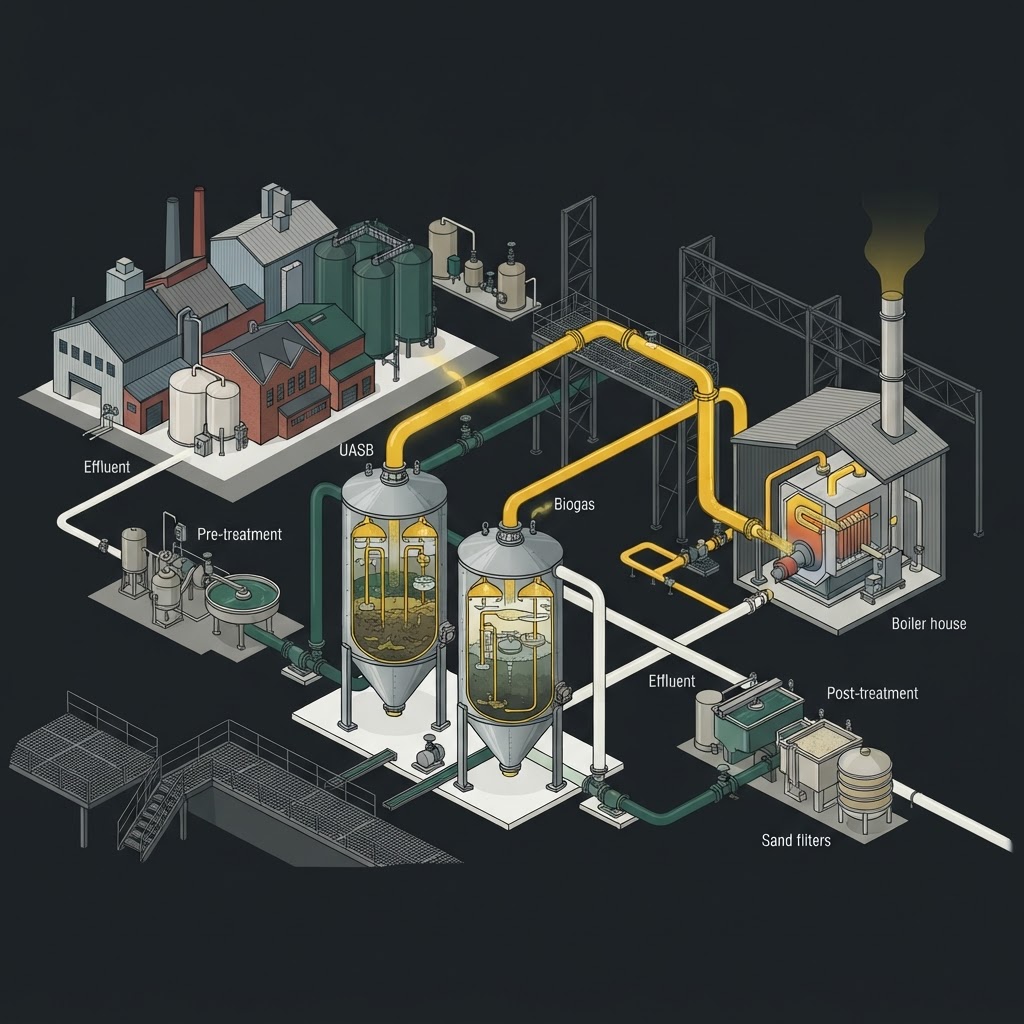
An industrial biogas plant is an anaerobic digester built into a factory's own waste and energy flows. It takes the site's effluent or organic residues, turns part of the organic load into methane-rich gas, and sends that gas back into the plant as steam, heat or electricity. UNIDO's guidebook puts medium to large biogas plants at 100 m3 to more than 10,000 m3 of digester volume, producing 50 kWe to 5 MWe, and notes that they need experienced contractors and skilled operators to keep running.
The part buyers underestimate is that no two industrial plants are the same. The IEA's 2025 report on the food and beverage sector says industrial AD facilities still need to be tailor-made, because their economics depend on site parameters and feedstock characteristics. It also recommends a cascading approach: reuse by-products as food or feed first, and digest what is left.
The test that decides everything: can microbes eat your waste?
Wet, high-COD streams digest well
Anaerobic digestion is a biological process, so it rewards material that bacteria break down easily. A review of biomass recalcitrance reports methane yields of up to 450 mL CH4 per gram of volatile solids from sugar and starch crops, against no more than 330 mL for lignocellulosic biomass. The same review finds that each 1% rise in lignin content cuts methane output by about 7.49 L per kg of total solids.
That is why food and beverage effluents are the classic industrial feedstock. They are wet, high in dissolved organics (measured as chemical oxygen demand, COD) and mostly free of the woody fibre that slows digestion down.
Lignin is where digestion stops
Lignin, the structural polymer in wood, husks and stalks, is not degraded under anaerobic conditions. In that study, untreated wood fibre produced no biogas at all after 20 days in a digester. A review of plant feedstocks concludes that high-lignin woody substrates are more suitable for gasification or incineration than for biogas, and notes that digestion is generally considered profitable only above about 30 m3 of biogas per tonne of material treated.
Fibrous crop residues sit in between. With 10 to 25% lignin, straw and stalks can work when co-digested with nitrogen-rich manure, but only with pre-treatment or careful blending.
Industry by industry: which streams belong in a digester
Breweries and beverages
Brewing is the best-documented industrial biogas case. Each hectolitre of beer leaves about 20 kg of spent grain and 300 litres of wastewater, and breweries need saturated steam for brewing and bottle washing. The wastewater goes to the digester, while the spent grain usually goes to animal feed first.
Nigeria already runs this model. Nigerian Breweries says it uses biogas from its wastewater treatment plants to power its boilers. At its Aba brewery the company reported 6.38 MJ of biogas per hectolitre, covering 10% of the brewery's thermal energy requirement. A turnkey plant near Lagos for a global brewer recovers biogas that generates up to 15% of the brewery's fossil fuel demand for steam. Its contractor called it their tenth biogas-for-steam installation in Africa.
The useful lesson is that 10 to 15% is the realistic range here. In a brewery, the digester is mainly a wastewater treatment asset that also saves fuel. It does not replace the boiler.
Cassava, starch and sugar
Starch processing produces large volumes of strong wastewater. A study of southwestern Nigeria estimated effluent volumes of 9,554 m3 per day from cassava flakes, 4,806 m3 from beer and 2,768 m3 from sugar refining, and cited earlier work showing that half of the region's food and beverage effluent is discharged untreated.
The upside is clearest in Indonesia. The Hamparan cassava starch factory produces about 40,000 tonnes of starch a year. Its covered anaerobic lagoon feeds two 1.5 MW gas engines that exported 9,372,204 kWh to the grid in 2024 and removed over 98% of the organic pollution from the wastewater. Closer to home, a case study from Bayelsa State describes a cassava starch factory where peels, roots and washing water feed anaerobic reactors whose gas runs engines, producing hot water and electricity for the factory and the surrounding village. The same paper puts biogas at 50 to 75% methane, with a net heating value of 20,000 to 24,000 kJ per Nm3.
Abattoirs and meat processing
Slaughterhouse waste is wet, rich in protein and fat, and a hygiene liability if left untreated. At Ibadan's Bodija abattoir, about 1,000 cattle a day were estimated to yield 1,500 m3 of biogas a day, at a planned capital cost of US$480,000.
The smaller Oko Oba abattoir in Lagos shows how the economics change with scale. Digesting about 330 kg of waste a day, it cost N43.65 million up front and returned an IRR of 6%, rising to 14% if fully expanded, with payback around 11 years. Our guide to the cost of a biogas plant in Nigeria breaks those numbers down tier by tier.
Dairy and agro-processing
The same industrial review puts dairy wastewater at 0.4 to 0.5 m3 per cubic metre of processed milk, a stream that must be treated anyway. In Kenya, agro-processors have gone further. An IEA workshop paper documents Olivado's two digesters with 1,400 m3 of capacity running on avocado residues, and Vegpro's 2.4 MW plant fed 150 tonnes a day, which replaced 6 million litres of diesel. For a Nigerian processor running generators, that diesel line is the one to compare against, as our note on alternatives to diesel generators for Nigerian businesses sets out.
Matching the reactor to the stream
Once you know a stream digests, its solids content picks the reactor:
| Stream | Typical reactor | Why |
|---|---|---|
| Low-solids wastewater (brewery, beverage) | UASB or similar high-rate reactor | Fast treatment in a small vessel, but intolerant of suspended solids |
| Wastewater high in solids or fats (meat, dairy) | Anaerobic contact process | Handles suspended solids and FOG without build-up |
| Slurries and mixed residues | Complete mix (CSTR) | Tolerant, simple, larger volume |
| Large, dilute starch effluent | Covered lagoon | Low cost per m3 where land is available |
A US food-processing casebook explains the trade-off well. Upflow anaerobic sludge blanket (UASB) systems process wastewater faster in a smaller vessel but do not tolerate high suspended solids, while contact process systems handle solids, fats, oils and grease. A Norwegian design study makes the size difference concrete. For 150 m3 a day of wastewater at 70 kg COD per m3, both designs reached about 4,130 m3 of methane a day, but the UASB needed four 636 m3 tanks while the contact process needed 1,526 m3 plus 5,941 m3.
If a vendor quotes a "biodigester" before characterising your stream, check what they mean: in Lagos the word often refers to a sanitation tank, as explained in biodigester vs biogas digester.
Where the gas goes: steam, power or both
Most factories need a mix of heat and power, and many already cover both with natural gas, which is why biogas is usually treated as a direct substitute. Breweries mostly burn it in boilers because steam is their largest thermal load. Making electricity costs more: UNIDO notes that a combined heat and power unit costs more than a simple genset. At Bodija the planners estimated the gas could make about 3,600 kWh of electricity a day, but they chose cooking gas instead because power generation needed so much capital.
The rule of thumb is to put the gas where it displaces the most expensive fuel you burn on site, and to size the plant from that use backwards. For the sizing and payback mechanics, MFC Energy's guide on how to size a commercial biogas plant and estimate payback goes deeper than we do here.
When an industrial site needs a gasifier instead
Diageo's sub-Saharan programme, worth N79.1 billion across 11 breweries, includes biomass boilers burning bamboo, wood chip and rice husk at sites in Kenya and Uganda. So brewers digest their wastewater and burn their dry biomass: one industry, two processes, each matched to its stream.
Many Nigerian industrial sites have both kinds of waste. A rice mill has husk, a sawmill has sawdust, a cassava processor has wet peels and dry stems. For the dry fraction, thermal conversion is the better route. Energaia's five-step process gasifies local biomass or sludge into clean syngas, turns it into dispatchable electricity and heat, and captures biochar and verified CO2 offsets, all on site. Our explainers on how biomass gasification works and on biomass gasification cost let you compare the two routes on the same basis.
A five-step feasibility check before you buy steel
- Characterise every stream for two weeks. Measure flow, COD, solids, fats and moisture. The IEA report treats feedstock analysis as the starting point of any industrial project.
- Split wet from dry. Wet, low-lignin streams go to the digester. Woody, dry streams go to a thermal route or to co-digestion only if the blend works.
- Name the fuel you will displace and what it costs: boiler gas, generator diesel or grid power.
- Size to the waste you reliably collect, including seasonal swings in production, not to the volume on paper.
- Simulate before you build. Energaia runs feasibility studies and process modelling before a plant is ordered, because a wrong feedstock assumption costs least to fix at the design stage.
For the wider picture of feedstock and projects in the country, see our overview of biogas production in Nigeria.
FAQ
What industries use biogas plants?
Food and beverage is the largest group: breweries, distilleries, sugar, starch, potato processing, meat and dairy. The IEA also lists pulp and paper, chemicals and pharmaceuticals among the industries running anaerobic digestion, all of which produce organic wastewater that has to be treated anyway.
Can an industrial biogas plant run a whole factory?
Rarely. Breweries typically cover a slice of their steam demand, 10% at Nigerian Breweries' Aba site and up to 15% at a brewery near Lagos. Factories with very strong effluent and modest energy needs, such as starch mills, can produce a surplus and export power to the grid.
Can sawdust or rice husk go into an industrial biogas plant?
Not efficiently. Lignin does not break down without oxygen, and untreated wood fibre produced no biogas in a 20-day test. Dry, woody residues are better suited to gasification or combustion, while straw-type residues can work only when blended with manure.
How much methane does industrial wastewater produce?
It depends on flow and strength. A design study for 150 m3 a day of wastewater at 70 kg COD per m3 estimated up to about 4,130 m3 of methane a day. Weaker effluents produce proportionally less, which is why COD testing comes before any sizing.