
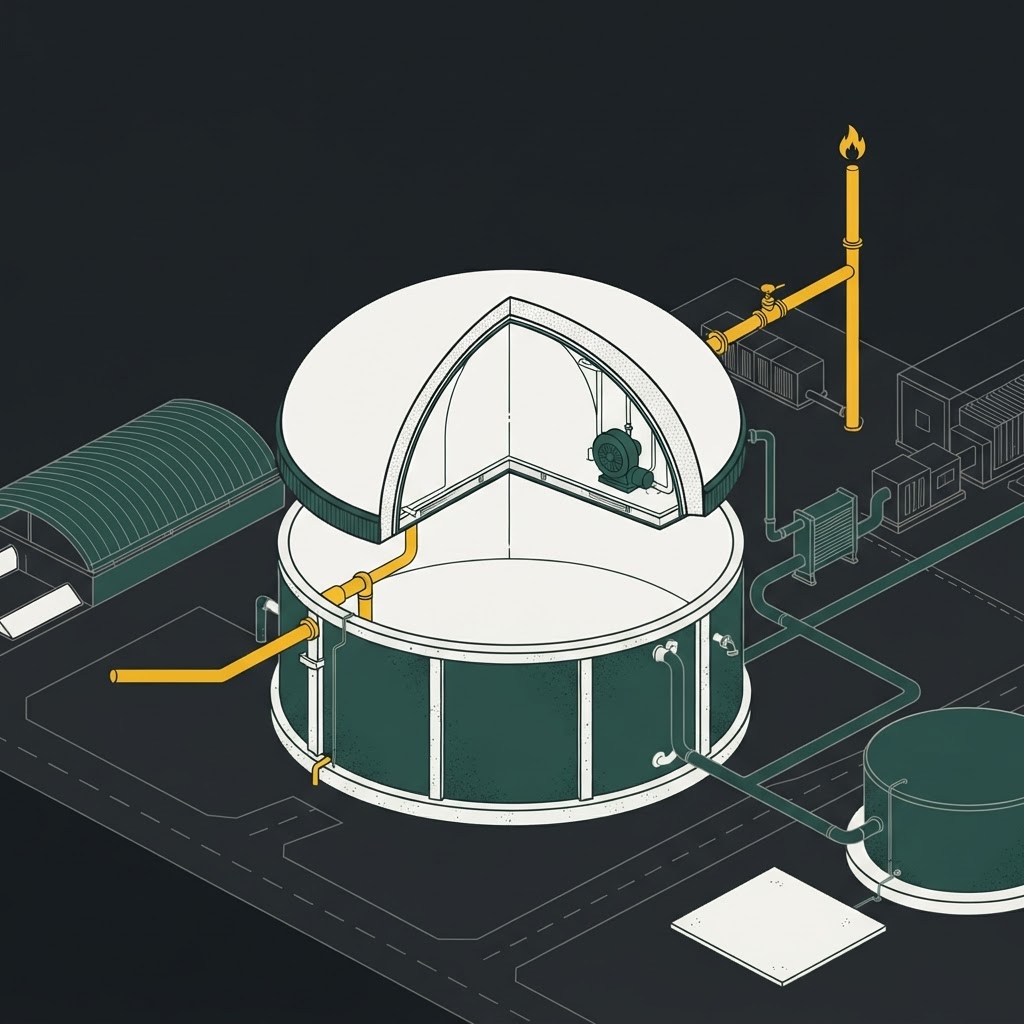
A biogas storage tank price can be N18,000 or EUR 186,800, and both numbers are honest. The first buys a PVC bag for a kitchen digester in Anambra; the second buys a 13,789 m³ double membrane dome for a European CHP plant. What the supplier listings never do is put those prices on one scale, or tell you how many cubic metres you should be pricing in the first place.
This guide does both. It lines up published list prices for every common type of biogas storage, from household bags to membrane gasholders and pressure cylinders, converts them to a price per cubic metre where the listing allows it, and then shows the sizing rule that decides which row of the table you belong in. All per m³ figures below are our arithmetic on the cited list price, not quotes, and all list prices are advertised prices, not delivered ones.
The short answer: biogas storage tank prices by type
| Storage type | Typical size | Published list price | Price per m³ (calculated) |
|---|---|---|---|
| PVC storage bag, Nigeria | 0.5 to 5 m³ | N18,000 to N105,000 | roughly N21,000 to N60,000 |
| PVC balloon, India | 1 to 10 m³ | Rs 5,300 to Rs 37,632 | roughly Rs 3,800 to Rs 5,300 |
| Standalone double membrane sphere, China | 50 to 5,000 m³ | US$12,000 to 80,000 | about US$45 at 1,000 m³ |
| Tank-mounted double membrane dome, Germany | 228 to 13,789 m³ | EUR 11,700 to 186,800 | EUR 51 falling to EUR 14 |
| Used double membrane holder, UK | 100 to 500 m³ | GBP 25,000 to 26,000 | GBP 260 falling to GBP 50 |
| High pressure composite cylinder | per cylinder | INR 45,000 to 90,000 | not comparable, see below |
Two patterns stand out. Small flexible storage is cheap per unit but tiny, and membrane holders get dramatically cheaper per cubic metre as they grow. The sections below give the source for every row.
Household and small farm bags
What a bag costs in Nigeria
Nigerian suppliers sell reinforced PVC bags in a band from 500 litres to 5,000 litres. Hi-bioTech in Ogidi lists its biogas storage bag at N18,000 to N80,000 and claims a lifespan above 10 years. KedoWealthMart in Ikorodu prices the same size band at N30,000 to N105,000 for 500 L to 5,000 L. If that range runs from the smallest bag to the largest, the 500 L bag costs about N60,000 per m³ and the 5,000 L bag about N21,000 per m³. In Kano, Blonergy quotes the same sizes in dollars, US$50 to US$200.
The bag is rarely bought alone. Kaspharyn Solutions sells a 1,000 L mobile biodigester for N800,000, and the bag is one of nine line items alongside a moisture collector, scrubber, desulphuriser with gauge, biogas pump and hose. Its installation notes also say the bag belongs under a shed, not in open sun. At the next size up, a Lagos installer prices a complete 6 to 10 m³ household system at N850,000 to N1.5 million installed. Against either figure, the bag itself is a small share of the bill. For the full ladder from household to municipal scale, see what a biogas plant costs in Nigeria.
Indian and imported bag prices
India has the deepest public price list. On IndiaMART, a 1 m³ PVC biogas storage balloon is listed at Rs 5,300, a 9 m³ cylindrical bag at Rs 33,868 and a 10 m³ bag at Rs 37,632, which works out to about Rs 3,760 per m³ at the larger size. The same directory also shows listings that do not add up, such as a 6 m³ holder at Rs 900, so treat any single marketplace price as a starting point for a quote, not a benchmark.
For imported bags, a review of the PUXIN range found advertised prices of about US$60 to US$300 for models in the 1 to 10 m³ range, and made the point most listings skip: the bag price excludes freight, import duties, pipework, valves, pressure protection and condensate management.
Commercial gasholders: double membrane domes and spheres
Above about 50 m³, the market moves to double membrane holders. An outer membrane, kept taut by an air blower, protects an inner membrane that rises and falls with the stored gas.
Tank-mounted domes
The clearest public price table comes from Zorg Biogas. Its tank-mounted double membrane gasholder with a dome height of half the tank diameter runs in 31 sizes, from 228 m³ for EUR 11,700 to 13,789 m³ for EUR 186,800, with the price covering the complete equipment set and installation materials. A 1,756 m³ dome on a 20 m tank is EUR 46,700. Per cubic metre, that is about EUR 51 at the smallest size, EUR 27 in the middle and EUR 14 at the top.
The flatter version, with a dome only a quarter of the tank diameter high, stores less gas on the same tank and so costs more per unit: 89 m³ for EUR 25,400 up to 5,320 m³ for EUR 74,500, excluding VAT, transport and installation. That is about EUR 285 per m³ at the small end and EUR 14 at the large end. The lesson: on a given tank, a taller dome buys storage cheaply.
Standalone spheres
Where the digester roof cannot carry storage, a separate ground-mounted sphere does the job. Chinese manufacturer Mingshuo lists double membrane sets at US$12,000 to US$80,000 for capacities from 50 to 5,000 m³, and a separate 1,000 m³ listing at US$45,000, about US$45 per m³, with a claimed life of up to 25 years. The 25 years is a manufacturer claim, not test data.
Used holders
The second-hand market shows how weakly price tracks size at the small end. A UK marketplace lists a 100 m³ double membrane holder at GBP 26,000 and a 500 m³ holder with ancillaries at GBP 25,000. Blowers, controls and pressure protection cost much the same at either size, so the smallest commercial holders carry the highest price per cubic metre.
Pressure storage: why cylinders rarely pay for raw biogas
The obvious question from anyone holding a gas cylinder: why not compress biogas and store more in less space? Because compression eats the gas. A California sourcebook calculates that compressing biogas for medium pressure storage uses about 10 percent of the energy in the gas, and compressing upgraded biomethane to high pressure about 17 percent. The same source rates low pressure systems as the least expensive and easiest option on farms, with a flexible fabric top the cheapest of all because it does not react with hydrogen sulphide.
The GIZ Biogas Digest is blunter for developing countries: medium and high pressure gasholders cannot be recommended under the conditions in most developing countries, and even a separate low pressure holder only pays off when gas must travel 50 to 100 m or the digester is leaking.
Cylinder prices confirm it. A European research project found high pressure composite cylinders cost INR 45,000 to 90,000 (EUR 650 to 1,300) each, and that a domestic LPG cylinder holds only 0.35 kg of upgraded biogas at 14.2 bar. A Tanzanian trial of portable biogas used 10 litre steel cylinders at 15 bar that held about 300 litres of gas each, and the researchers judged the capital cost high compared to low pressure storage. Pressure storage makes sense for upgraded biomethane sold as vehicle fuel. For raw biogas feeding a stove or generator, it rarely does.
How much storage you actually need
Price per cubic metre is only half the sum. The other half is how many cubic metres, and here the rules differ by plant type.
Small and medium plants. The Practical Action sizing method takes the larger of two volumes: the gas burned during peak use, or the gas produced during the longest period with no use, plus a 10 to 20 percent safety margin. In practice, 40 to 60 percent of daily gas production normally has to be stored, and digester volume runs about five to six times the gasholder volume. A household digester making 2 m³ a day therefore needs a bag of roughly 1 m³ before the safety margin. How much gas your digester will make is the first number to pin down, covered in how much gas a biogas digester produces.
CHP plants. A plant feeding an engine needs proportionally less, because the engine burns gas as it is made. A planning study for biogas energy plants puts adequate storage at 20 to 50 percent of daily biogas output for a CHP unit. The Irish energy agency's technology guide notes that since biogas is not compressed, storage is normally limited to two to three hours of production, and that extra storage avoids flaring gas during equipment downtime.
Take a plant producing 5,000 m³ a day. The 20 to 50 percent rule gives 1,000 to 2,500 m³, which on the Zorg table means a dome costing roughly EUR 33,700 to EUR 56,500. The two to three hour rule gives about 420 to 625 m³. The gap between those answers is not a rounding error. It is a design decision about how the plant will run.
Storage is what makes biogas power dispatchable
In a grid-tied European plant, storage smooths the engine. In Nigeria, where a biogas generator usually competes with diesel, storage decides whether the generator can run when the load actually needs it: evenings, peak production shifts, or the hours the grid fails. A digester produces around the clock; a business uses power in blocks. Storage is the bridge.
That flexibility has a measurable price. A cost analysis of five plant configurations found the additional cost of supplying biogas on demand for 8 hours a day ranged from 2 to 11 EUR per MWh, with storage concepts the favourable option for short term supply. If a generator only needs to run for the evening peak, you size storage for the hours in between, and you price the storage against the diesel it replaces. Energaia's own five-step process ends in dispatchable electricity and heat for the same reason: power that arrives only when the reactor feels like it is worth less than power on demand. The wider case for running a biogas plant to generate electricity, and how it compares with other diesel generator alternatives for Nigerian businesses, is covered separately.
This is also where we would model before buying. Energaia's work is feasibility consulting and simulation ahead of procurement, and storage is one of the cheapest components to get right on paper and one of the most annoying to retrofit. A load profile, a gas production estimate and an hour-by-hour balance will tell you whether you need a 1 m³ bag or a 1,000 m³ dome before a supplier does.
What the list price leaves out
Every price above is for the storage vessel or package. Budget separately for:
- Freight, duties and taxes, especially on imported bags and Chinese membrane sets.
- Installation, which Zorg's flatter dome price excludes, along with VAT and transport.
- Gas cleaning: a desulphuriser and moisture trap, as in the Kaspharyn kit, protect both the membrane and the engine.
- Pressure protection: over and under pressure valves, and a blower for double membrane holders.
- Pipework and pressure balancing between digesters, storage and the user.
- Shade or foundation: a shed for a household bag, a concrete base for a standalone sphere.
One last check before you pay: confirm whether the quote is for a gas storage bag or a sanitation tank. In Nigeria the word "biodigester" often means a septic system that vents its gas, which we unpack in biodigester vs biogas digester.
FAQ
Can I store biogas in an LPG cylinder?
Not usefully. A domestic LPG cylinder holds only 0.35 kg of upgraded biogas at 14.2 bar, according to the VALORGAS project, and researchers in the Tanzanian trial advised against reusing LPG cylinders because users may confuse the gases and hydrogen sulphide in raw biogas corrodes steel from the inside.
How long does a biogas storage balloon last?
Suppliers claim more than 10 years for Nigerian PVC bags and up to 25 years for double membrane holders. These are manufacturer claims. Keeping a bag out of direct sun and removing hydrogen sulphide before storage both protect the material.
Is a steel biogas tank better than a membrane gasholder?
For low pressure biogas, usually not. Membrane holders are marketed as the replacement for traditional steel gasholders, flexible fabric covers do not react with hydrogen sulphide, and steel corrodes when the gas is not cleaned.
Does a bigger storage tank produce more gas?
No. Storage only holds gas the digester has already made. If your stove or generator runs short every day, the fix is more feedstock or a larger digester; extra storage only helps when gas is being wasted at times of no use.