
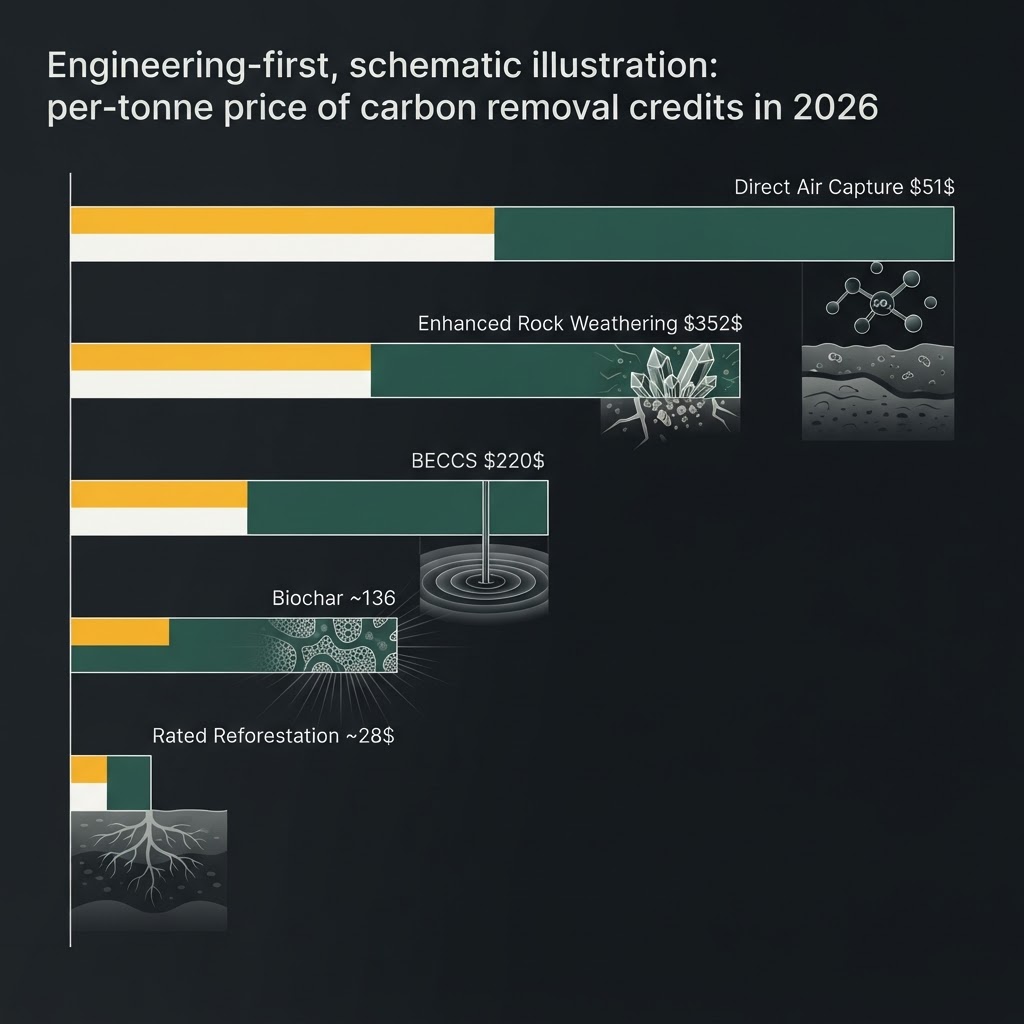
The cost of carbon removal credits in 2026 spans more than an order of magnitude. Rated reforestation averaged 28.55 US dollars per tonne in the first half of the year, biochar trades around 135 euros on the Puro.earth index, and the weighted averages of disclosed deals sit at 220 dollars for BECCS, 352 for enhanced rock weathering and 516 for direct air capture, according to a 2026 price roundup built on Sylvera, Puro.earth and CDR.fyi data.
Those headline numbers are where most price pages stop. They are also the least useful part of the answer, because a removal tonne carries three different prices at once: what it sells for, what it costs to make, and what a buyer is willing to pay. The gap between them decides which projects get built.
We engineer the gasification and pyrolysis plants that sit underneath biochar and waste-to-energy removal, and we run carbon credit management covering certification, MRV and trading strategy. This guide reads the market from the plant side.
The Short Answer: What a Tonne of Removal Costs Today
Durability explains most of the spread. Removals that store carbon for decades are cheap; removals that store it for centuries to millennia cost several times more.
| Method | Typical 2026 price | Euro range (catalogue offers) | Storage |
|---|---|---|---|
| Reforestation (ARR, rated BBB+) | USD 28.55 average | EUR 22 to 50 | Decades to centuries |
| Biochar | EUR 135 index, USD 136 weighted | EUR 105 to 200 | Long-lived where demonstrated |
| BECCS | USD 220 weighted | not listed | Geological |
| Enhanced rock weathering | USD 352 weighted | EUR 350 to 450 | Long-lived |
| Direct air capture with storage | USD 516 weighted | EUR 450 to 1,000+ | Geological |
The euro column comes from Senken's 2026 transaction and offer data by methodology, which also prices microbial mineralisation at 170 to 200 euros and REDD+ avoidance at just 12 to 15. If the difference between those last two categories is new to you, start with avoidance vs removal carbon credits.
Price, Cost and "Too Expensive" Are Three Different Numbers
What actually transacts
Most removal is sold through bilateral contracts that never publish a price. The LSE Grantham Institute's 2026 dataset covers 43 million tonnes of contracted durable removal, but only 37 percent of it, about 10 million tonnes across 2,264 deals, comes with a price attached. A techno-economic study from the University of Mannheim finds disclosure for roughly 30 percent of transactions but only about 13 percent of contracted tonnage, skewed toward small biochar orders.
So every "average price" is an average of the deals that chose to be visible. Treat it as a signal, not a quote.
What suppliers need to break even
Supplier break-even prices in 2025, from the CDR.fyi and OPIS survey as compiled in Senken's 2026 to 2040 price corridor report:
- Biochar: 143 dollars per tonne
- BECCS: 232 dollars
- Enhanced rock weathering: 272 dollars
- Mineralisation: 316 dollars
- Direct air capture: 670 dollars
Set those against the weighted averages in the table above. BECCS clears slightly below its break-even, enhanced weathering above it, and the DAC average sits well below its break-even. That gap is plausible only because most durable contracts are commitments to future delivery from plants not yet operating, as the Mannheim study notes, so buyers are pricing tomorrow's cost, not today's.
What buyers will pay
The CDR.fyi pricing survey put the two sides next to each other. Biochar suppliers need 187 dollars per tonne for a reasonable profit, while buyers already call 155 dollars expensive. For enhanced weathering it is 349 against 271. Across almost every method, the price buyers consider expensive sits below the price suppliers need. That gap is the real cost of carbon removal credits today: somebody, a buyer, a subsidy or an investor, has to close it.
Method by Method: Why Each Tonne Costs What It Costs
Reforestation and other nature-based removal
Trees are cheap to plant and expensive to guarantee. The low price reflects storage measured in decades and reversal risk from fire, pests and land-use change. Rating matters, which is why the 28.55 dollar figure is quoted for BBB+ projects only.
Biochar
Biochar is the most mature durable removal. In the LSE dataset it has the lowest mean price of any durable method at 184.40 dollars, yet deals still range from 27.78 to 843.83 dollars across 748 contracts. The World Economic Forum's 2026 CDR market overview puts the biochar average at 192 dollars with the tightest price range of any pathway, because it is the most mature one.
What sets a biochar tonne apart from the next one is origin, reactor temperature, MRV and co-product revenue. We take that apart in our biochar carbon credit price per ton guide.
From the engineering side, what lowers a biochar tonne's price is everything else the plant sells. Our five-step process gasifies local biomass and sludge into syngas, converts it to dispatchable power and heat, and captures biochar alongside verified CO2 offsets. Every one of those revenue lines lowers the price the credit has to carry.
BECCS and waste-to-energy capture
BECCS captures CO2 at a plant that already burns or processes biomass, which is why its prices are compressed. LSE records a mean of 330 dollars with a range of 130 to 500, and 71 percent of BECCS deals are offtakes. Mannheim's tonnage-weighted median is lower again, about 214 dollars, because a few very large contracts dominate.
Two data points from Fastmarkets' first-half 2025 offtake review show the band: JP Morgan's 13-year BECCS offtake sold for under 200 dollars per tonne, while Frontier paid 316 dollars for 100,000 tonnes of waste-to-energy carbon removal. For a municipality or utility in Germany or Nigeria that already runs, or is planning, a thermal waste plant, that second number is the relevant one. The plant exists for its gate fees and power; capture turns the stack into a second product.
Enhanced rock weathering
Spreading crushed basalt on farmland is cheap. Proving how much CO2 it removed is not. A large part of the 352 dollar weighted average goes into monitoring, reporting and verification, and Frontier's 78,707 tonne ERW purchase cleared at 419 dollars. The LSE mean of 310.42 dollars sits close to the CDR.fyi figure, with deals ranging from 75 to 1,577.
Direct air capture
DAC is the most measurable tonne and the most expensive. WEF puts current costs at 500 to 1,200 dollars per tonne, Mannheim finds a tonnage-weighted median of about 650, and Frontier's electrochemical DAC offtake from Phlair cleared at 651 dollars. The LSE mean is 1,000.96 dollars. In the US, the 45Q tax credit pays up to 180 dollars per tonne for DAC storage.
Two Levers That Move a Quote More Than the Method Label
Contract type: prepurchase, offtake, pay on delivery
LSE finds prepurchase agreements priced significantly above offtake agreements: the buyer pays early, carries the delivery risk, and the supplier is often a first-of-a-kind plant. WEF adds the opposite pattern for mature methods. Payment on delivery, typical for biochar, brings slightly higher but more predictable prices, because the supplier carries the operating risk until the tonne is verified.
For a buyer this means two quotes for the same method can differ by hundreds of dollars and both be fair. For a developer it means the contract structure is a financing decision, not just a sales term.
Accounting boundary: leakage and co-products
Mannheim models the levelised cost of removal per net tonne at 29 to 1,076 dollars across 18 current, US-calibrated project configurations. Two adjustments do most of the work:
- Leakage. Leaving out the emissions a project causes, from energy, feedstock transport or rock grinding, can understate the true net cost by as much as 70 percent. Grid-powered DAC configurations carry leakage factors above 30 percent.
- Co-products and policy. Selling power, heat or bio-oil, plus subsidies, cut the break-even price by 0 to 54 percent against a revenue-free baseline.
This is the engineering lever. A gasification plant that sells clean electricity and heat, and runs its pre-treatment on recovered heat rather than grid power, lowers both leakage and the price the credit must carry. The cheapest tonne on paper is not always the cheapest net tonne.
Where Removal Prices Go Next
Do not plan on a solar-style price collapse. Across 43 million tonnes of contracted removal, Senken measures a learning rate for durable methods of 1 percent per doubling of capacity, against 20 percent for solar. A biochar plant needs 12 to 24 months from investment decision to first credit, and demand has a date: from 2035, companies with an SBTi target must buy removals equal to at least 1 percent of their emissions.
Senken's base case for biochar runs from 120 euros in 2026 to 180 euros by 2040, with European BECCS at 234 to 331 euros acting as the ceiling, because above that it becomes the cheaper durable tonne. For DAC, Mannheim's policy-free 2050 configurations still land at 182 to 207 dollars; none reaches the 100 dollar target.
Regulation will sort the field too. Only removals certified as permanent under the EU framework will count toward European compliance, which we cover in EU CRCF permanent carbon removal credits.
How to Budget a Removal Portfolio
Few companies buy only one method. Senken's portfolio data shows buyers paying a blended 25 to 80 euros per tonne for a carbon-neutral portfolio and 60 to 220 euros for an SBTi-aligned net-zero one, with the durable share growing every year toward the target date.
A practical sequence:
- Fix the claim first. A net-zero claim needs durable removal; a contribution claim does not. The claim sets which rows of the table you can buy from.
- Price per net tonne, not per credit. Ask each supplier for its leakage assumption and co-product treatment.
- Match contract to maturity. Pay on delivery for biochar and BECCS; accept prepurchase only where you are deliberately funding a first-of-a-kind plant.
- Blend durability. Use biochar and BECCS for volume, DAC and ERW for a smaller, deliberate share.
- Check the pipeline. Credits for 2030 come from plants financed now. Compare the main carbon removal technology routes before committing to one.
We will cover the purchasing process itself, registries, marketplaces and contract terms, in our guide to how to buy carbon removal credits.
FAQ
Why are carbon removal credits more expensive than avoidance credits?
Removal pays for physically taking CO2 out of the air and storing it; avoidance pays for not emitting it in the first place. That difference shows up in price: Senken lists REDD+ avoidance at 12 to 15 euros per tonne against 450 to over 1,000 euros for direct air capture.
Will direct air capture ever reach 100 dollars per tonne?
Not on current evidence. Mannheim's modelling finds that no DAC configuration reaches the 100 dollar target; even the policy-free 2050 cases land at 182 to 207 dollars. With the US 45Q credit, mature 2030 plants could reach 111 to 135 dollars.
Is the cheapest durable removal always the best buy?
No. Disclosed biochar deals start below 30 dollars, but a low price can hide a narrow accounting boundary. Ask for the leakage factor and the MRV method; a tonne that ignores its own process emissions is not a net tonne.
Do removal prices differ between Germany and other markets?
Yes. Senken prices German-origin biochar at 189 to 200 euros, the top of the biochar range, because of a domestic origin premium and higher production costs. For comparison, EU ETS allowances trade at 60 to 90 euros.