
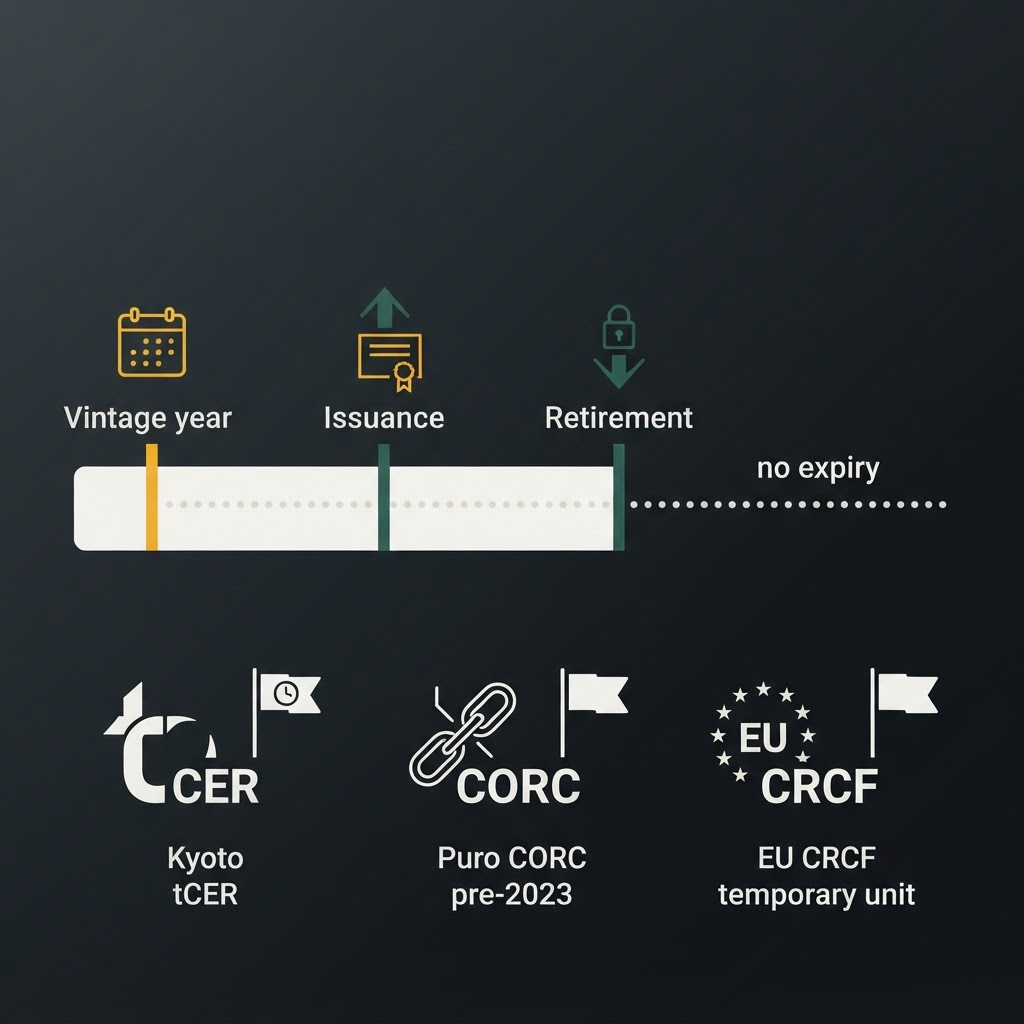
Do carbon credits expire? For almost every credit traded today the legal answer is no. A Verra VCU, a Gold Standard VER or a Puro CORC sits in a registry under its serial number until somebody retires it, and that can take years. But three families of credit have carried a hard expiry date, one of them a biochar removal certificate as recently as mid 2023, and a credit that never expires on paper still loses value on a predictable calendar. This article covers both halves: the rulebooks that say when a credit dies, and the market data that says how fast an unexpired one decays.
The short answer: a credit does not expire, it waits to be retired
A carbon credit has three dates and none of them is an expiry. The vintage is the year the reduction or removal happened, the issuance date is when the registry minted the unit, and the retirement date is when a buyer used it. A credit can be vintage 2021, issued in 2023 and retired in 2024, three different years for the same tonne.
Between issuance and retirement the credit is simply an asset. It can be traded several times among market participants and can exist unretired for some time; at the point of retirement it is permanently removed from circulation and cannot be resold. The ICVCM defines retirement as the permanent removal of a carbon credit in a registry for the purpose of claiming the associated reductions or removals, and cancellation as permanent removal without claiming anything. Both end the credit. Neither happens on its own.
So the honest answer to "do carbon credits expire" is that the registry will hold your credit indefinitely. Whether anyone will still accept it, or pay for it, is a different question, and that is where the real shelf life sits.
The three kinds of carbon credit that really did expire
Kyoto tCERs and lCERs: expiry date printed in the serial number
The Clean Development Mechanism solved the non-permanence of forestry by making the credit itself temporary. The UNFCCC registry lists temporary CERs as credits for afforestation and reforestation projects to be replaced upon expiry at the end of the second commitment period, and long-term CERs as credits to be replaced upon expiry at the end of the project's crediting period or in the event of storage reversal. The UN's own project manual spells out the mechanics: tCERs expire at the end of the commitment period following the one they were issued for, lCERs expire at the end of the crediting period, both carry their expiry date as an element of the serial number, and retired tCERs and lCERs must be replaced with other valid credits at the time of their expiry.
Every national registry therefore ran a replacement account, and an expired lCER may not be further transferred, nor may lCERs be carried over to a subsequent commitment period. This is the only mainstream design in which a buyer's retired credit stopped counting on a date. It was unpopular precisely because of that, and the voluntary market never copied it.
Puro CORCs: a five-year expiry that was abolished in June 2023
The example that matters most to biochar buyers is recent. Puro.earth's General Rules carried a chapter on certificate expiry from launch, and earlier versions show the clock being moved: the change history records an extension of the expiry date by six months, and a rule that CORCs issued in the experiment phase would expire normally twelve months after issuance. Version 3.1 of the rules, dated 1 June 2023, then states: removed Chapter 3.4 Certificate Expiry as per resolution in Advisory Board on 31 May 2023; CORCs no longer expire automatically after five years.
So a CORC bought in 2021 and left unretired would, under the rules at purchase, have lapsed in 2026. Under the rules since mid 2023 it will not. Anyone holding removal certificates from that era should confirm which version their contract references.
EU CRCF temporary units: expiry is back, by design
The EU's carbon removal certification regulation brings temporary credits back for the activities that cannot promise permanence. The Commission's own Q&A sets the monitoring periods: permanent removals must be stored for at least 200 years, carbon storage in long-lasting products for at least 35 years and carbon farming for at least five years, and certified units from carbon farming and carbon storage in products are temporary and therefore expire at the end of the monitoring period unless it is renewed or permanent storage is demonstrated.
The design is clean; the enforcement is not yet. An Ecologic Institute review notes that Article 12(5) makes carbon farming units temporary units subject to an expiry date, but the draft certification methodologies do not specify any consequences for expiry, such as liability for replacing expired units, and do not restrict their use cases. For a buyer that means a CRCF soil unit can expire while still sitting in a net-zero claim. Permanent units, the category biochar aims for, do not expire, and we cover the qualifying rules in our guide to EU CRCF permanent removal credits.
Compliance allowances: banked for ever, but surrendered on a date
Allowances are often confused with credits, and here the expiry question has a history. In the EU ETS, if an installation reduces emissions the company can sell spare allowances or keep them to use in the future; phase 1 allowances could not be banked into phase 2, and with supply far above demand the price fell to zero in 2007. Since then banking is unlimited. What is fixed is the deadline: companies under the EU ETS must surrender allowances equal to their verified emissions from the previous year by 30 April. The allowance never expires; the obligation does.
CORSIA, aviation's offsetting scheme, is the inverse case. The credit stays valid in its registry, but the scheme's eligibility window closes around it. For the first phase, 2024 to 2026, CORSIA accepts only reductions and removals that occurred between 1 January 2021 and 31 December 2026, from projects whose first crediting period started on or after 1 January 2016. A 2019 vintage credit that was CORSIA-eligible in the pilot phase did not expire on 1 January 2024. It simply lost its largest compliance buyer overnight.
The commercial half-life: how an unexpired credit loses value
Vintage discount: around 18 percent a year
This is the number most "do carbon credits expire" explainers leave out. MSCI's carbon market team reported in June 2025 that vintage remains a key differentiator with around 18 percent price uplift per year for newer vintages, driven by a widening gap between post-2019 credits and older vintages, particularly lower-rated 2012 to 2018 REDD+ projects. Ecosystem Marketplace's transaction survey measured the same shift from the demand side: buyer preference for recent vintages reached a 217 percent premium for credits with a vintage from the last five years, up from a 53 percent premium in 2023, while 182 million tonnes were retired in 2024.
The discount is not smooth, and it is not a physics statement. Carbon Growth Partners showed with February 2024 benchmarks for one high-quality Cambodian REDD+ project that the price spread between the 2017 and 2018 vintages was more than 100 percent, while the spread between 2016 and pre-2016 was just 8 percent. A tonne avoided in 2017 did the same work as one avoided in 2018. The market priced the year, not the tonne.
Exchange and scheme cut-offs that hit on a calendar date
The sharpest devaluations are scheduled. Xpansiv's benchmark nature-based contract prices a basket of Verra AFOLU credits from vintages 2019 to 2024, with the range rolling forward every year on 1 July; credits that age out migrate to trailing contracts covering 2016 to 2018. A treasury holding credits across that date sees its benchmark eligibility change while nothing changes at the project. Methodology decisions do the same thing to whole cohorts: in August 2024 the ICVCM concluded eight renewable energy methodologies were insufficiently rigorous on additionality, a decision covering about 236 million unretired credits. Those credits did not expire. They became very hard to sell.
The 817 million tonne surplus
Why does age bite so hard? Because supply outruns retirement by years. CORE Markets' May 2025 report counted retirements of 11.2 million credits in the month, up 75 percent year on year, bringing the January to May total to 70 million, while the market surplus expanded to 817 million non-retired credits and demand focused on newer vintages, V22 and V23. At the 2024 retirement pace that stock is more than four years of demand. In a glut, buyers choose the youngest units, and everything older waits.
What can still kill a credit you hold
Expiry is not the risk; cancellation and invalidation are. Under the Verra program a project must submit a verification approval request within five years of the previous one or be flagged "late to verify", Verra may open a quality control review at any time and cancel VCUs already issued, and proponents remain liable for erroneously issued VCUs for six years from issuance. For nature-based removals the same source describes the buffer: 10 to 20 percent of each issuance held in a pooled account, cancelled against a reversal so that VCU holders are not touched.
Puro handles it at the supplier. If a reversal occurs the rules say the issuing body withdraws and invalidates CORCs from the account of the CO2 removal supplier equal to the reversal quantity, and the supplier must deposit CORCs of the same type or comparable permanence to replace them. In every mainstream design the retired credit in the buyer's name stays retired. The liability for a failed tonne sits with the project, which is why how carbon credits are verified matters more than how old they are.
Why biochar removal certificates age differently
Vintage anxiety is mostly an avoidance-credit problem: a baseline set years ago under a methodology that has since been replaced. Biochar carbon removal has a different relationship with time, and it is the reason Energaia's public process ends with capturing biochar plus verified CO2 offsets rather than with a reduction claim.
Three rules make the difference. First, durability is a floor, not a countdown. Puro raised the minimum from 50 years at its 2019 launch to 100 years for all new registrations from January 2023, and states that durability does not imply the carbon reverts at year 100; most removed carbon is expected to remain sequestered for centuries. Second, decay is priced in before issuance. The same post explains that Puro applies a pre-issuance deduction equal to the expected degradation over the contracted period, so no separate reversal buffer is needed, and the General Rules define reversal as an unaccounted event, explicitly not the slow decay of biochar in soil, which the methodology already deducted. We go into the soil chemistry in how long biochar stores carbon. Third, the vintage is unambiguous: Puro defines it as the calendar year the removal occurred, and where it spans several years the latest year counts.
The one timing rule that does bind removal buyers comes from the claim side. SBTi's Corporate Net-Zero Standard V2 requires removals to deliver verified mitigation outcomes within the same reporting period as the emissions they cover. A removal certificate bought three years ahead of use does not expire, but it may not count against the year you intended. For Energaia's clients that is the practical reason carbon credit management, certification, trading strategy and MRV is run as a service alongside the plant: retirement timing is an engineering output, not an afterthought.
A holding policy for credits that never expire
The absence of an expiry date shifts the discipline onto the holder. Five rules cover most cases.
- Retire in the year of the claim, and keep the record. Vintage, issuance and retirement can differ, so the retirement certificate with serial range, vintage, beneficiary and purpose is what an auditor will ask for. Puro's registry lets a beneficiary delay publication of the retirement details for up to a year if the claim is not yet public.
- Set a vintage window and write it down. Regreener's buying guide suggests a window of a few years before the delivery year and flags vintages more than seven years old for a second look. Exceptions should rest on the methodology version, not on the price.
- Model the cliffs before you bank inventory. CORSIA phase boundaries and the 1 July exchange roll are published in advance. If you hold credits for future claims or resale, know which date moves them out of the benchmark.
- Buy removals close to use. The SBTi same-period rule means forward purchases should be structured as delivery contracts, with CORCs issued and retired in the target year, rather than as stockpiles.
- Let the registry pick the oldest first. Puro's simple-path retirement selects CORCs starting from the oldest reporting period, which keeps the hold time of a portfolio from drifting. Our guide to buying carbon removal credits covers the contract side, and the price logic of avoidance and removal credits explains why the premium for recent removals is likely to hold.
A credit that never expires is a credit whose value is entirely in the buyer's hands. The registry will wait. The market will not.
FAQ
Do carbon credits have an expiration date?
Not in the mainstream voluntary registries. Verra, Gold Standard and, since 1 June 2023, Puro.earth issue credits that remain valid until retired. The exceptions are Kyoto-era temporary and long-term CERs for forestry, which expired on dates written into their serial numbers, EU CRCF temporary units from carbon farming and carbon storage in products, which expire at the end of their monitoring period, and Puro CORCs issued under rules before mid 2023, which lapsed five years after issuance.
What happens to carbon credits that are never used?
They stay in the registry as transferable units. CORE Markets counted 817 million non-retired credits in May 2025 against roughly 70 million retirements in the first five months of the year. Unused credits do not vanish, but older vintages trade at a growing discount, lose scheme eligibility such as CORSIA, and fall out of benchmark exchange baskets on fixed dates.
Can a retired carbon credit be reused or resold?
No. Retirement is irreversible by design. Puro's General Rules state that a CORC cannot be retired more than once and that the beneficiary becomes sole owner of the removal attributes; Verra describes retirement as taking a unit out of circulation so it can be used only once. The retirement record, with serial numbers and purpose, is public.
How old can a carbon credit be and still count?
It depends on who is counting. CORSIA's first phase accepts only 2021 to 2026 vintages from projects that started crediting in 2016 or later. SBTi's Net-Zero Standard V2 wants removals delivered in the same reporting period as the emissions. Most voluntary buyers set their own window of a few years; the credit itself has no legal age limit.
Can a carbon credit be cancelled after I bought it?
A registry can cancel units after a quality review or a reversal. Under Verra the project proponent is liable for erroneously issued VCUs for six years from issuance and buffer credits absorb reversals; under Puro the supplier's own CORCs are invalidated and must be replaced. A credit already retired in your name stays retired, which is why our checklist on biochar carbon credit reliability focuses on the project rather than the vintage.