
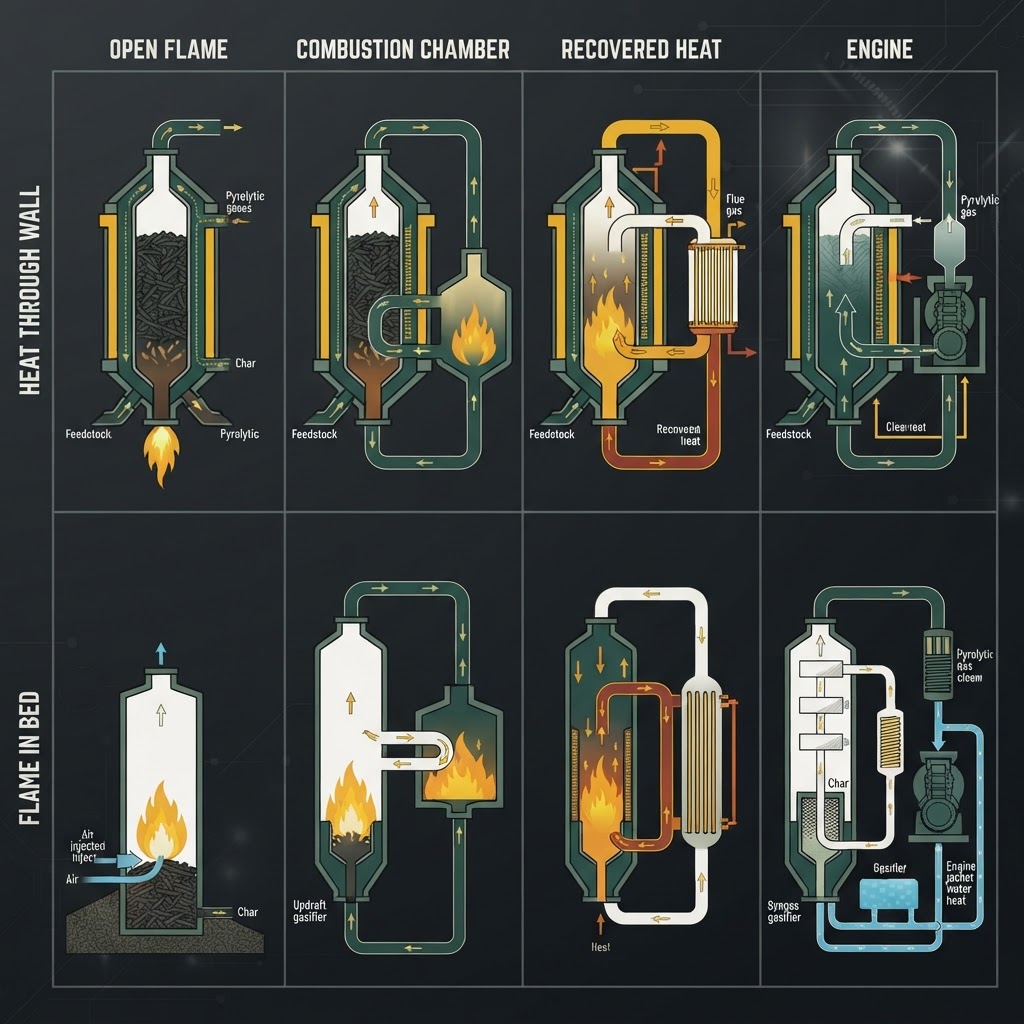
A biochar reactor is any vessel that heats biomass with too little oxygen to burn it, so the carbon stays behind as a solid. That definition covers a steel cone on a farm and a containerised plant that runs around the clock. The price runs from about $1,000 to more than $2 million. Market yields run from 15% to 40% of dry feed. Picking by price or by yield alone is how projects end up with the wrong machine.
This guide sorts every biochar reactor class by two engineering questions, puts the published numbers side by side, and adds what most buying guides skip: wet feedstocks such as sewage sludge, certification limits, and the option of taking char from a reactor that also sells power.
What a biochar reactor is, and the two questions that sort every design
The International Biochar Initiative's reactor guide uses three terms that buyers often mix up. A pyrolyser is any reactor that decomposes biomass with limited oxygen. A kiln is an insulated chamber that can be heated from inside or outside. A retort is an airtight vessel heated from outside, with the released gases collected and burned. Each can run in batch mode (fill, run, empty) or continuous mode (biomass in at one end, char out at the other). IBI notes that continuous devices cost more but give more output per unit of labour, tighter process control and lower emissions.
Inside every reactor the same sequence happens. The IBI pyrolysis plant guidelines describe drying up to about 120 to 150 °C, torrefaction between about 150 and 250 °C, and pyrolysis from around 250 °C. The outputs are always the same three: biochar, non-condensable gas and a condensate of tars and water. A 2026 comparative review in the Journal of Cleaner Production puts typical operating temperatures at 350 to 700 °C.
So the chemistry doesn't separate the designs. Two questions do:
- How does heat reach the biomass? Either a flame burns inside or on top of the bed, or heat comes through a steel wall from a separate fire.
- What happens to the gas? It gets burned in an open flame, burned in a controlled chamber, cleaned and recovered for heat, or sent to an engine for power.
The answers to those two questions explain most of the differences in emissions, char quality, labour and cost.
Biochar reactor types compared
| Reactor class | Heat path | Mode | Typical published figures |
|---|---|---|---|
| Flame curtain kiln | Flame on top of the bed | Batch | Lowest cost, manual, wood and dry residues |
| Retort / drum retort | Through a wall from a firebox | Batch | 48 h cycle for portable retorts |
| Trough kiln | Radiant heat from gas burned above the bed | Continuous | ~450 °C, 25 to 40% yield, 300 to 1,000 kg/h |
| Rotating drum / rotary kiln | Through the drum wall | Continuous | ~450 °C, 20 to 35% yield, 500 to 2,000 kg/h |
| Auger (screw) reactor | Through the screw housing | Continuous | Needs power for drives, fine uniform feed |
| Gasifier with char take-off | Partial oxidation in the bed | Continuous | About 20% char at heat-only settings, less when making power |
Flame curtain kilns
A flame curtain kiln, such as the Kon-Tiki cone, is lit from the top. The flame consumes the oxygen, so the layers below carbonise instead of burning. A review of small-scale kiln designs by KEFRI explains that heat moves down mainly by conduction, because there is little oxygen for convection or radiation below the flame. It is cheap and portable, and the char can be good. The downsides are that it is manual, the gas is burned in the open, and quality depends on the operator.
Retorts and drum retorts
A retort has two chambers: a firebox and a sealed pyrolysis chamber. KEFRI describes how pyrolysis gases are routed back into the firebox and burned. That gives retorts lower emissions and shorter cycles than open kilns, and the review rates drum retorts as the best fit for most low-income settings. At larger scale, Washington State University's Biomass2Biochar chapter records portable retorts on a 48 hour cycle, deployed in groups of 40 to get economic throughput. Batch retorts scale by adding more units, not bigger ones.
Continuous trough, drum and rotary kilns
This is where a reactor becomes a plant. IBI documents the Kansai trough kiln: a screw moves the biomass along a trough while gas burned above it radiates heat down onto the bed. It runs at roughly 450 °C, yields 25 to 40% depending on feedstock, handles 300 to 1,000 kg/h, and only accepts particles under 10 mm. The gas flame is held above 800 °C to burn completely.
According to IBI, most kilns operating today are rotating drums designed in China. They are heated through the drum wall by burning the pyrogas, which is first washed, with the condensate reused to quench the char. They run at about 450 °C, yield 20 to 35% and take 500 to 2,000 kg/h. WSU describes containerised rotary kilns processing up to 20 tonnes in 24 hours at 400 to 600 °C, switchable between bio-oil and biochar output.
Auger (screw) reactors
An auger reactor pushes biomass through a heated tube with a screw. It gives tight control of residence time and suits small, uniform particles. KEFRI's caveat applies here: automated kilns need electricity for the screw motors and a skilled operator, which has kept them out of rural markets without a grid connection. That matters for Nigerian sites with unreliable power.
Gasifiers that keep a char fraction
A gasifier can also be a biochar reactor if it is run to stop short. Huang and colleagues report a 3 MW downdraft unit that sends 47% of its energy to syngas and 44% to char, so one plant sells power, heat and carbon. All Power Labs' Chartainer converts 250 kg/h of biomass into 40 to 50 kg/h of biocarbon, or 20%, and produces heat but no electricity. We cover this class in depth in our biochar gasifier guide, and the underlying chemistry in pyrolysis vs gasification.
Yield is not the number to optimise
Every vendor quotes yield first. It is the least useful number on the sheet. Planboo's 2026 survey of more than 30 manufacturers finds most systems at 15 to 40% on a dry basis. It also notes that a lower-yield machine running hotter often makes more stable char and can earn more carbon credits per tonne of biomass. The credit conversion they report is 1.0 to 2.3 credits per tonne of biochar.
The spread among small kilns is even wider. KEFRI reports yield efficiency of 10 to 46% and fixed carbon from 26 to 87%. Two kilns with the same yield can produce char of very different value.
What decides whether the char sells as carbon removal is stability and contaminants. The European Biochar Certificate guidelines require a molar H/Corg ratio below 0.7, and below 0.4 for char made from sewage sludge. They also warn that PAH condenses onto char when it cools in contact with pyrolysis gas. That is a reactor design question (how and where the char is discharged and cooled), not something you can fix in the lab later. Gasification is certifiable too, provided the unit is optimised for biochar. Our pages on biochar quality standards and biochar yield calculation work through the thresholds and the arithmetic.
Matching the reactor to your feedstock
Dry woody and agricultural residues
Woody chips, nut shells and dry husks work in almost any class. The limit is particle size. Planboo notes that continuous systems often need chips under 30 to 50 mm, and the Kansai trough needs under 10 mm, so the chipper and screen are part of the reactor decision. The Journal of Cleaner Production review recommends dispersed, low-cost batch kilns where crop residues are spread across farms. It recommends centralised continuous rotary or auger kilns where residues already collect at mills.
Wet feedstocks: manure, digestate and sewage sludge
This is where most guides go quiet. IBI notes that only some kiln designs can process sludges and manures at all. Every kilogram of water has to be evaporated before pyrolysis starts, and in an open kiln that heat is simply lost. Sludge char also has to meet the stricter H/Corg limit of 0.4.
Our position at Energaia comes from process engineering, not from any one machine: thermal pre-treatment is non-negotiable. Drying lowers moisture, raises energy density and makes the feed uniform enough for a continuous reactor to hold a stable temperature. For sludge, that means planning the dryer, the enclosed reactor and the gas handling as one system. Our article on thermal treatment of sewage sludge covers the drying chain.
What a biochar reactor costs
Planboo's market survey gives three tiers:
- $1,000 to $10,000: open flame and simple retort kilns, labour-intensive, often portable.
- $25,000 to $150,000: semi-continuous and automated batch systems, often with monitoring and certification pathways.
- $500,000 to $2 million and above: fully continuous industrial systems that need skilled operators and grid or generator power.
IBI puts Chinese rotating drum plants at US$200,000 to US$1 million. The sticker price is not the project cost. Planboo puts maintenance on industrial machines at 3 to 5% of CAPEX per year, and shipping, duties and commissioning can add 10 to 25% to an ex-works quote. Chippers, dryers and feed handling are rarely included. For the full business case, see starting a biochar business.
How to choose: a five-step engineering check
- Get lab data on your feedstock first. Moisture, ash and particle size rule out half the market before you speak to a vendor.
- Decide the revenue model. Char only, char plus heat, or char plus power. Each points to a different reactor class. Planboo notes that enclosed systems can recover heat to dry incoming feed, and some larger units turn the gas into electricity.
- Fix the certification target. EBC class and H/Corg limit decide the temperature you need and how the char must be cooled.
- Design the gas path and the permit together. The EBC guidelines require syngas combustion to meet national emission limits. Ask every vendor where the gas goes and how it has been measured.
- Simulate before you order steel. Energaia builds simulation tools, including a MATLAB suite for volatile organic compound emissions in biomass-to-energy, because finding a mass-balance or emission problem on screen costs far less than finding it on site.
For how a chosen reactor fits into a full plant, see our upcoming guide to the biochar production process.
FAQ
What is the difference between a biochar kiln and a retort?
A kiln is an insulated chamber that can be heated by a flame inside the biomass or from outside. A retort is an airtight vessel heated only from outside, with its gases collected and burned to drive the process. Retorts generally give more control and lower emissions.
What temperature does a biochar reactor run at?
Typically 350 to 700 °C. Many continuous drum and trough units make char at around 450 °C, and a trough kiln holds its gas flame above 800 °C so it burns out completely. Higher temperatures usually give lower yield but more stable carbon.
Can a biochar reactor process sewage sludge?
Not in a simple batch kiln. Sludge needs drying first, then an enclosed continuous reactor with controlled gas handling, and the EBC requires sludge char to reach a molar H/Corg ratio below 0.4.
Does a biochar reactor need electricity?
Flame curtain kilns and natural-draft retorts do not. Automated auger and screw systems need power for their drives. Some large continuous systems become fully exothermic once hot and need power only to start up and run auxiliaries.