
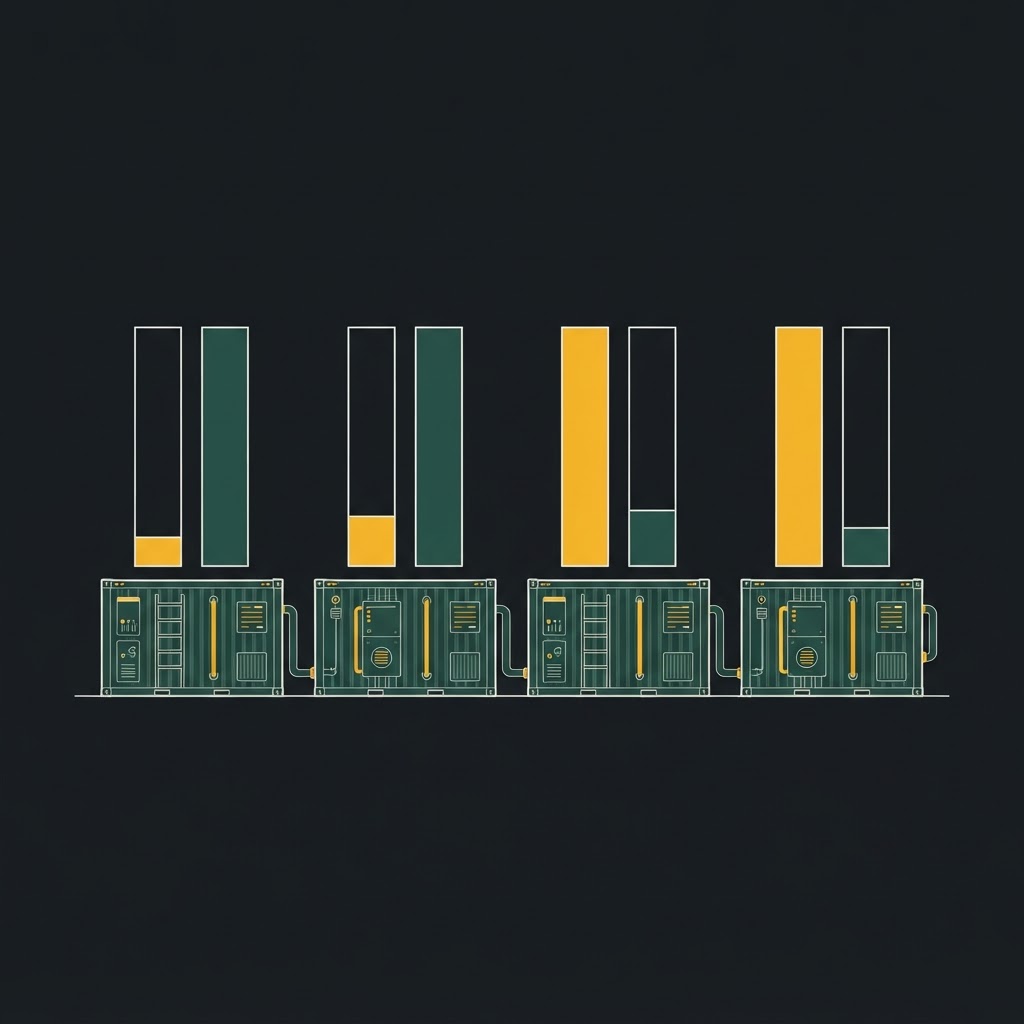
A biochar gasifier is a gasifier run on purpose to stop short. A conventional unit tries to turn every gram of carbon into gas. A biochar gasifier leaves a deliberate share of that carbon as a solid, so one reactor sells electricity, heat and a certifiable carbon sink. The catch is that the share of feed leaving as char ranges from 5% to 25% depending on the design, and that single number decides your revenue model more than anything else on the brochure.
This guide reads the spec sheets of the units that rank for the term, puts them on one axis, and adds what vendor pages leave out: what gasification char is actually like, what the European Biochar Certificate (EBC) requires before you can sell it as carbon removal, and the questions we ask on a client's behalf before any steel is ordered.
What a biochar gasifier actually is
The clearest engineering description comes from a commercial plant, not a lab. Huang and colleagues report a 3 MW downdraft fixed-bed gasifier in Hebei, China that runs on nut shells and produces electricity, heat and partially activated carbon at the same time. The authors call it a combination of gasification to make syngas and carbonisation to make biochar. The main reaction zone sits at 600 to 800 °C, with a steam activation zone at 850 to 900 °C, and air and steam are fed in three stages so the operator can hold the temperature where char survives. Accepting char as a product, they note, also removes most of the slagging and discharge problems that plague high-temperature designs.
The standards body agrees that this is still biochar. The EBC guidelines state that gasification is part of the pyrolysis technology spectrum and can be certified under the EBC if it is optimised for biochar production. The qualifier matters. A gasifier tuned for maximum gas does not produce a certifiable biochar by accident. It produces ash with some carbon in it.
If the distinction between the two thermal routes is new to you, our comparison of pyrolysis vs gasification explains why every gasifier pyrolyses first and where the two processes part ways.
The one number that defines every design: char as a share of feed
Line up the public spec sheets and the whole market sorts itself by one ratio: kilograms of char per kilogram of dry feed. Everything else, from the engine to the certificate, follows from it.
| Unit | Type | Feed in | Char out | Char share | Power |
|---|---|---|---|---|---|
| ALL Power Labs Powertainer | gasifier CHP plus biochar | not stated | not stated | 5% | electricity and heat |
| RESET SyngaSmart GAS Unit 260 | downdraft gasifier CHP | 120 kg/h | 8.4 kg/h | 7% | 720 MWh/yr electrical |
| ALL Power Labs Chartainer | gasifier, heat and biochar | 250 kg/h | 40 to 50 kg/h | 20% | heat only, 500 kWth |
| pyropower Pyro-ClinX 150 | pyrolysis CHP | 315 kg/h | 75 kg/h | 20 to 25% | 130 kW net plus 450 kW heat |
Power-first: 5 to 7 percent
ALL Power Labs states that its Powertainer, a combined heat, power and biochar unit, converts 5% of biomass to biochar, against 20% for the Chartainer, which makes heat and char but no electricity. RESET's SyngaSmart brochure gives the same story in absolute terms: a 120 kg/h downdraft fixed-bed unit running at 900 °C yields 8.4 kg/h of biochar on average, about 7% of feed, alongside 260 Nm3 of syngas. These are gasifiers in the classic sense. The reactor is run hot and with enough air that most of the char is consumed to make gas, and the engine gets the bulk of the energy.
Heat-and-char: around 20 percent
Drop the engine and the picture flips. The Chartainer turns 250 kg/h of biomass into 500 kWth of heat and 40 to 50 kg/h of biocarbons, with no electrical output at all. The syngas is burnt in a combustor and only the heat is recovered. The smaller CharPallet 25 follows the same logic: 25 kg/h in, up to 5 kg/h of biochar out, against 2 kg/h from the equivalent Power Pallet that makes electricity. Same reactor family, two and a half times the char, no kilowatt-hours.
Pyrolysis CHP: 20 to 25 percent
The top of the char range is not a gasifier at all. pyropower's Pyro-ClinX 150 heats 315 kg/h of wood chips to 650 to 800 °C without oxygen, oxidises the pyrolysis gas flamelessly in a burner and drives an externally fired micro gas turbine on hot air. It delivers 130 kW net, up to 450 kW of heat and around 75 kg/h of biochar, 20 to 25% of input, with EPA16 PAH below 4 mg/kg and 1,720 t of CO2 equivalent sequestered a year before life-cycle deductions. Its own FAQ draws the contrast cleanly: a wood gasifier burns producer gas in an engine and therefore needs dry, uniform fuel and gas cleaning, while the turbine here never touches the gas.
The physics behind the ladder is simple. Char becomes gas when it meets oxidant and residence time at temperature. A gasifier that wants gas gives it both. A unit that wants char starves it of one or the other, and pays with less fuel gas. There is no setting that maximises both. To size the trade for your own feedstock, see our note on biochar yield calculation.
What the char from a gasifier is like
Vendors publish yield. They rarely publish what the material is, and buyers of carbon removal will ask.
Carbon stability: H/C and O/C
Fryda and Visser at the Energy Research Centre of the Netherlands made biochar from the same feedstocks in a slow-pyrolysis auger at 400 and 600 °C and in fluidised-bed gasifiers at 600 to 750 °C, then compared them. Gasification gave lower char yields but larger surface areas, higher pH, higher ash and very low tar content. Almost all chars from both routes met the International Biochar Initiative thresholds of a molar H/C below 0.6 and O/C below 0.4, and the authors cite work putting chars with O/C between 0.2 and 0.6 in the 100 to 1,000 year half-life range. In plain terms: the higher temperature of gasification tends to carbonise the material more completely, which is good for permanence.
Ash and surface area
The same heat concentrates minerals. Brewer and colleagues characterised chars from fast pyrolysis and gasification and found that switchgrass and corn stover chars carried 32 to 55 wt% ash, much of it silica, with BET surface areas of only 7 to 50 m2/g and aromaticities of 81 to 94%. Wood runs far lower in ash, but the lesson holds: ash is set by what you feed, and gasification leaves more of it in the char because more of the carbon has left as gas. The share of organic carbon in the char, not just its mass, is what a carbon registry will credit. Our guide to biochar quality standards covers the full test list.
PAH: the condensation problem
Polycyclic aromatic hydrocarbons are the contaminant that disqualifies otherwise good char. The EBC guidelines explain the mechanism: PAHs leave with the pyrolysis gas and are destroyed when that gas is burnt, but if the char is cooled in the presence of PAH-laden gas, significant amounts condense into its pores. Char and gas must be separated at a temperature that prevents condensation. The guidelines also note that some industrial pyrolysis and gasification technologies of past decades produced elevated PAH, which they read as a sign of unsuitable production conditions rather than an inherent limit. In a gasifier the discharge design is therefore not a detail. It is the difference between a product and a waste.
Can gasifier biochar be certified and sold as carbon removal
Yes, under conditions, and the conditions are specific. From the EBC guidelines version 10.5:
- Stability. Molar H/Corg must be below 0.7 for every class and below 0.4 for feed-grade biochar. Values above 0.7 are treated as evidence of non-pyrolytic char or a process deficiency.
- PAH. For the agricultural classes the limit is 6 g/t dry matter for the 16 EPA PAH (with a 2.4 g/t tolerance) and 1 g/t for the 8 EFSA PAH. EBC-Basic, the industrial class, allows 4 g/t of the 8 EFSA PAH.
- Below Basic means waste. Solid residues from pyrolysis or gasification that exceed EBC-Basic limits must be treated as potentially toxic waste and disposed of under the applicable law.
- The unit itself. To certify the carbon sink the pyrolysis unit needs an EBC type certificate or endorsed emission measurements of the waste-gas stream, and syngas combustion must meet national emission limits.
- Feedstock. Sewage sludge is on the positive list, but sludge-derived char must reach H/Corg below 0.4 to guarantee elimination of biological hazards and micropollutants.
The commercial point is that a gasifier buyer is really buying two things: a power plant and a certifiable production process. If the vendor cannot show the type certificate and a PAH analysis on your feedstock, the carbon revenue line in the model is a hope. Once the char qualifies, the mechanics of monetising it are covered in how biochar carbon credits work. Carbon credit management, from certification to MRV, is one of the three services Energaia provides, and it is the part most buyers underestimate.
Power output: what one kilogram of feed buys you
The energy side is where gasification earns its place. Pyro-ClinX publishes 130 kW net and 450 kW of heat from 315 kg/h of chips. RESET's 120 kg/h unit is rated at 720 MWh of electricity and 1,051 MWh of heat a year at 7,200 operating hours, plus 60.5 t of biochar. In the Hebei plant, 47% of the biomass energy went into syngas and 44% stayed in the char, with 5% to hot water and 4% lost; syngas to electricity ran at about 35%, which the authors concede is not outstanding, but the plant had run for four years and for three of them without major maintenance, and they put its economic return at two to three times that of combustion or pure gasification in local conditions.
Gas quality affects what the engine can do. ALL Power Labs' Gen 3 reactor starts at roughly 25% hydrogen in the base syngas and exceeds 50% with steam and oxygen injection, and it can switch between full biocarbon, power, gas and heat modes. That elasticity is new for small gasifiers and it is what makes "biochar gasifier" a real category rather than a marketing label. For what the gas can and cannot do downstream, read can syngas generate electricity, and for the reactor families themselves, our overview of types of biomass gasifiers.
Feedstock and moisture: the limit every spec sheet hides in the footnote
Pyro-ClinX quotes its 315 kg/h at 10% moisture, on G30 to G45 chips, with 25% as the maximum permissible. The Hebei authors list feed preparation (collection, drying, chipping, pelletising) as the first economic barrier to any gasification project and feeder bridging as the second. Both are feedstock problems, not reactor problems.
This is why we argue publicly that thermal pre-treatment is non-negotiable for gasification and pyrolysis: moisture reduction, energy density and feedstock homogenisation are what let a reactor hold the temperature band that produces certifiable char. Nut shells, wood chips and dry agricultural residues go in with little help. Sludge and green residues do not, and the dryer becomes a project in itself. Many of the trade-offs on the char side are the same ones catalogued in our piece on biochar disadvantages.
Nine questions to ask a biochar gasifier vendor
Every figure above is a vendor's own number or a peer-reviewed one. Use them to ask better questions.
- What share of my dry feed leaves as char at the power setting I will actually run? Not the best case. The 5% and 20% figures from the same manufacturer show how far the answer moves.
- Which EBC class has the char reached, on which feedstock, and does the unit hold a type certificate? Without it there is no carbon sink to sell.
- What were the 16 EPA and 8 EFSA PAH results, and how is the char separated from the gas before cooling?
- What is the H/Corg of the char at my feedstock and temperature? Below 0.7 for any class, below 0.4 for sludge or feed grade.
- What ash content should I expect? Straw and stover can run above 30% ash; wood will not.
- What moisture does the throughput assume, and what is the maximum? Then price the dryer.
- How many validated hours does this exact configuration have, and what was replaced? Four years of commercial operation is a benchmark that exists in the literature.
- Who takes the char? pyropower offers to sell the biochar and certificates or buy them at an agreed price; if your vendor does not, you need an offtaker before the plant is ordered.
- Does the exhaust meet my national emission limits, with measurements, not a brochure line?
How we approach this at Energaia is the five-step model: collect local biomass or sludge, gasify it to clean syngas, convert that to dispatchable electricity and heat, capture biochar and verified CO2 offsets, and run it all on site. Before any of it is built, we model the feedstock, the thermal pre-treatment and the emissions in simulation, so the answer to question one is a number you can bank, not a line on a data sheet. If you are at the stage of choosing a unit rather than a process, our forthcoming guide to the biochar reactor market will go through the vendors one by one.
FAQ
How much biochar does a gasifier produce?
Between about 5% and 7% of dry feed in power-first gasifiers, around 20% in heat-and-char units with no engine, and 20 to 25% in a pyrolysis CHP that is not strictly a gasifier. The more of the energy you take as gas, the less char remains.
Is biochar from a gasifier EBC certifiable?
Yes, provided the unit is optimised for biochar and the char meets at least EBC-Basic: molar H/Corg below 0.7 and the PAH limits of the target class. Char that exceeds the Basic limits is legally waste, not biochar.
What is the difference between a biochar gasifier and a pyrolysis CHP?
A gasifier burns producer gas in an engine, so it needs dry, uniform fuel and gas cleaning, and it keeps a small char fraction. A pyrolysis CHP such as Pyro-ClinX oxidises the gas in a burner and drives an externally fired turbine, so it needs no gas cleaning and keeps 20 to 25% of the input as char, at a lower electrical output per tonne.
Why does gasification biochar have more ash than pyrolysis biochar?
Higher temperatures and the presence of an oxidant convert more of the carbon into gas, so the mineral fraction is concentrated in what remains. ECN measured higher ash and pH in gasification char than in slow-pyrolysis char, but also a larger surface area and very low PAH.