
Most pages on pyrolysis vs gasification stop at oxygen: none in one, a little in the other. That is true, and it will not tell you which plant to build. You decide by asking which product you will get paid for.
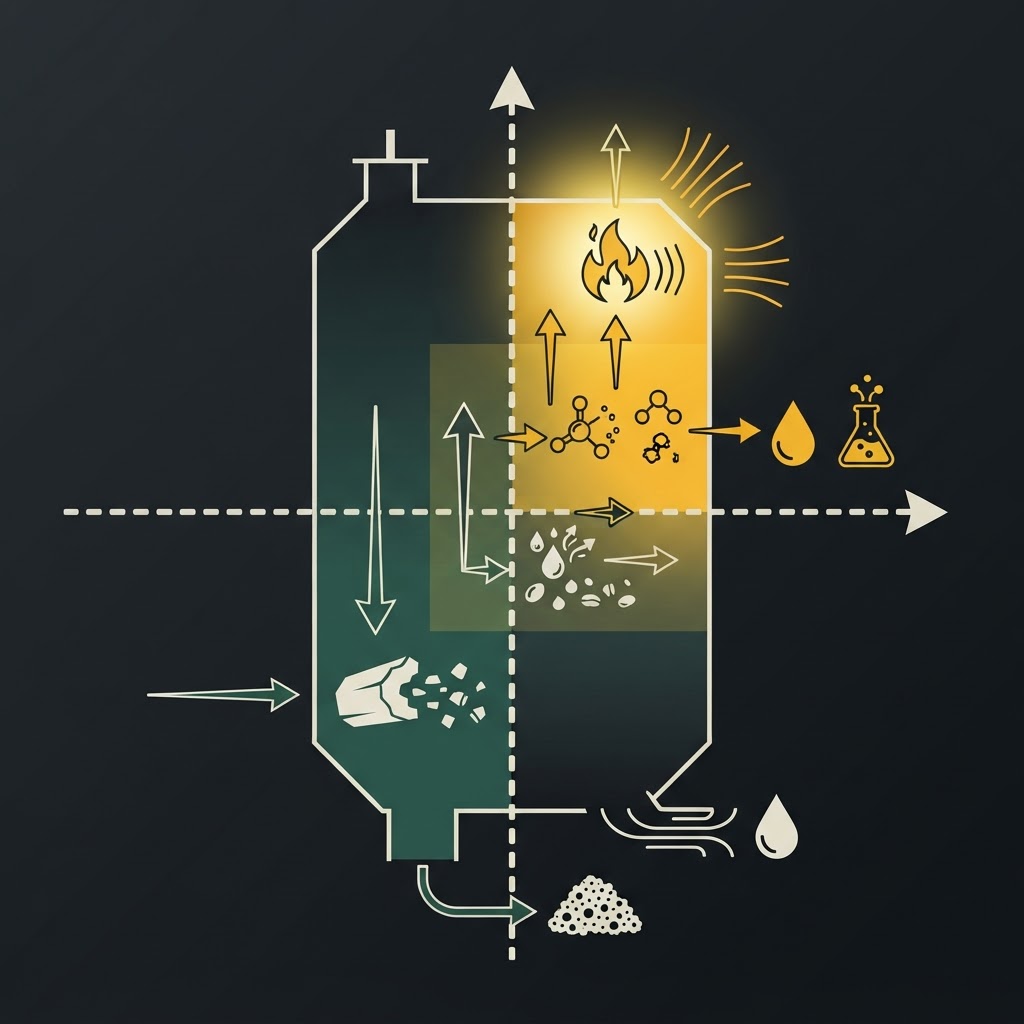
The two processes are closer than the comparison suggests. Pyrolysis is the first stage of both combustion and gasification. Every gasifier pyrolyses its feedstock first, then keeps going: it adds a gasifying agent (air, oxygen, steam or CO2) and pushes the temperature up until most of the char and tar become carbon monoxide and hydrogen. A pyrolysis plant stops early and keeps what that first stage produces, which is char, a condensable oil and some gas.
So the real question is where you want the carbon to end up. If it goes into a solid, you have a biochar and carbon removal business. If it goes into a liquid, you are selling fuel. If it goes into a gas, you are generating power. At Energaia we engineer gasification systems that also recover biochar, so we have a stake in this answer, and we will say plainly where pyrolysis is the better choice.
Pyrolysis vs gasification side by side
The most useful single comparison in the literature is a table in Brown's 2021 review in Processes. Here it is, condensed:
| Slow pyrolysis | Fast pyrolysis | Gasification | |
|---|---|---|---|
| Temperature | 300 to 600 °C | 400 to 600 °C | 800 to 1,500 °C |
| Major product | Solid (char) | Liquid (bio-oil) | Gas |
| Biochar yield | 25 to 45 wt% | 10 to 20 wt% | 0 to 10 wt% |
| Biomass carbon sequestered | under 55% | under 20% | 50 to 100% |
| Typical scale | Small | Moderate | Large |
| Capital cost | Low | Moderate | High |
The sequestration figure for gasification needs a warning. It only reaches 50 to 100% when the CO2 in the gas is captured and stored. A gasifier that burns its syngas in an engine and releases the exhaust sequesters only what stays in its small char stream.
Oxygen is a dial, not a switch
Competitor explainers say pyrolysis needs a complete absence of oxygen. The same review shows that is too strict. Most gasifiers admit air or oxygen at an equivalence ratio of about 0.20 to 0.25, meaning roughly a fifth to a quarter of what full combustion would need, so that partial oxidation supplies the process heat. Fast pyrolyzers can also run autothermally at 0.06 to 0.12, and they lose very little oil yield doing it.
The practical reading is that oxygen sits on a spectrum. Near zero you get pyrolysis. Around a quarter of stoichiometric you get gasification. At full stoichiometric and beyond you get combustion. The oxidant you use also dilutes the product gas, which matters later.
Temperature decides the product split
Heat is the other dial. Bio-oil yield peaks at 350 to 500 °C. At higher temperatures the liquid and solid molecules crack into smaller ones that leave as gas. Gasification typically runs at 650 to 1,200 °C. The same pyrolysis reactor can come out very differently depending on how it is run: across the studies reviewed in Environmental Chemistry Letters, oil ranged from 9.07 to 40.59%, biochar from 10.1 to 41.25% and gas from 11.93 to 28.16%.
What each route actually makes
Char: why slow pyrolysis wins the carbon removal case
If biochar is the product, slow pyrolysis is the natural route. It produces as much as three times more char than fast pyrolysis. The ECL review estimates that biochar from forestry residues could sequester 2.74 t CO2e per tonne of biochar when applied to soil. That figure is the basis of the carbon removal credit, which is often the revenue line that makes a small plant viable. (If you want to size that line for your own feedstock, here is how to calculate biochar yield, and here is how biochar carbon credits work once you have it.)
The weak spot is the co-product. The gas from slow pyrolysis is low in calorific value and worth only about $2 to 4/GJ, according to the Processes review. For a char-first plant that gas mainly supplies its own process heat.
Bio-oil: the liquid nobody buys unrefined
Fast pyrolysis looks better on paper: the same review values bio-oil upgraded to transport fuel at $23/GJ or more. The key word is upgraded. PG&E's conversion whitepaper puts crude bio-oil's heating value at 40 to 50% of hydrocarbon fuels. Its high oxygen content makes it corrosive and unstable, and it needs refining before it is useful. Fast pyrolysis only makes sense if you already have an upgrading partner, or a local buyer for crude oil as boiler fuel.
Gas: why syngas makes gasification the power route
Gasification aims to turn the whole feedstock into one fuel gas, and the gasifying agent sets its quality. The Energies review gives heating values of 4 to 6 MJ/Nm3 for air gasification, 10 to 12 MJ/m3 with oxygen and 15 to 20 MJ/m3 with steam. Air-blown gas is fine for engines and boilers, but it is poorly suited to pipelines. The reason is dilution: a review of waste gasification notes that air-blown product gas can be up to 60% nitrogen. That same review puts gas yield at 30 to 60% of the feed by weight.
This is the output for dispatchable power: a gas you can run through an engine on demand, unlike a solar panel. If that is your business, start with what biomass gasification is and whether syngas can generate electricity in your application.
Choose by revenue model, not by definition
Here is the rule we use when a client asks us to compare the two:
- You need electricity and heat on site, or to sell. Gasification. It is the only route here whose main product is an engine-ready fuel. This is the usual case for a site trying to replace a diesel generator.
- Your revenue is carbon removal credits and char sales. Slow pyrolysis. It gives the highest char yield and the lowest capital cost, and it works at small scale, which suits scattered biomass.
- You have a refinery or upgrading offtaker. Fast pyrolysis, and only then.
- You want power and credits. Gasification with char recovery. PG&E notes that a gasifier forms char in its pyrolysis zone, so a gasifier can yield some biochar alongside power. You get less char than slow pyrolysis, but you have two revenue lines instead of one. This is the five-step model Energaia runs: local biomass or sludge becomes clean syngas, the syngas becomes dispatchable electricity and heat, and the plant captures biochar and verified CO2 offsets on site.
The reactor design follows from which of these you pick. Our overview of types of biomass gasifiers covers the gasification side.
The step both routes share: getting the water out
No ranking page mentions this, and on real waste it often decides the project. Both processes spend heat on water before any chemistry starts. PG&E points out that the wetter the feedstock, the more of the heating energy goes into evaporating water, and that some technologies cannot handle wet feedstock at all.
Sewage sludge and many agricultural residues are exactly that kind of feedstock. That is why we have argued publicly that thermal pre-treatment is non-negotiable in gasification and pyrolysis. It cuts moisture, raises energy density and makes the feedstock uniform enough for the reactor to run steadily. The dryer is a real piece of engineering in its own right, and it brings its own emissions questions. For sludge specifically, see our guide to thermal treatment of sewage sludge.
Where each route is weak
Some honest limits that apply whichever route you choose:
- Pyrolysis stays small. The UK government's review of advanced gasification technologies describes commercial pyrolysis systems as small modular plants of 7,000 to 10,000 tonnes a year. That suits a farm cluster or a single sludge site, not a city.
- Advanced gasification has a thin track record. The same review found none of the advanced gasification technologies it assessed in commercial operation. It also notes that the syngas needs multicomponent clean-up for tars and particulates. Choose proven reactor types and pilot-scale data over brochures.
- Pyrolysis output follows the feed. The waste plastics review stresses that pyrolysis product distribution depends strongly on feed composition. In gasification, the variation mainly shows up in the gas composition. So a mixed or seasonal waste stream is harder to sell from as pyrolysis products.
FAQ
Is pyrolysis cheaper than gasification?
Per plant, usually yes: the Processes comparison rates slow pyrolysis capital cost as low, fast pyrolysis as moderate and gasification as high. That compares the reactors only. Whether the project pays depends on the value of what comes out, and slow pyrolysis gas is worth far less than power sold from syngas.
Can a gasifier produce biochar?
Yes. Char forms in the gasifier's pyrolysis zone and can be recovered. Expect far less of it: 0 to 10 wt% against 25 to 45 wt% for slow pyrolysis. Many operators accept that trade in exchange for a steady power output.
Which is better for plastic waste?
Neither is simple. Gasifying plastic makes more tar than biomass or coal does, and in steam gasification of plastics tar can exceed 100 g/m3. Pyrolysis of plastics avoids the oxidant but gives a product mix that swings with the polymer blend. For the gasification side in depth, see Zero-X on gasifying plastic waste.
Is syngas from pyrolysis the same as syngas from gasification?
No. Pyrolysis gas is a by-product carrying light hydrocarbons and CO2. Gasification drives the conversion further toward carbon monoxide and hydrogen, at a quality set by the gasifying agent: air, oxygen or steam.