
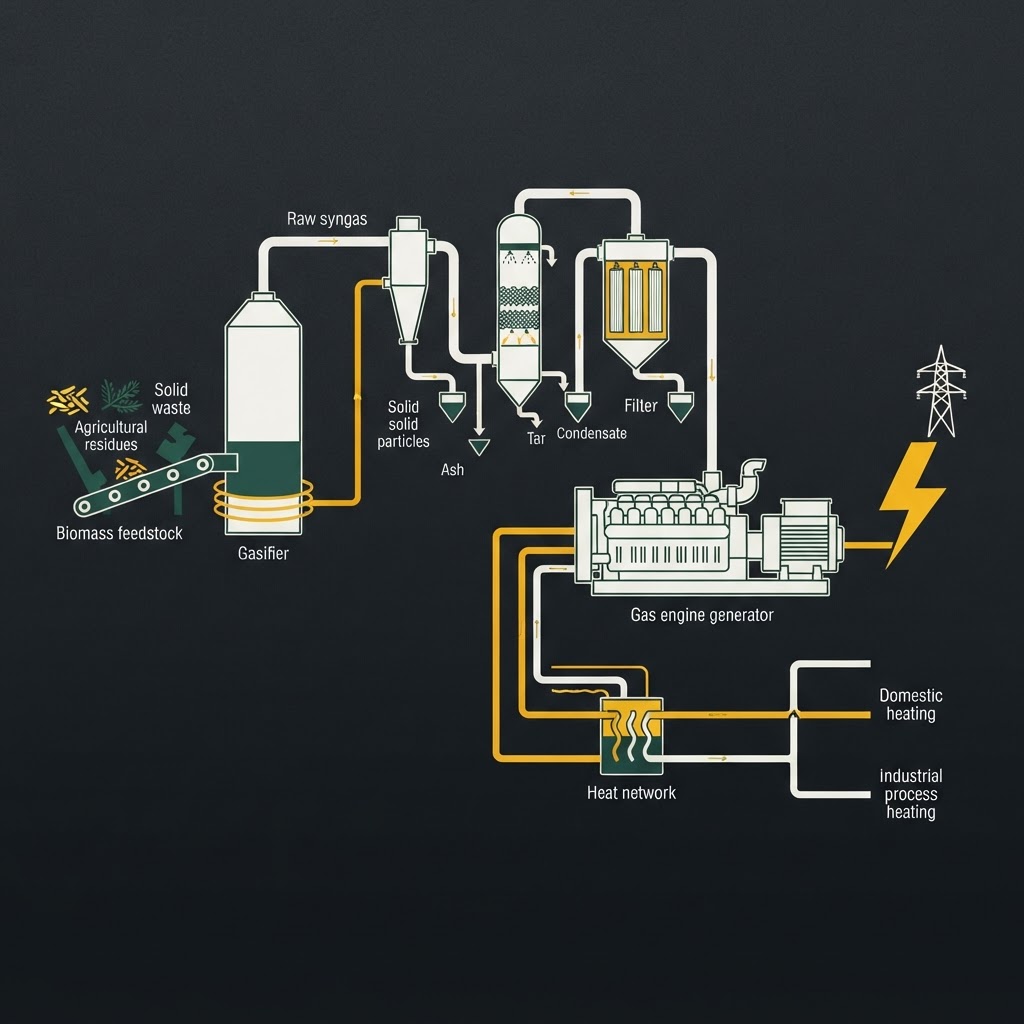
Can syngas be used to generate electricity? Yes. Gas from gasification is burned in reciprocating engines, gas turbines and integrated gasification combined cycle plants, and it can also feed solid oxide fuel cells, as a review of gasification tar and its remediation lays out. The technology is not the hard part. Two engineering facts decide whether a syngas power plant runs for years or stalls in its first season: the gas has a low heating value, so the engine loses power, and the gas carries tar and dust, so the engine has to be protected from it.
This article covers both, with the numbers, so you can judge a project before anyone orders steel.
What syngas is, and why its heating value matters for power
Syngas, or producer gas when air is the gasifying agent, is a mix of carbon monoxide, hydrogen and methane diluted by nitrogen and carbon dioxide. If you want the reactor side first, start with how biomass gasification works.
Air blown vs steam or oxygen blown gas
The gasifying agent sets the energy content. Air gasification gives a gas of 4 to 7 MJ/Nm3, while oxygen or steam gives a nitrogen free gas of 10 to 28 MJ/Nm3, according to a review of syngas in spark ignition engines. A simulation of Italian biomass residues found an even wider spread: 1.86 to 4.5 MJ/Nm3 with air and 5.2 to 7.5 MJ/Nm3 with steam. What matters in the cylinder is not the gas alone but the gas mixed with combustion air. The FAO's gasifier handbook puts a producer gas and air mixture at around 2,500 kJ/m3 against roughly 3,800 kJ/m3 for a stoichiometric petrol and air mixture, which is why a power loss of about 35 percent can be expected from an unmodified engine. Less energy per stroke means fewer kilowatts per cylinder. Every syngas power design starts from that fact.
Four ways to turn syngas into electricity
Spark ignition gas engines
This is the workhorse. A 2025 review of syngas combustion found that spark ignition engines can run on up to 100 percent syngas, typically at 20 to 30 percent reduced power output. The same review notes that downdraft fixed bed gasifiers account for roughly 75 percent of installed systems, mostly for small scale power and combined heat and power.
The derating can be engineered down. Syngas resists knock, so compression ratios can be raised, and the FAO notes that a correctly modified petrol engine loses about 30 percent of maximum output, while a turbocharged or supercharged engine on producer gas can match its petrol rating.
Not every engine maker will sign off. In a US Department of Energy front end design study, the licensee of a 9.6 MWe diesel engine could not develop a syngas conversion, and the team selected two Jenbacher JMS620 gas engines rated at 1,965 kWe each instead. The lesson for buyers: ask for the engine OEM's written approval for your gas composition, not just the gasifier vendor's.
Dual fuel diesel engines
Syngas will not self ignite in a compression ignition engine, so a diesel pilot does the job. The combustion review puts that pilot at 10 to 20 percent of total energy. FAO data show derating of a direct injection diesel can usually be held to 15 to 20 percent at 80 percent producer gas and 20 percent diesel. This is the natural retrofit path for sites that already run diesel gensets, a common setup for Nigerian businesses. We compared the options in our piece on alternatives to diesel generators in Nigeria.
Running on both fuels also covers feedstock gaps. An experimental study on blending found power derating to be the limiting factor, growing as the syngas energy share rises, which is why many plants top up with natural gas. Whether syngas can go the other way and stand in for pipeline gas is a separate question we cover in whether syngas can replace natural gas.
Gas turbines and combined cycle
At utility scale, syngas runs gas turbines, and in an integrated gasification combined cycle the turbine exhaust raises steam for a second turbine. At biomass project scale, turbines are rare for a practical reason the FAO flagged decades ago: gas turbines are very sensitive to dust, especially at high inlet temperatures. Engines tolerate dirtier gas than turbines do, which is why small and medium plants choose engines.
Fuel cells
Solid oxide fuel cells can convert syngas directly. The catch is purity. Tar does more than clog flow paths, it poisons catalytic layers, so a fuel cell demands far cleaner gas than an engine. For now this is a research and demonstration route, not a procurement option.
Gas cleaning decides whether the engine survives
Raw syngas carries condensable tar, dust and acids. Tar condenses on cooler surfaces such as intake manifolds, valves and coolers, and an engine that ingests it fouls fast.
The limits tighten as the technology gets more sensitive:
| Application | Tar limit | Source basis |
|---|---|---|
| IC engine (FAO handbook) | below 500 mg/m3, dust below 50 (ideally 5), acids below 50 | older engine generation |
| IC engine (modern review) | below 50 mg/Nm3 | spark ignition engine review |
| IC engine (tar review) | 100 mg/Nm3 | tolerance chart |
| Fischer Tropsch or methanol synthesis | 0.1 mg/Nm3 | tolerance chart |
The spread between 50 and 500 is worth noticing. Older engines were more forgiving, modern lean burn gas engines are less so, and the safe design target is the tighter number.
Reactor choice does a lot of the cleaning before the filters do. The combustion review reports downdraft gasifiers producing gas with tar below 100 mg/Nm3 and particles below 50 mg/Nm3, because the gas passes through the hot zone where tar cracks. Updraft designs are far dirtier. Our guide to the types of biomass gasifiers compares them in detail, and zero-x has written up what a gasifier generator needs to run around the clock.
Cleaning starts before the reactor, too. Energaia's position is that thermal pre-treatment is non-negotiable in gasification: drying the feedstock, raising its energy density and homogenizing it. Wet, uneven feed lowers reactor temperature, and a cooler reactor makes more tar. Much of what reaches the engine is decided at the feedstock yard.
How much electricity you actually get
Syngas power is a chain of conversions, and each link loses energy:
- Feedstock to gas. Cold gas efficiency is the share of the feedstock's energy that ends up in the cooled gas. The Italian simulation reported 16 to 41 percent for air gasification and 37 to 60 percent for steam, depending on residue and settings.
- Gas to electricity. The engine converts part of that gas energy into power.
- Electricity net of the plant. Fans, feeders, cleaning and dryers consume some of the output.
Measured end to end, from feedstock energy to electricity, the same simulation reached 26 percent electrical efficiency with air gasified olive prunings and 30 percent with steam gasified hazelnut shells. Techno-economic analyses of small downdraft gasifier engine systems, cited in the combustion review, report overall efficiencies of 13 to 14 percent. Those figures are a range, not a promise, and the honest reading is that small plants land at the lower end.
That is why heat recovery matters. The gas energy that does not become electricity leaves the engine as exhaust and jacket heat, and a site that uses it for drying feedstock, process heat or cooling changes the economics completely. Our breakdown of biomass gasification cost shows how that plays into payback.
Where syngas power makes sense
Syngas electricity wins where three conditions meet: a steady local feedstock that currently costs money to dispose of, a weak or expensive grid, and a use for the waste heat.
That describes two markets Energaia works in. In Germany, municipal utilities and agricultural operators hold residues and sewage sludge with rising disposal costs. In Nigeria, businesses pay for diesel to cover an unreliable grid while agricultural residues go unused. Energaia's five step process is built for that situation: collect local biomass or sludge, gasify it at high temperature into clean syngas, convert it to dispatchable electricity and heat, capture biochar and verified CO2 offsets, and run it on site.
Dispatchable is the key word. Unlike solar, a syngas engine produces power when the load needs it, as long as the fuel store is full. And when the gasifier is tuned to leave carbon behind, the residue becomes a second product, the idea behind a biochar gasifier.
A feasibility checklist before you buy a gasifier genset
Ask these before any capital is committed:
- What is the moisture and ash content of my feedstock, measured, and what pre-treatment brings it into the gasifier's range?
- What is the expected heating value of the gas, and what derated kW does the engine deliver on it? Insist on derated output, not the nameplate rating for natural gas.
- What tar and dust levels reach the engine, and by which sampling method were they measured?
- Has the engine manufacturer approved this gas composition in writing?
- Where does the waste heat go? If the answer is nowhere, rework the business case.
- What is the backup when feedstock runs short: diesel pilot, natural gas blend or grid?
A vendor that answers all six with measured data is selling a machine. One that answers with nameplate figures is selling a brochure.
FAQ
Can you run a diesel generator on syngas? Yes, in dual fuel mode. The engine keeps a diesel pilot for ignition, typically 10 to 20 percent of the energy, and FAO data show derating can usually be held to 15 to 20 percent at an 80 to 20 split of producer gas and diesel.
Can syngas be used in a gas turbine? Yes. Large integrated gasification combined cycle plants do exactly that. At small and medium biomass scale, engines dominate because turbines are very sensitive to dust and need cleaner gas.
How much syngas does it take to make one kWh? There is no single figure, because it depends on the gas heating value and the engine efficiency. Divide 3.6 MJ by the engine's electrical efficiency to get the gas energy needed per kWh, then divide by your measured heating value in MJ/Nm3 to get the gas volume.
Can syngas power a fuel cell? Solid oxide fuel cells can run on syngas, but tar poisons their catalytic layers, so gas cleaning must be far stricter than for an engine. Treat it as a demonstration technology for now.