
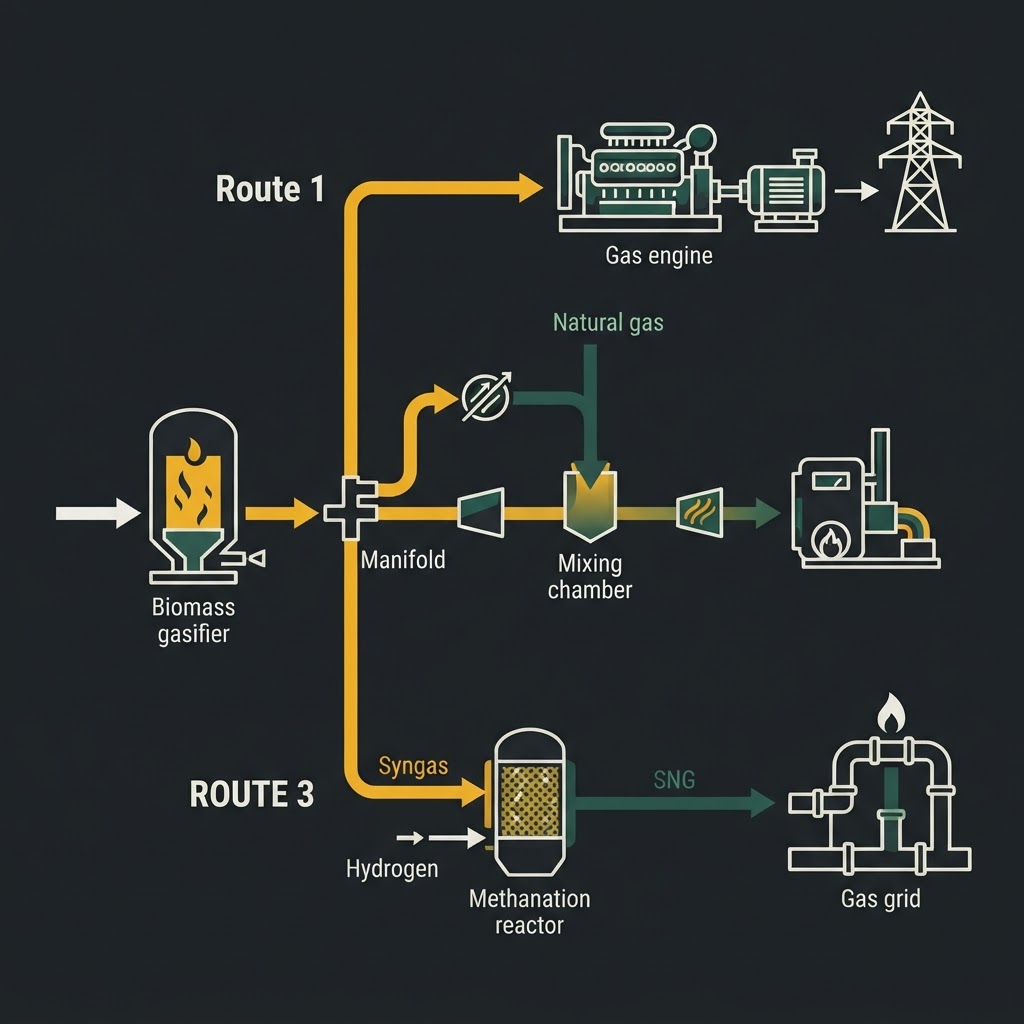
Can syngas replace natural gas? Partly, and how much depends on which of three routes you take. Raw syngas can fuel a gas engine on its own, at a power penalty. It can be blended into natural gas burners, and a peer-reviewed interchangeability study found blends of up to 15 percent syngas by volume ran in atmospheric natural gas burners without modification. Or it can be upgraded by methanation into synthetic natural gas, which can replace fossil gas completely, at a real cost in energy and money.
Most answers online pick one of these and stop. This article walks through all three with the numbers, so a plant owner in Saxony or a factory owner in Lagos can see which one fits their site before anyone orders steel.
The short answer: partly, and in three different ways
Think of it as a ladder, from cheapest to most complete:
- Direct use in engines. A spark ignition gas engine can run on syngas alone. You lose output, but the gas is used as it leaves the cleaning train.
- Blending into burners. Syngas tops up a natural gas supply. Small shares need no burner changes; larger shares do.
- Upgrading to bio-SNG. Syngas is converted catalytically into methane, cleaned to grid specification, and becomes interchangeable with natural gas. Full replacement, highest complexity.
Which rung makes sense depends on what the natural gas does today: generating power, firing a kiln or boiler, or feeding a grid.
Why syngas is not a drop-in fuel
Syngas is a mixture of hydrogen, carbon monoxide, carbon dioxide, methane and, in air-blown gasifiers, a lot of nitrogen. If you are new to how it is made, start with how biomass gasification works. The mix varies with the gasifying agent, which Zero-X breaks down in its piece on syngas composition by gasifying agent.
Heating value: the gap in numbers
This is the core problem. A 2025 review of syngas combustion in engines puts air-blown syngas at roughly 4 to 6 MJ/Nm3 and oxygen or steam-blown syngas at roughly 10 to 15 MJ/Nm3, against natural gas at about 37 MJ/kg. A French review of gasification for power gives a similar picture: 4 to 7 MJ/Nm3 for air gasification and 10 to 28 MJ/Nm3 for oxygen or steam gasification, which produce nitrogen-free gas. Natural gas itself is typically quoted at about 8,900 kcal per cubic metre.
Put plainly, methane has a lower heating value five to ten times higher than syngas. To deliver the same energy, you push several times the gas volume through the same pipes, valves and burner nozzles.
Wobbe index: why burners care about more than energy
A burner is set up for a gas of a given Wobbe index, a number that combines heating value and density and predicts how much heat flows through a fixed nozzle at a fixed pressure. Swap in a gas with a very different Wobbe index and the flame lifts, flashes back or burns too cold. That is why the interchangeability study above used a corrected Wobbe index method to judge blends, and why bio-SNG producers deliberately leave a few percent of CO2 in the product to hit the grid's Wobbe range (more on that below).
Tar, dust and variable composition
Natural gas arrives clean and constant. Syngas arrives with tar and particulates, and its composition moves with feedstock moisture, particle size and gasifier temperature. Energaia treats thermal pre-treatment as non-negotiable: reducing moisture, raising energy density and homogenizing the feedstock are what make the gas steady enough for any downstream equipment. The choice of reactor matters too, as our guide to types of biomass gasifiers explains.
Route 1: replacing natural gas directly in engines
This is where syngas replaces natural gas most completely without chemistry. The 2025 review reports that spark ignition engines can run on up to 100 percent syngas, typically at 20 to 30 percent less power output than on conventional fuel. Compression ignition engines cannot ignite syngas on their own and run in dual fuel mode, with a diesel pilot supplying 10 to 20 percent of the energy.
An experimental study of syngas and natural gas in spark ignition engines quantifies the derating more broadly, at 15 to 40 percent of maximum output, and makes a practical point every operator learns: when the gasifier's gas flow drops, natural gas is injected to hold the load. In other words, in many real gen-sets syngas does not eliminate natural gas, it displaces most of it while natural gas stays as the backup.
We cover engine choice, derating and gas quality limits in detail in can syngas be used to generate electricity.
Route 2: blending syngas into natural gas burners
For process heat, boilers and kilns, blending is the low-risk entry point. The interchangeability study tested air-blown syngas with a lower heating value of 3.0 to 3.8 MJ/Nm3 and found that blends of up to 15 percent syngas by volume could run in atmospheric natural gas burners with no modification. The blend's methane number was 5.8 percent higher than natural gas alone, and flue gas composition, flame temperature and flame speed shifted only slightly.
Two things follow:
- 15 percent by volume is a modest energy share. Because syngas carries so much less energy per cubic metre, the share of heat it supplies is well below its share of volume.
- Beyond that, the burner has to change. Higher shares need nozzles, gas trains and controls designed for the larger volume flow and the different Wobbe index. That is an engineering project, not a valve setting.
Blending makes most sense where a site already has a gasifier, or residues it pays to dispose of, and wants to cut gas purchases without touching its process equipment.
Route 3: upgrading syngas to bio-SNG
If the goal is to replace natural gas completely, including in the grid, syngas must become methane.
How methanation turns syngas into grid gas
In a catalytic methanation reactor, hydrogen and carbon monoxide react to form methane and water. According to the ECN/TNO bio-SNG study, crude SNG is roughly three equal parts methane, CO2 and water. After upgrading, the product is compressed to grid pressure, with a few percent CO2 deliberately left in to meet the Wobbe index. On that route, the authors put the potential for natural gas substitution at 100 percent, limited mainly by how much biomass is available.
The prize is infrastructure. As the US NETL paper on SNG notes, SNG can move through existing natural gas pipelines and be used in existing gas-fired plants. Nothing downstream changes.
What it costs in energy
Methanation is not free. The ECN/TNO work estimates that converting H2 and CO to methane loses about 20 percent of the energy as heat, and puts the overall efficiency of biomass-to-SNG at about 70 percent, plus 5 to 8 percent net power recovered from process heat. NETL cites the same 70 percent on a lower heating value basis, with about 40 percent of the biomass carbon ending up in the SNG and an equal 40 percent leaving as a concentrated CO2 stream that could be captured.
The nitrogen problem from earlier comes back here: air-blown syngas is a poor methanation feed, so bio-SNG plants use indirect or steam gasifiers that make nitrogen-free gas. The pyrolysis vs gasification comparison explains why the reactor's operating mode shapes the gas it makes.
What GoBiGas proved, and why it closed
The best real-world test is GoBiGas in Gothenburg, a 20 MW wood-to-biomethane plant. The Chalmers demonstration report records over 15,000 operating hours and, in February 2018, over 1,800 hours of continuous running at full design capacity. Technically, it worked.
Commercially, it did not. The same report states that the regional biomethane price, below SEK 600/MWh (about EUR 60/MWh), was less than the variable cost of running the plant stand-alone, so it was mothballed. A Chalmers economic assessment concluded that a 200 MW plant on forest residues could produce biomethane for about EUR 60/MWh, with feedstock around 36 percent of the cost. Scale is the lever. A 20 MW unit carries far higher costs per unit of gas.
When the economics close
ECN/TNO found bio-SNG more expensive than natural gas at a gas price of 6 EUR/GJ across plant sizes from 10 to 1,000 MWth. A more recent TNO analysis of renewable syngas for industry finds that renewable syngas routes become cost-competitive only if natural gas costs at least around 3 EUR/GJ and carbon taxes rise from 90 EUR per tonne of CO2 today to 300 EUR by 2050, and that biomass gasification looks like the strongest of the five routes it compares. It also counts only about 600 MW of biomass and waste syngas capacity worldwide, a sign of how early this market still is.
What that means on the ground:
- Grid-scale replacement is a policy and scale question. Without carbon pricing or green gas support, fossil gas usually wins on price.
- On-site replacement is a different calculation. A factory or utility that already pays to dispose of residues, or that runs on expensive trucked fuel, is not competing with a wholesale gas price. Using syngas directly in an engine or blending it into burners skips methanation and its 20 percent energy loss.
- Carbon value changes the sum. Biomass carbon is biogenic, and a gasifier that also produces biochar, which our biochar gasifier guide covers, can earn carbon credits on top of the fuel savings.
How Energaia approaches a natural gas replacement project
Energaia's public five step process is built around the on-site case: collect local biomass or sludge, gasify it at high temperature to clean syngas, convert it to dispatchable electricity and heat, capture biochar and verified CO2 offsets, and run it on site. In practice, a replacement study answers four questions before any hardware is chosen:
- What does the natural gas do today? Power, process heat, or both. That decides between route 1 and route 2.
- What share must be replaced? Under about 15 percent by volume in burners is a blending project; full replacement in burners or the grid is a different plant.
- Can the feedstock deliver steady gas? Moisture, ash and supply over twelve months, with pre-treatment sized accordingly.
- What is the gas worth on this site? Avoided purchases, avoided disposal fees, biochar and carbon credits, compared on the same basis.
Energaia models these steps digitally before steel is ordered, because the cheapest gasifier is the one you find out you do not need on paper.
FAQ
Can syngas be put into the natural gas grid?
Not as raw syngas. It has to be methanated, then stripped of water and most of its CO2 and compressed to grid pressure. Only then does it meet the grid's specification and Wobbe index.
Is syngas the same as SNG?
No. Syngas is mainly hydrogen and carbon monoxide. SNG, synthetic or substitute natural gas, is the methane-rich gas made from syngas by methanation. Be aware that in industrial gas supply, SNG also refers to LPG blended with air to mimic natural gas, which has nothing to do with gasification.
Can a natural gas generator run on syngas?
A spark ignition gas engine can run on 100 percent syngas once the gas is cleaned of tar and dust, but expect roughly 20 to 30 percent less power, and engine settings such as ignition timing need adjusting.
Does replacing natural gas with syngas cut CO2 emissions?
When the syngas comes from biomass or residues, its carbon is biogenic rather than fossil. In a bio-SNG plant, about 40 percent of the biomass carbon also leaves as a concentrated CO2 stream that can be captured, which can push the balance further.