
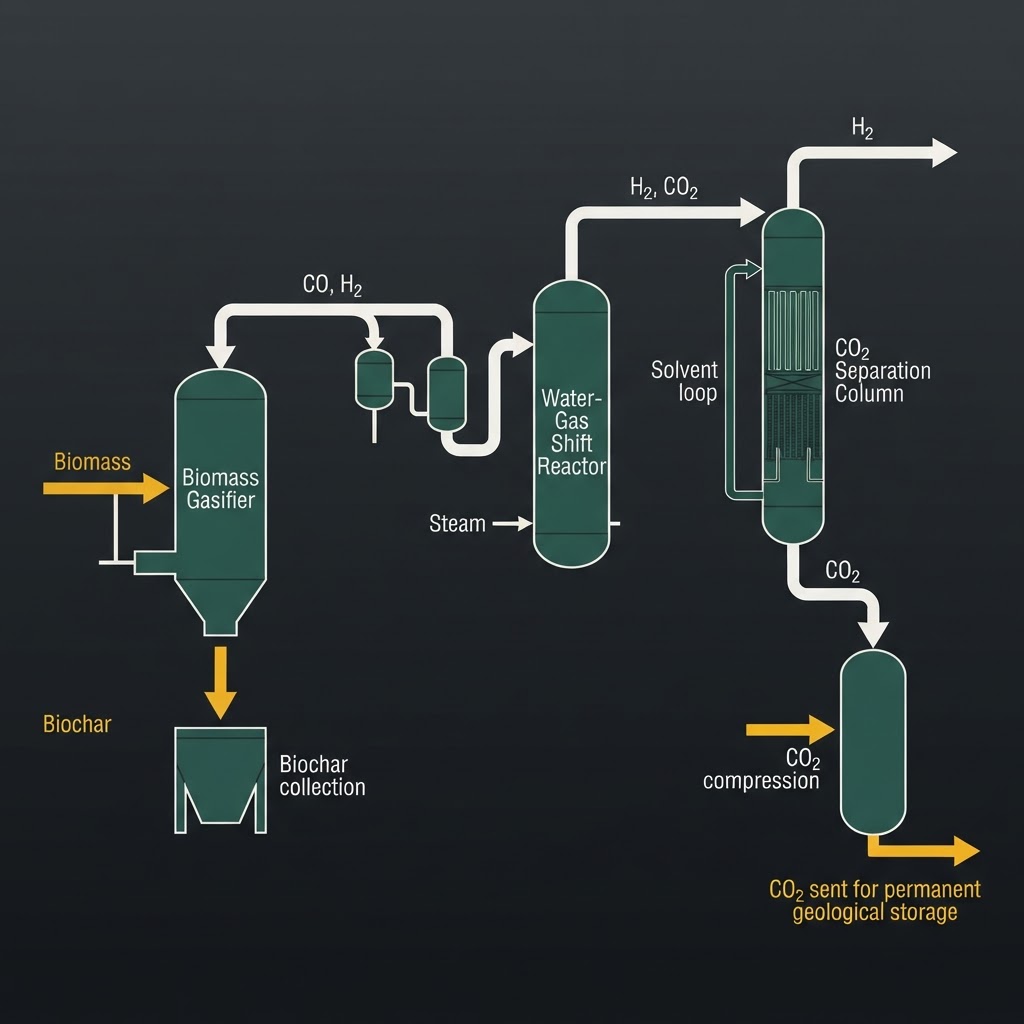
Biomass gasification with carbon capture takes CO2 out of the gas stream before anything is burned, which is where it is most concentrated and cheapest to separate. A boiler with carbon capture has to scrub a large, dilute flue gas. A gasifier can shift its syngas and pull the CO2 from a small, rich stream. The biomass took that carbon from the atmosphere, so once the CO2 is stored underground the plant counts as a carbon removal, not just a cleaner power station.
This article sets out the engineering numbers that decide whether the pathway works: how concentrated the CO2 is, what share of the feedstock carbon you can actually capture, what a tonne costs, and who is already paying for the result. Every figure links to the study or project it comes from.
What biomass gasification with carbon capture actually is
If you need the basics of the reactor itself, start with how biomass gasification works. The capture step is added downstream of it, in four moves:
- Gasify. Biomass reacts with a controlled amount of air, oxygen or steam and becomes syngas: mainly CO, H2, CO2 and some methane.
- Shift. Steam and a catalyst convert CO into CO2 and more H2 (the water-gas shift).
- Separate. A solvent or adsorbent removes the CO2 from the shifted gas.
- Compress and store. The CO2 is compressed and sent to geological storage. The hydrogen-rich gas goes on to an engine, a turbine, a hydrogen product or a fuel synthesis.
Bioenergy Europe's BECCS report describes this as pre-combustion capture, suited to streams above roughly 20% CO2 by volume. That threshold is the whole argument for doing capture on a gasifier instead of a boiler.
Why syngas is easier to strip than flue gas
Concentration and volume
A study of a 10 MWth biomass gasification CHP plant put the numbers side by side. The syngas stream was about 11% of the flue gas flow rate and held 33 vol% CO2, against 13 vol% in the flue gas. You are moving roughly a tenth of the gas, at about two and a half times the CO2 concentration. Smaller columns, smaller blowers and a separation that does far less work per tonne.
Energy cost per tonne captured
The energy penalty shows the same thing. A techno-economic comparison of negative-emission options in industry lists pre-combustion capture at 95% capture with 0.34 GJ of electricity and 1.97 GJ of heat per tonne of CO2, against amine (MEA) post-combustion capture at 89% with 0.78 GJ of electricity and 4.4 GJ of heat. Pre-combustion needs less than half the heat per tonne and captures a larger share of the stream it treats.
Heat is the cost that sinks most bioenergy capture projects, because every gigajoule sent to a solvent reboiler is a gigajoule you no longer sell as district heat or turn into power.
The capture rate depends on what you make
This is the part most explanations skip. "90% capture" usually means 90% of the CO2 in the stream being treated, not 90% of the carbon in the biomass. On a gasifier, the share of biomass carbon you can store depends mostly on the product.
Hydrogen: most carbon leaves as CO2
If the target product is hydrogen, the shift step pushes nearly all the carbon into CO2, and nearly all of it can be captured. A techno-economic study of bio-hydrogen and bio-methanol plants found hydrogen plants reach 64 to 90% capture through pre-combustion capture alone, depending on the gasifier, and 98 to 99% when a post-combustion amine unit is added.
A 2026 IEA Bioenergy case study modelled a decentralised version: a 1 MW bubbling fluidised bed gasifier fed 300 kg/h of wood pellets at 800 C, with two shift reactors and Rectisol (chilled methanol) capture. It reported a 98% CO2 capture rate, CO2 at 99% purity, net emissions of minus 859 kg CO2e per MWh of hydrogen, and 27% overall energy efficiency. The removal is real; the efficiency is the price.
Methanol and fuels: carbon stays in the product
A methanol or jet-fuel plant wants carbon in its product, so less of it can go to storage. The same study found methanol plants capture 26 to 55% through pre-combustion capture, with a ceiling of 55 to 57% even with extra post-combustion capture. The rest of the carbon leaves in the fuel and is released when the fuel is burned. Any removal claim from a fuels plant applies only to the stored share, which is why credit contracts for these plants split the carbon benefit between fuel and removal.
Power and CHP: the combustor problem
Small power and CHP plants are where the headline rate misleads most. In the 10 MWth CHP study, pressure vacuum swing adsorption captured 87.3% of the CO2 on a syngas basis but only 48.5% on a biomass basis, because the CO2 from the gasifier's own combustor was not touched. Net electrical efficiency fell from 27.8% to 22.7%. An amine unit on the flue gas instead captured 58.4% on a biomass basis but needed 3.34 MWth of steam.
In practice: if a vendor quotes a capture rate for a gasification power plant, ask which basis it is on, and whether the char combustor or the engine exhaust is included.
What it costs per tonne of CO2
The cost range is wide, and the low end is where gasification sits.
| Configuration | Cost per tonne CO2 | Source |
|---|---|---|
| Biomass to methanol, pre-combustion, incl. 13.4 EUR/t transport and storage | 41 to 46 EUR | Poluzzi et al. |
| Biomass to hydrogen, pre-combustion, incl. transport and storage | 52 to 56 EUR | Poluzzi et al. |
| Post-combustion top-up to 98 to 99% (marginal) | 98 to 205 EUR | Poluzzi et al. |
| Biorefinery high-concentration streams | 22 to 24 USD | IEAGHG |
| Biomass gasification combined cycle (BIG-CC), best cases | 57 to 68 EUR | Restrepo-Valencia and Walter |
| BECCS capture in general (excl. transport and storage) | 40 to 240 EUR | Bioenergy Europe |
Two points stand out. First, where the process already has to remove CO2 to make its product (methanol synthesis needs it out of the syngas anyway), capture costs little more than compression and storage. Second, the last stretch of capture is expensive: the marginal tonne from a post-combustion top-up costs roughly two to five times the average tonne from pre-combustion capture. IEAGHG found that extending capture from the concentrated streams to flue gas raised the cost to 27 to 66 USD per tonne.
The second capture route: carbon kept as biochar
Geological storage is not the only way a gasifier can store carbon. A gasifier run for both gas and char leaves part of the feedstock carbon as solid biochar, which can be applied to soil or used in materials instead of being burned. Energaia's own process model pairs the two outputs: gasify local biomass or sludge to clean syngas, convert it to dispatchable power and heat, and capture biochar plus verified CO2 offsets on site.
The difference is practical. Biochar needs no pipeline, no injection well and no storage licence, which matters for a decentralised plant far from a CO2 hub. The trade-off is that the char takes carbon away from the gas, so you produce less power. In the EU both routes now sit inside the same certification framework, covered in our guide to permanent carbon removal credits under the CRCF.
At Energaia we model this split before a plant is specified: how much carbon goes to gas, how much to char, and which revenue stream the feedstock and location can actually support.
Who is building it and who is buying the tonnes
The largest gasification-based project on record is C2X's Beaver Lake plant in Louisiana. It is designed to turn forestry residues into more than 500,000 tonnes of bio-methanol a year while capturing and storing about 1 million tonnes of CO2 a year. Microsoft has contracted 3.6 million carbon removal units from it over 12 years. The investment is put at about USD 2.5 billion, with operations expected from 2029. Lifecycle emissions are subtracted, and the carbon benefit is split between the methanol and the credits so it is not counted twice, which is the methanol accounting problem described above, handled in a contract.
The demand is real. Fastmarkets counted BECCS offtakes of just under 10 million tonnes of CO2 in the first half of 2025, with Microsoft the largest buyer, and disclosed a 13-year pulp-and-paper CCS offtake priced below USD 200 per tonne. For how those prices compare across pathways, see what carbon removal credits cost.
For contrast, most BECCS capacity in Europe is still combustion-based. Evero's Ince plant in the UK will retrofit post-combustion capture to remove 217,000 tonnes of CO2 a year from 170,000 tonnes of waste wood, by 2029. It works, but it captures from flue gas, the harder stream.
Where it fits in Germany and Nigeria
The studies above show the technology works from 1 MW upward. What decides a project is access to CO2 transport and storage.
- Germany. A municipal or industrial gasifier can add pre-combustion capture, but geological storage means exporting CO2 to a hub. For plants below hub scale, our engineering view is that biochar is the more bankable carbon route today, with geological capture as a later retrofit once pipeline or shipping access exists.
- Nigeria. The case for gasification is dispatchable power from local residues where the grid is unreliable. Without nearby storage, biochar is again the realistic removal route, and it adds a credit revenue stream to a power project instead of a cost.
Hydrogen is the product that maximises storable CO2, which is why the pathway pairs naturally with biomass gasification for hydrogen production wherever storage is reachable.
FAQ
Is biomass gasification with carbon capture carbon negative?
It can be, once lifecycle emissions are counted. The IEA Bioenergy hydrogen case came out at minus 859 kg CO2e per MWh of hydrogen after feedstock supply, conversion and CCS infrastructure were included. Credit buyers such as Microsoft require those lifecycle emissions to be subtracted before a tonne is issued.
Which solvents capture CO2 from syngas?
Physical solvents such as Rectisol (chilled methanol) suit high-pressure, CO2-rich syngas. MDEA, an amine, is used in pre-combustion units at around 30 bar, where it can remove about 95% of the CO2 in the syngas. At small scale and near-atmospheric pressure, pressure vacuum swing adsorption is an alternative that avoids solvent regeneration heat.
Can a small gasifier capture CO2?
Yes, technically. The modelled cases run from a 1 MW hydrogen unit to a 10 MWth CHP plant. The constraint is economic: compression, transport and storage are a fixed cost per tonne, so small plants without a nearby CO2 network usually store carbon as biochar instead.
Does capture reduce a gasifier's power output?
Yes. In the 10 MWth CHP case, adding pre-combustion capture cut net electrical efficiency by about five percentage points, because the adsorption units and CO2 compression draw power the plant would otherwise export.