
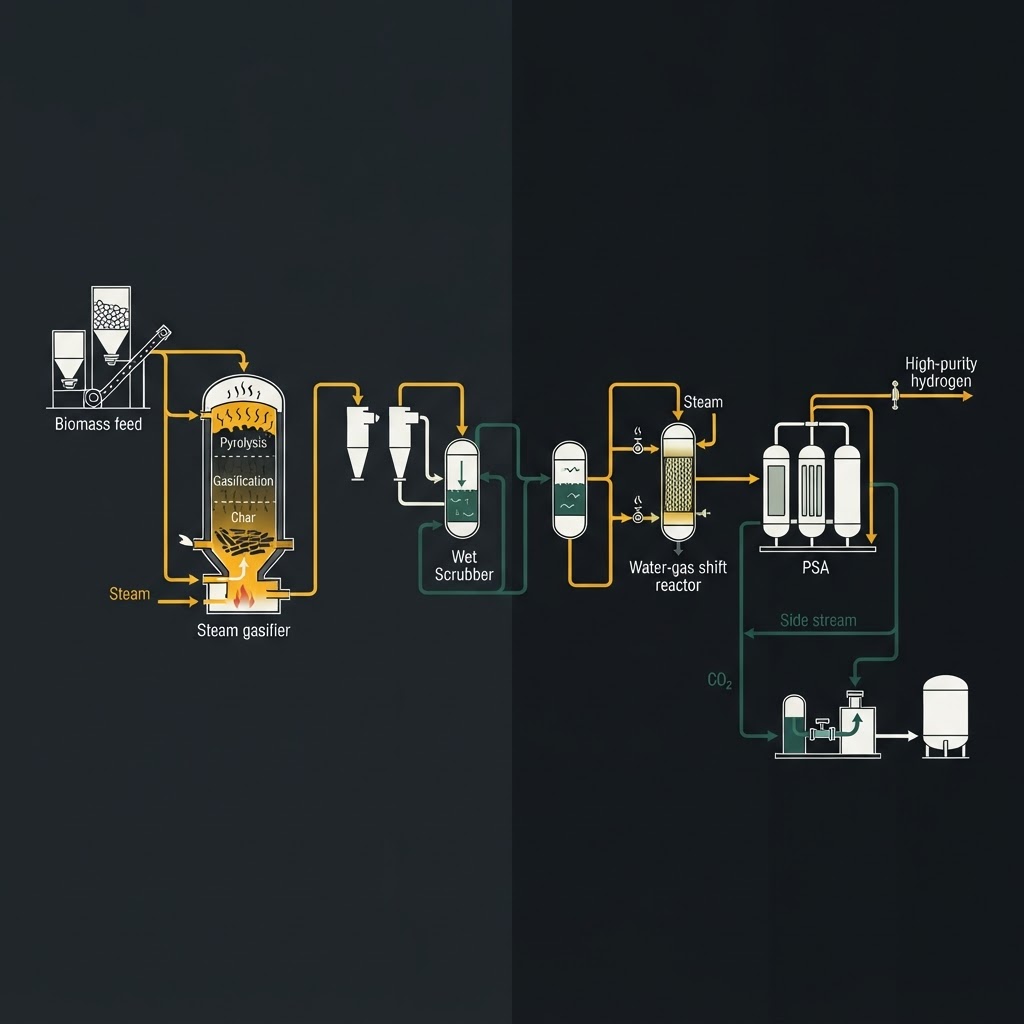
Biomass gasification for hydrogen production yields roughly 100 kg of hydrogen from every tonne of dry biomass. That is the working figure IEA Bioenergy uses in its 2025 Task 33 report on biomass gasification for hydrogen, with energy efficiency normally between 40 and 70% on a lower heating value basis. The same report estimates a production cost of about EUR 4 per kg at a 200 MW plant, and it states plainly that no commercial biomass gasification plant for hydrogen is operating anywhere in the world yet.
Those three facts frame everything below: the yield is respectable, the cost is close to fossil hydrogen at scale, and the technology is still waiting for its first integrated commercial reference. This page sets out the process chain, what the yield numbers really mean, where the cost comes from, and when a gasifier should make hydrogen at all.
The short answer: about 100 kg per dry tonne
The theoretical ceiling is higher. A 2024 techno-economic analysis by Gubin and colleagues calculates a maximum of 172 g of hydrogen per kg of dry woody biomass if every carbon atom is converted. Real plants lose part of that to tar, char, methane and the heat the process itself needs, which is why modelled designs land between 68 and 87 g/kg.
In practical terms, one kilogram of hydrogen needs about 10 kg of dry biomass at the IEA reference yield, or 11.5 to 14.7 kg at the yields Gubin models for a large and a small plant.
How biomass becomes hydrogen: the four-step chain
Gasification itself only produces a mixed fuel gas. Hydrogen comes out at the end of a chain, and each link has its own engineering. If you need the reactor basics first, read how biomass gasification works.
Step 1: steam gasification
Biomass is heated to high temperature with a limited oxidant so it breaks down into carbon monoxide, hydrogen, CO2 and methane instead of burning. For hydrogen, steam is the preferred gasifying agent, because it drives the steam reforming reactions that add hydrogen, while air dilutes the gas with nitrogen, as the 2024 review by Copa Rey and colleagues explains. Pilot dual fluidised bed gasifiers produce 0.84 to 0.91 Nm3 of gas per kg of wood at 800 C, with cold gas efficiency of 63 to 69%, according to a simulation and techno-economic review in Energies.
At Energaia we treat this step as a feedstock problem before it is a reactor problem. As we have argued publicly, thermal pre-treatment is non-negotiable: moisture reduction, energy density and a homogeneous feed decide how stable the gas quality is, and a hydrogen train downstream is far less forgiving of swings than an engine.
Step 2: gas cleaning
Raw gas carries tar, particulates and trace contaminants such as H2S, NH3 and HCl, all of which poison the catalysts that follow. Tar is the stubborn one: it condenses in cooler pipework and fouls equipment. Tar formation depends on reactor type and temperature, so the cheapest tar is the tar the gasifier never makes; this explainer on where gasification tar comes from covers the mechanism.
Step 3: water-gas shift
Steam reacts with carbon monoxide over a catalyst to make more hydrogen and CO2. After the shift reactor the gas typically holds 65 to 70 vol% hydrogen, per the IEA Task 33 report. For the starting mix before the shift, see our breakdown of biomass syngas composition.
Step 4: pressure swing adsorption
Pressure swing adsorption (PSA) strips out the remaining CO2, methane and CO. The SGH2 design described in an earlier version of the IEA report targets purity above 99.97%, which is fuel cell grade.
Hydrogen yield: what the numbers actually say
Why reported yields range from 15 to 165 kg per tonne
A 2024 review in Sustainability by Borges and colleagues tabulates published yields from 0.0154 to 0.165 kg of hydrogen per kg of biomass, with an average around 0.1 kg/kg. The spread is not noise. It reflects different feedstocks, gasifier types, whether methane is reformed, and whether part of the carbon is deliberately kept as biochar.
That last point matters. The Torrgas two-stage concept reaches about 70 kg of hydrogen per dry tonne with 56% overall efficiency including biochar, according to an IEA Bioenergy Bio-H2 webinar. Lower hydrogen, but a solid carbon product that can earn removal credits.
Levers that raise yield
- Temperature and steam ratio. In steam gasification of char, hydrogen yield rose from 109.7 to 190.6 g per kg of char as the steam to carbon ratio went from 0.7 to 3.1, with the maximum at 950 C, in a study in Scientific Reports. Our page on gasification temperature covers the trade-offs.
- Catalysts in the bed. Borges and colleagues report olivine, CaO and CeO2-Ni-CaO raising the hydrogen content of the gas severalfold.
- Reactor choice. Dual fluidised beds give a nitrogen-free gas; fixed beds are simpler but yield less. Compare the options in types of biomass gasifiers.
What it costs per kilogram
Scale is the biggest cost driver
The IEA report collects five estimates ranging from EUR 2.2 to 7.4 per kg depending on technology and size. Its own central figure is about EUR 4 per kg for a 200 MW plant with biomass at EUR 20 per MWh, falling below EUR 3 with expected learning.
Scale is brutal. Gubin's team modelled a 60 MW dual fluidised bed plant at EUR 5.6 per kg and a 1 MW fixed bed unit at EUR 15.0 per kg, both in 2022 euros. The small plant costs about 2.7 times more per kilogram. Borges and colleagues report an average levelised cost of USD 3.15 per kg across the literature, with feedstock price a major swing factor. For the capex side, see our guide to biomass gasification cost.
How it compares with natural gas hydrogen
Hydrogen from steam methane reforming in Europe averaged EUR 3.8 per kg in 2023, after spiking to EUR 5.7 in 2022, per the IEA Task 33 report. A large biomass plant at EUR 4 per kg is therefore already within reach of fossil hydrogen, before any value is put on its carbon.
The CO2 stream: how biomass hydrogen goes carbon negative
Here is the feature that sets gasification apart from electrolysis. Producing hydrogen from biomass separates a concentrated CO2 stream as an integral step of the process, roughly 15 to 20 kg of CO2 per kg of hydrogen, according to IEA Task 33. Because that carbon came from plants, storing it makes the hydrogen carbon negative.
The economics follow. If 85% of the CO2 is captured and earns a net EUR 50 per tonne after handling, the IEA estimates production cost falls to EUR 2.2 to 3.5 per kg, competitive with fossil hydrogen today. We cover capture rates and costs in detail in biomass gasification with carbon capture.
Where the technology really stands
Honesty helps buyers here. A 2025 IEA Bioenergy synergies report found every biohydrogen concept it reviewed at technology readiness levels 4 to 7, none commercialised, with integrated operation as the weakest link. The individual units are mature; running them together on biomass is not yet proven at scale.
The IEA Task 33 status database for hydrogen projects shows what exists:
| Project | Country | Status | Scale |
|---|---|---|---|
| Swindon Advanced Biofuels Plant | UK | Operational since 2024 | 500 t/y hydrogen from 8,000 t/y refuse derived fuel and waste wood |
| CAPPYRO H2 | France | Operational demonstration | 3 kg/h hydrogen from 80 kg/h biomass |
| Blue Tower Herten | Germany | On hold | 150 m3/h hydrogen from roadside greenery |
The pipeline is larger. HyCarb in the Netherlands plans about 15,000 tonnes of hydrogen a year from demolition wood and prunings, per the IEA Task 33 report.
Should your gasifier make hydrogen, power, or both?
For a municipal utility in Germany or an industrial site in Nigeria, the realistic plant is small, and small hydrogen-only plants carry the 2.7 times cost penalty above. Gubin's team tested the alternative: a decentralised fixed bed plant that switches between heat, electricity and hydrogen. It was economically feasible if at least 63% of annual operating hours went to hydrogen, at a selling price of EUR 17.5 per kg in Austria.
That is our view at Energaia too. Below tens of megawatts, design for flexibility. Our own five-step process runs local biomass to clean syngas, dispatchable power and heat, plus biochar and verified CO2 offsets. Adding a shift and PSA train turns that syngas into a hydrogen option when a buyer pays enough. Where nobody does yet, biomass gasification for power generation is the bankable first step, and we simulate both modes before any steel is ordered.
FAQ
Is hydrogen from biomass gasification green hydrogen?
It is renewable and low carbon, but it is not electrolytic. With the CO2 stream captured and stored, it can be carbon negative, which electrolytic hydrogen cannot be. How it is labelled depends on the certification scheme in your market.
What purity can biomass gasification deliver?
With water-gas shift followed by PSA, fuel cell grade. The SGH2 design targets above 99.97%.
Which gasifier type is best for hydrogen?
Steam-blown dual fluidised beds give the richest, nitrogen-free gas and the highest yield in modelled plants (87 g/kg against 68 g/kg for fixed bed). Fixed beds suit small, flexible plants where simplicity matters more than yield.
How much biomass is needed for one kilogram of hydrogen?
About 10 kg of dry biomass at the IEA reference yield, or 11.5 to 14.7 kg at the yields modelled for large and small plants. Wet feedstock needs drying first, which adds to the energy demand.