
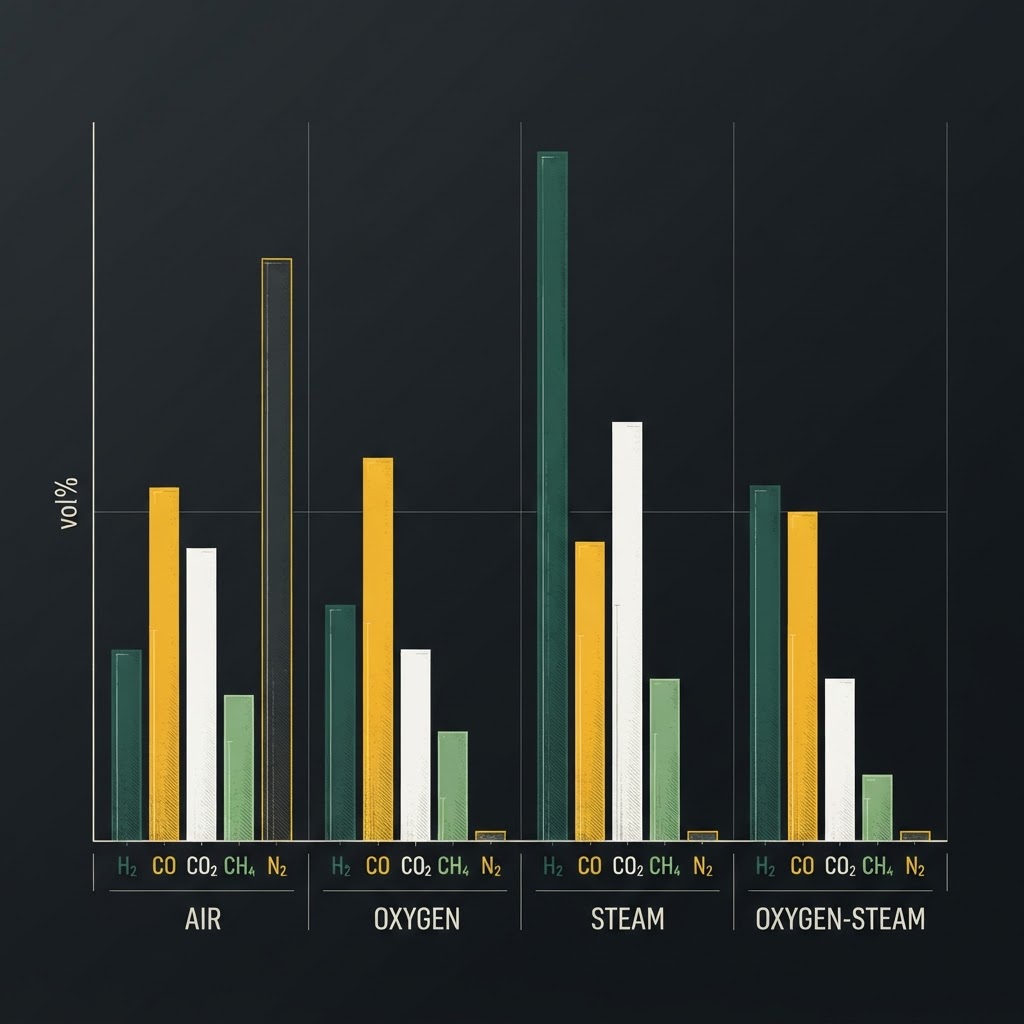
The biomass gasification syngas composition you get is not a property of biomass. It is the result of three choices: the gasifying agent, the reactor and the feedstock. Blow air through wood chips and roughly half of what leaves the reactor is nitrogen. Use steam or oxygen on the same chips and hydrogen and carbon monoxide take over, and the heating value roughly doubles.
This guide gives the typical numbers for each of those choices, side by side, then covers the part most composition tables leave out: the tar, ammonia and sulphur that decide whether the gas can actually run an engine.
The short answer: typical biomass syngas composition
A 2023 review in Sustainable Energy and Fuels separates the two gases that are both loosely called syngas (Alves et al., RSC). Gas made with air is properly called producer gas. Gas made with pure oxygen, steam or a mix of both is syngas. The difference is nitrogen.
| Component | Producer gas (air) | Syngas (oxygen and/or steam) |
|---|---|---|
| H2 | 13 to 19 vol% | 20 to 40 vol% |
| CO | 18 to 22 vol% | 35 to 40 vol% |
| CO2 | 9 to 12 vol% | 25 to 35 vol% |
| CH4 | 1 to 5 vol% | 0 to 15 vol% |
| N2 | 45 to 55 vol% | 2 to 5 vol% |
| LHV | 4.5 to 6.0 MJ/Nm3 | 5.3 to 12.6 MJ/Nm3 |
Values are on a dry gas basis. Raw gas also carries water vapour, tar, dust and trace compounds, covered further down.
Composition by gasifying agent
The agent is the single biggest lever. A 2025 MDPI Energies review compiled typical ranges for the four common options (Copa Rey et al.):
| Agent | H2 | CO | CO2 | CH4 | N2 | LHV (MJ/Nm3) |
|---|---|---|---|---|---|---|
| Air | 8 to 18% | 15 to 25% | 5 to 15% | 0 to 3% | 45 to 55% | 4 to 7 |
| Oxygen | 20 to 30% | 45 to 55% | 5 to 15% | 0 to 5% | 0 to 3% | 10 to 12 |
| Steam | 40 to 55% | 15 to 25% | 5 to 12% | 2 to 6% | 0 to 3% | 12 to 14 |
| Oxygen and steam | 30 to 45% | 35 to 50% | 5 to 12% | 1 to 5% | 0 to 3% | 10 to 14 |
The pattern is consistent. Oxygen pushes CO up. Steam pushes H2 up, through the water gas and water gas shift reactions. Air dilutes everything with nitrogen that contributes no energy. The engineering cost behind each option, from oxygen plants to external heat for steam, is covered in our guide to choosing a gasifying agent.
Same fuel, same reactor, different agent
Review tables mix feedstocks and reactors, so a controlled comparison is more convincing. A fluidized bed study at UC Davis gasified almond shells and hulls with air, then with steam (McCaffrey et al., Frontiers in Energy Research):
- Air: 14 to 18% H2, 16 to 19% CO, 16 to 17% CO2, 3 to 4% CH4, 43 to 50% N2, heating value 4 to 6 MJ/m3.
- Steam: 35 to 40% H2, 18 to 21% CO, 16 to 18% CO2, 5 to 7% CH4, heating value 10 to 12 MJ/m3.
The steam runs still showed 17 to 21% N2, which the authors trace to the nitrogen used in the pneumatic feeder. Even on a nitrogen free basis, steam lifted hydrogen from 29.8% to 47.0% and cut CO from 32.2% to 24.5%. The agent mattered more to the gas than the feedstock did.
Composition by reactor type
Reactor design changes the gas less than the agent does, but it changes the contaminants enormously. Hasler and Nussbaumer compared raw gas from atmospheric, air blown biomass gasifiers (Biomass and Bioenergy, via Verenum):
| Downdraft (co-current) | Updraft (counter-current) | Circulating fluidized bed | |
|---|---|---|---|
| H2 | 15 to 21% | 10 to 14% | 15 to 22% |
| CO | 10 to 22% | 15 to 20% | 13 to 15% |
| CO2 | 11 to 13% | 8 to 10% | 13 to 15% |
| CH4 | 1 to 5% | 2 to 3% | 2 to 4% |
| N2 | balance | balance | balance |
| LHV (MJ/Nm3) | 4.0 to 5.6 | 3.7 to 5.1 | 3.6 to 5.9 |
| Tar (mg/Nm3) | 10 to 6,000 | 10,000 to 150,000 | 2,000 to 30,000 |
| Particles (mg/Nm3) | 100 to 8,000 | 100 to 3,000 | 8,000 to 100,000 |
Read the bottom two rows before the top five. The heating values barely differ, but an updraft unit can carry thousands of times more tar than a good downdraft unit, because its pyrolysis vapours leave without passing through a hot zone. A fluidized bed carries the most dust. Why each design behaves this way is explained in our overview of types of biomass gasifiers.
What real plants measured
Lab ranges are wide, so plant data helps. An IEA Bioenergy overview of small scale gasification compiled gas from three Scandinavian plants (Swedish Energy Agency report, IEA Task 33):
| Plant | H2 | CO | CH4 | N2 | LHV (MJ/Nm3) |
|---|---|---|---|---|---|
| Viking (two stage, DTU) | 30.5% | 19.6% | 1.2% | 33.3% | 5.6 |
| Värnamo (pressurised CFB) | 9.5 to 12% | 16 to 19% | 5.8 to 7.5% | 48 to 52% | 5.0 to 6.3 |
| Harboøre (updraft) | 19.0% | 22.8% | 5.3% | 40.7% | 5.6 |
All three are air blown and all three land between 5 and 6.3 MJ/Nm3. That is the realistic heating value band for producer gas from a working plant.
Composition by feedstock
Wood is the reference fuel in most tables. Residues are where composition and cleaning get harder, and they are what most projects in Nigeria and most municipal sludge projects in Germany actually burn.
Wood vs sewage sludge
A TU Wien case study compared dual fluidized bed steam gasification of softwood pellets and sewage sludge pellets (Fürsatz, IEWT 2021):
| Dry gas | Softwood pellets | Sewage sludge pellets |
|---|---|---|
| H2 | 43.9% | 32.6% |
| CO | 22.6% | 12.6% |
| CO2 | 21.1% | 33.5% |
| CH4 | 9.7% | 10.8% |
| Heating value (MJ/Nm3) | 11.6 | 10.53 |
| Water in raw gas | 37 vol% | 62 vol% |
The heating values are close, and the sludge gas even had a higher H2:CO ratio (2.6 against 1.9). The difference sits elsewhere. Because of its ash, roughly double the mass of sludge was needed for the same gas yield. Dust rose from 0.4 to 8.1 g/Nm3, gravimetric tar from 1.5 to 4.75 g/Nm3, and ammonia and hydrogen sulphide were many times higher than with wood. The study concluded that sludge gas needs an extra acidic scrubber for ammonia that a wood plant can do without. How the main syngas scrubber designs compare, and what they do with the wastewater, is its own engineering question. For the wider picture of sludge as a fuel, see sewage sludge to energy.
Moisture and ash
Moisture lowers the bed temperature and shifts the gas. A Roskilde University bioenergy chapter notes that drier fuel raises syngas quality and heating value, that swings in moisture cause swings in bed temperature and therefore in gas composition, and that 10 to 20% moisture is generally recommended (Roskilde University). Updraft units tolerate up to 60% moisture; downdraft units take at most 25%. Only biomass below about 2% ash can be used in every gasifier type. Temperature acts through the same reactions, and its effect on H2, CO and methane is covered in our guide to biomass gasification temperature.
The part composition tables leave out: contaminants
H2, CO and CH4 decide the energy in the gas. The trace components decide whether you can use it. An IEA Bioenergy Task 33 report lists them: dust, tars, alkali metals such as potassium and sodium, BTX, sulphur compounds (H2S, COS), nitrogen compounds (NH3, HCN), chlorine as HCl, and heavy metals (IEA Bioenergy Task 33 gas analysis report). Clean wood carries little sulphur, nitrogen or chlorine. Agricultural residues, manure, sewage sludge and refuse derived fuel carry much more, which is the main reason residue projects cost more to clean.
How much is acceptable depends on the end use. A gas cleaning review in Renewable and Sustainable Energy Reviews gives tar limits of about 500 mg/Nm3 for compressors, 100 mg/Nm3 for internal combustion engines and 5 mg/Nm3 for direct fired gas turbines (gas cleaning review, ScienceDirect). Fischer-Tropsch synthesis needs under 0.1 mg/Nm3 of tar and under 10 ppm of ammonia, while raw producer gas typically holds 1,000 to 5,000 ppm NH3. Hasler and Nussbaumer set engine targets at under 50 mg/Nm3 of particles and under 100 mg/Nm3 of tar.
Set those limits against the reactor table above and the design logic is plain. Even a good downdraft gasifier needs gas cleaning to feed an engine, and an updraft gasifier needs a great deal of it.
What the composition decides downstream
- Power in a gas engine. Producer gas at 4 to 6 MJ/Nm3 runs spark ignition engines, at reduced output. Whether that is the right route for your site is covered in can syngas be used to generate electricity.
- Replacing natural gas. Nitrogen diluted gas cannot simply replace natural gas in existing burners; see can syngas replace natural gas.
- Fuels and chemicals. Synthesis needs a nitrogen free gas with the right H2:CO ratio. Fischer-Tropsch requires a ratio above about 2.1, which oxygen and steam gasification can reach and air gasification cannot (Fischer-Tropsch route analysis, Energy).
How to read a syngas analysis from a vendor
A composition table on a datasheet is only useful if you know what it leaves out. Ask four questions:
- Dry or wet basis? Raw gas can be over a third water vapour, as the TU Wien data shows, so a dry basis table looks richer than the gas at the engine inlet.
- Nitrogen included or excluded? A nitrogen free figure from an air blown gasifier can look like oxygen blown syngas. Check that the components add up to 100%.
- Which fuel, at what moisture? A wood pellet test says little about straw, husks or sludge.
- Where are tar, dust and NH3? If the sheet gives H2 and CO but no contaminants, the expensive half of the answer is missing.
How Energaia uses composition in project design
Our process collects local biomass or sludge, gasifies it at high temperature to clean syngas, converts it to dispatchable power and heat, and captures biochar and verified CO2 offsets on site (Energaia on LinkedIn). Composition is where that chain is designed backwards from the end use:
- End use sets the specification. An engine, a turbine and a synthesis route each set a different limit for nitrogen, H2:CO, tar and NH3.
- Feedstock sets the cleaning load. Sludge and residues need the ammonia and sulphur cleaning that wood does not.
- Pre-treatment stabilises the gas. We treat thermal pre-treatment as non-negotiable because it cuts moisture, raises energy density and evens out a variable fuel, which steadies bed temperature and gas composition (Energaia on LinkedIn).
- Simulate before steel. Emissions are modelled digitally, including with our MATLAB-based VOC simulation suite, before equipment is ordered (Energaia).
FAQ
What is the H2:CO ratio of biomass syngas? It depends mostly on the agent. Air blown producer gas usually sits below 1, oxygen blown gas around 0.5 because CO dominates, and steam gasification well above 1. In the TU Wien steam tests, wood gave 1.9 and sewage sludge 2.6.
Why is there so much nitrogen in producer gas? Air is about 78% nitrogen, and in air gasification it passes through the reactor unchanged. It adds volume but no energy, which is why air blown gas has roughly half the heating value of oxygen or steam blown syngas.
What is the difference between producer gas and syngas? Producer gas is made with air and is about half nitrogen. Syngas is made with oxygen, steam or both and holds only a few percent nitrogen, so it carries more H2 and CO per cubic metre. Many vendors call both syngas, so check the N2 line.
How is syngas composition measured? Main gases (H2, CO, CO2, CH4, N2) are usually measured online by gas chromatography or analysers, while tar, NH3, H2S and HCl need separate sampling. Sampling methods differ, so tar figures from different plants are often not strictly comparable.