
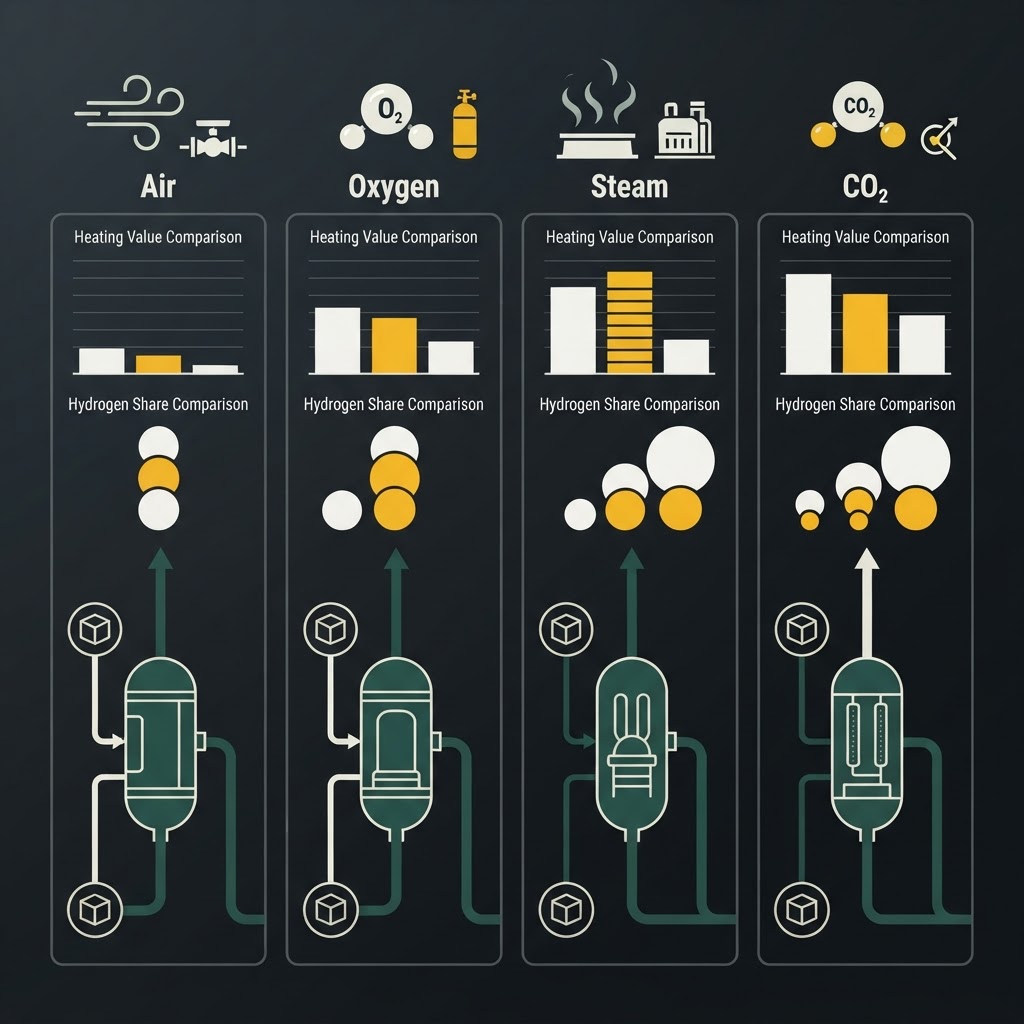
Change the gasifying agent and the same wood chips can give you a gas worth 4 MJ/Nm3 or one worth more than 12 MJ/Nm3. Air gasification typically yields 4 to 7 MJ/Nm3, while gasification with pure oxygen can reach 12 to 28 MJ/Nm3 (Sikarwar et al., Energy and Environmental Science). That one choice decides whether your gas can only fire an engine or can also become hydrogen, methanol or synthetic fuel. It also decides whether you need an air separation unit, with the capital cost and electricity bill that come with it.
This guide compares the four agents in use, air, oxygen, steam and carbon dioxide, with measured numbers for each, and then turns that into a decision you can apply to a real project.
What a gasifying agent does
A gasifying agent is the medium fed into the reactor that reacts with the fuel and converts solid char and heavy hydrocarbons into light gases, mainly carbon monoxide and hydrogen. The same review lists the four standard media as air, oxygen, steam and CO2, used alone or mixed. Comparative reviews treat the agent as a design variable in its own right, alongside temperature and equivalence ratio, because it changes both the yield and the composition of the product gas (Sidek et al.).
The agents do two different jobs. Air and oxygen burn part of the fuel and so supply the heat for the rest of the process. Steam and CO2 react with hot char to make more gas, but those reactions absorb heat, so they need a heat source. If you want the full reaction sequence first, start with how biomass gasification works.
The four agents at a glance
| Agent | Typical heating value | H2 in dry gas | Heat supply | Main drawback |
|---|---|---|---|---|
| Air | 4 to 7 MJ/Nm3 | about 10 to 11% | Self heating | About half the gas is nitrogen |
| Oxygen | 12 to 28 MJ/Nm3 | about 26 to 29% | Self heating | Needs an air separation unit |
| Steam | 10 to 18 MJ/Nm3 | 35% to above 50% | External or dual bed | Endothermic, cools the bed |
| CO2 (usually as co-agent) | Gas is 66 to 80% CO | Low | External | Slow, strongly endothermic |
The sections below give the source for each figure and the conditions behind it.
Air: cheap, simple and diluted
Air is the most widely used gasifying agent because it is available and costs nothing (Tondo Alves et al., Sustainable Energy and Fuels). The price is nitrogen. In one comparison, nitrogen made up about 50% of the product gas when air was the agent, with methane and hydrogen together only about 13% (Khlifi et al., Energies).
The US National Energy Technology Laboratory puts the penalty in one number: nitrogen typically dilutes the syngas by a factor of 3 compared with oxygen blown gasification, so a gas of about 300 Btu/scf from an oxygen blown unit becomes about 100 Btu/scf with air (NETL). Because that nitrogen must also be heated to the exit temperature, NETL notes that air blowing suits gasifiers that run at lower, non slagging temperatures. It also cuts the CO2 partial pressure in the gas to a third, which makes later carbon capture harder and more expensive.
In a 200 kWth updraft pilot, air alone gave 9.7 to 11.4% hydrogen across several residues (Cerone and Zimbardi, Energies).
None of this rules air out. A gas engine can run on low calorific producer gas, so when the product is power the nitrogen is often a cost worth accepting. If your end product is electricity, see how plants generate electricity from syngas.
Oxygen: nitrogen-free gas at a price
Swap air for oxygen and the nitrogen disappears. Reaction rates rise, residence time shortens and heating value climbs. The same oxygen also removes the cooling effect of nitrogen, so oxygen rich operation can drive the gasifier to excessive temperatures and push it toward combustion, the Tondo Alves review notes. That is one reason oxygen is so often fed together with steam, as in the tests below.
In the Cerone pilot, oxygen alone lifted hydrogen to 26.4 to 28.9% of the gas, roughly two and a half times the air figure.
The catch is the oxygen. Pure oxygen supply needs considerable electric energy, and air separation units are more efficient at large scale, so oxygen blown gasifiers are typically not applied for decentralized biomass conversion (steam gasification review, Renewable and Sustainable Energy Reviews). An older UK scoping study found that oxygen in atmospheric biomass gasifiers gives at best a slight improvement in cold gas efficiency, but roughly doubles the calorific value and halves the gas volume, which can shrink downstream equipment enough to pay for the oxygen plant at the top of the size range (ETSU scoping study).
Oxygen enriched air sits between the two. It lowers nitrogen without the full cost of pure oxygen, and works best for low nitrogen, low moisture feedstocks (Gao et al., ACS Omega).
Steam: hydrogen, but someone has to pay for the heat
Steam brings its own hydrogen. It drives the water gas and water gas shift reactions, and can raise the heating value of syngas to 10 to 18 MJ/Nm3 while increasing hydrogen yield, according to the ACS Omega review. Khlifi et al. report a steam case with 35.5% H2 and 31.8% CO and an LHV of 13.1 MJ/Nm3.
Steam also moves the H2/CO ratio, which matters for anything you want to synthesise. In the Cerone pilot the ratio rose from 0.34 to 0.66 with air to 0.80 to 2.08 once steam was added, and hydrogen reached 31.6 to 39.2% with oxygen plus steam.
There is a limit. Steam enters cooler than the bed, so too much of it chills the reactor. In the same work, raising the steam ratio on eucalyptus wood cut the average bed temperature from 688°C to 642°C and lifted tar from 29.5 to 45.5 g/kg. The lower heating value fell by 3 to 17% as steam flow rose at a fixed oxygen ratio. More on that balance in our guide to biomass gasification temperature.
The bigger problem is heat. Steam reactions absorb energy, and in a single reactor the only ways to supply it are burning part of the fuel with air (bringing nitrogen back) or with oxygen (bringing the air separation unit back).
Dual fluidized bed: steam without an air separation unit
Dual fluidized bed (DFB) gasification solves this by splitting the job across two connected reactors. Steam fluidizes the gasification reactor, which runs at 750 to 850°C, while the combustion reactor burns leftover char with air at about 900 to 970°C; hot bed material carries heat between them and the two gas streams stay separate (Schmid et al., TU Wien). The result is a nitrogen free product gas without oxygen. TU Wien lists industrial plants at Güssing (8 MW), Oberwart (8.6 MW) and Senden (15 MW), plus a 33 MW unit in Gothenburg producing 20 MW of synthetic natural gas.
The steam gasification review reports hydrogen contents of up to 50% or more from these systems, with heating values comparable to steam and oxygen blown units. IEA Bioenergy Task 33 counts the nitrogen free gas without pure oxygen as one of the advantages of this allothermal route over autothermal designs (IEA Bioenergy Task 33). For the trade-offs between reactor designs, see types of biomass gasifiers.
CO2: a co-agent that tunes the gas toward CO
Carbon dioxide reacts with char through the Boudouard reaction to form carbon monoxide. Compared with steam, CO2 gasification is slower and more endothermic, CO2 has a much lower heat capacity, and it shifts the equilibrium toward CO at the expense of hydrogen (Szul et al., Energies). In their pressurized fluidized bed tests, an oxygen and CO2 mix dropped the H2/CO ratio to 0.32.
That makes CO2 a tuning knob rather than a main agent. Mixed with steam, small additions have large effects: at 900°C, going from 0 to 5% CO2 raised CO tenfold and cut H2 by a factor of 3.3, and the H2/CO ratio could be set anywhere from 5.5 down to 0.25 (Butterman and Castaldi, Environmental Science and Technology). The same study found complete carbon conversion with 25% CO2 and 75% steam, against 90% with steam alone.
With pure CO2, pine bark gave a gas in which CO made up about 66 to 80% of the volume, and each gram of bark converted about 0.25 to 1.74 g of CO2 into products at 800 to 1,000°C (Wang et al., Applied Energy).
The dial behind every agent: equivalence ratio and steam ratio
Choosing the agent is half the decision. How much you feed is the other half. The equivalence ratio (ER) is the oxygen supplied as a fraction of what full combustion would need. In the Cerone pilot, bed temperature rose steadily with the oxygen ER, and oxygen plus steam gasification of torrefied wood gave the best cold gas efficiency and heating value with both ratios in the range 0.23 to 0.27.
Temperature often matters more than the exact dose. In bubbling fluidized bed CO2 gasification of pine, temperature had a significant effect on the gas, while changes in the CO2 to carbon ratio between 0.5 and 1.5 did not (Sadhwani et al., Industrial and Engineering Chemistry Research).
How to choose a gasifying agent for your project
Start from the end product, not the reactor.
- Electricity and heat from a gas engine. Air. The engine tolerates nitrogen and the plant avoids oxygen costs. Spend the effort on tar and moisture instead.
- Hydrogen or synthesis gas. Steam, or oxygen plus steam. Fischer-Tropsch synthesis prefers an H2/CO ratio slightly above 2, which conventional oxygen and steam gasification can often reach without a separate shift reactor, Szul et al. note. At decentralized scale, a dual fluidized bed avoids the air separation unit. Our planned guide to biomass gasification for hydrogen production covers this route.
- A CO rich gas or CO2 reuse. CO2 as a co-agent with steam, accepting the extra heat demand.
- Carbon capture planned later. Avoid air if you can; the nitrogen cuts CO2 partial pressure to a third.
The agent you choose also sets what comes out of the reactor, which we break down in biomass gasification syngas composition.
At Energaia this choice sits inside a fixed process: local biomass or sludge is gasified at high temperature into clean syngas, converted to dispatchable power and heat, with biochar and verified CO2 offsets as co-products (Energaia on LinkedIn). Before any agent decision we fix feedstock moisture, because thermal pre-treatment governs energy density and how evenly the fuel gasifies (Energaia on thermal pre-treatment). Wet fuel already acts like an unplanned steam feed. We then simulate the process, including with our MATLAB based VOC simulation suite, before any equipment is ordered (Energaia).
If a vendor promises synthesis grade gas from an air blown unit, ask where the nitrogen goes.
FAQ
Is a gasifying agent the same as an oxidizing agent? Not always. Air and oxygen oxidize part of the fuel. Steam and CO2 contain no free oxygen; they react directly with hot char to form CO and H2. All four count as gasifying agents.
Which gasifying agent gives the most hydrogen? Steam. Oxygen plus steam reached 31.6 to 39.2% H2 in pilot tests, and dual fluidized bed steam gasifiers report 50% or more. Air gives the least, because nitrogen dilutes the gas.
Can you mix gasifying agents? Yes. Oxygen plus steam in a two-stage downdraft reactor gave 27.4 to 35.9% H2 and an LHV of 7.13 to 8.35 MJ/m3, nearly twice air or air plus steam, with less tar.
Does wet biomass change the gasifying agent? In effect, yes. Moisture evaporates into steam inside the reactor and takes part in the reactions, but it also absorbs heat the process cannot spare. That is why fuel drying comes before agent selection.