
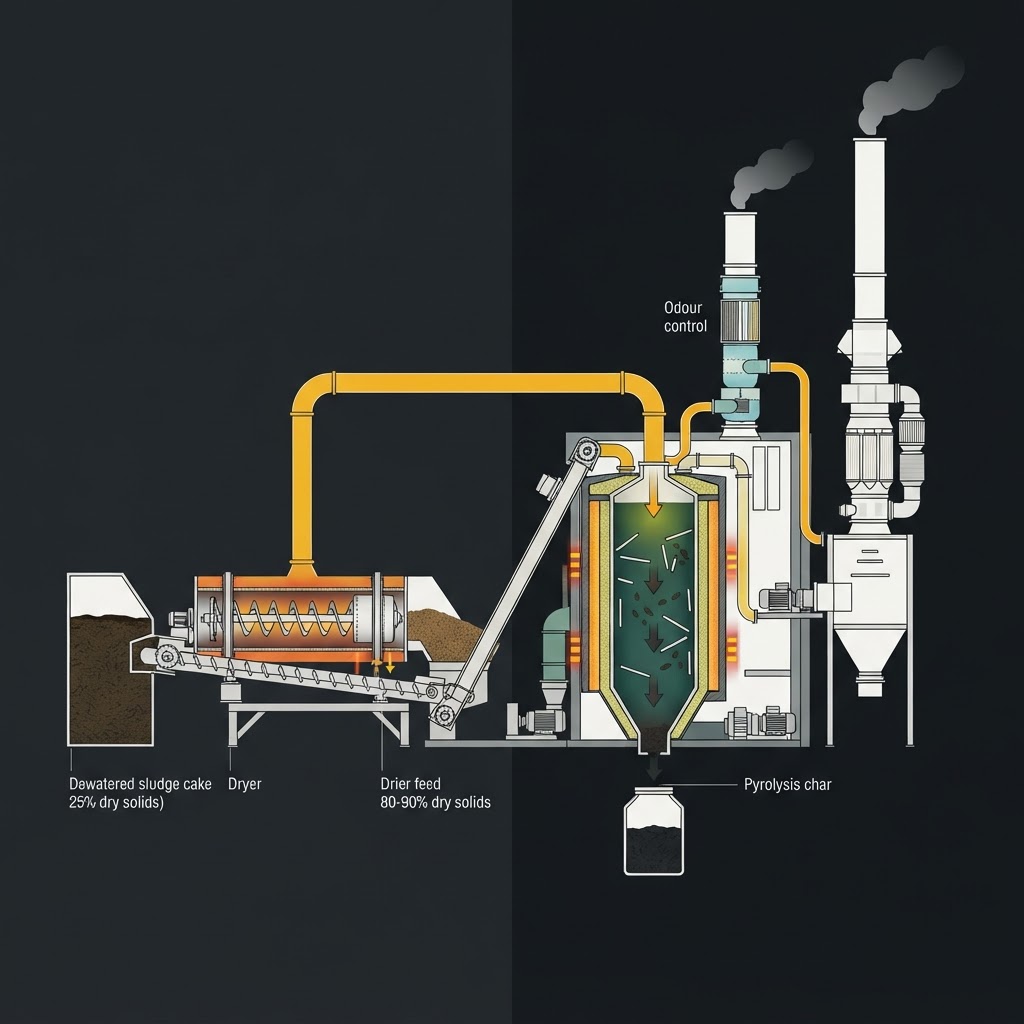
A sewage sludge pyrolysis plant is sold as a reactor. What a wastewater utility actually buys is a dryer with a reactor attached, an exhaust train that decides the permit, and a char whose market value depends on regulations the vendor does not control. The reactor is the smallest of those problems.
This guide sizes a plant the way a feasibility study should: from the tonnes of dry solids you have, through the reference plants already running at that scale, to the footprint, the energy balance, the permit and the published cost numbers. Every figure is linked to where it came from.
Sludge pyrolysis is already running at full scale
This is no longer a pilot technology. The European Sustainable Phosphorus Platform's technology inventory lists seven full-scale PYREG units on sewage sludge: Unkel (1,200 t DS a year, since 2015), Homburg (1,200 t, 2016), Redwood City in California (1,200 t, 2016), Hammenhög in Sweden (1,200 t, 2016), Trutnov in the Czech Republic (1,200 t, 2020), Lorsbach (1,500 t, 2021) and Kleve (1,600 t, 2023). Four of those seven are in Germany.
In Denmark, AquaGreen describes its Odsherred installation as the first integrated steam drying and pyrolysis plant for sewage sludge in commercial operation, running since 2021. In France, SUEZ and PYREG launched an integrated drying and pyrocarbonisation line called Pyrolis S2B in February 2026.
Japan went much larger, much earlier. Hiroshima and Tokyo built plants able to pyrolyse up to 27,800 and 109,000 tonnes a year of dewatered sludge, producing a carbonised fuel for co-firing. The Tokyo plant was expected to cut 37,000 t CO2e a year against incineration, largely because pyrolysis virtually eliminates the nitrous oxide that sludge incineration releases.
The pattern is clear. European plants are modular units of 1,000 to 1,600 t DS a year, sited at the works. That unit size is what you should be sizing against.
Sizing a plant from your own sludge
The unit that matters is tonnes of dry solids per year, not wet tonnes and not population equivalent.
PYREG publishes the conversion it uses: a typical biosolids project of 3,000 to 15,000 t DS a year, equal to 12,000 to 60,000 t of wet sludge and 150,000 to 750,000 PE. Its assumptions are 25 percent dry solids after dewatering, under 20 percent moisture after drying, and 20 kg of dry solids per PE per year. Those assumptions let you do the first screen yourself:
| Works size | Dry solids per year | Wet cake at 25% DS | Unit count at ~1,200 t DS |
|---|---|---|---|
| 50,000 PE | 1,000 t | 4,000 t | 1 |
| 100,000 PE | 2,000 t | 8,000 t | 2 |
| 250,000 PE | 5,000 t | 20,000 t | 4 |
The table is arithmetic on the vendor's stated assumptions, not a quote. Your real dry solids figure, measured at your dewatering outlet, replaces the PE estimate the moment you have it.
At the top end, a regional hub is a different machine class. A permit filed in Rhode Island in 2026 describes a two-reactor plant able to process roughly 158.7 tons of sewage sludge a day, accepting trucked cake at up to 75 percent moisture. That is a centralised merchant facility, not a works-side unit, and it carries a centralised facility's permitting load.
What sits on the site
The footprint
AquaGreen publishes dimensions. A HECLA 1000 unit, treating 1,000 t of dry matter a year, measures 15 x 14 x 5 m and weighs 45 t; the 1,500 t version measures 16 x 16 x 5.5 m and weighs 80 t, both excluding feeding and receiving systems. Budget extra space for cake reception, a dry feed silo and char handling. The reactor is compact; the logistics around it are not.
The operating profile
PYREG's sewage sludge brochure gives the operating numbers for two sizes. The PX500 draws 16 kW of electricity, delivers up to 200 kW of thermal output and an annual heat surplus of 1,400,000 kWh. The PX1500 draws 48 kW, delivers up to 575 kW and a surplus of 4,025,000 kWh. Both are rated for 7,000 operating hours a year with four hours of daily labour. The process guarantee is carbonisation above 550 degrees C for more than ten minutes.
That labour figure is worth noticing. A plant built around one attended shift a day is a works-side asset, not a separate operation with its own staff.
The dryer decides whether it works
Pyrolysis needs dry feed. The ESPP inventory states PYREG's minimum input as a calorific value of 10 MJ/kg, which is roughly 80 percent dry solids. Dewatered cake leaves the press at around 25 percent. Closing that gap is the single largest energy duty in the plant, which is why thermal pre-treatment is non-negotiable in gasification and pyrolysis: it reduces moisture, raises energy density and homogenises a feedstock that arrives variable.
Every serious design closes that heat balance internally. The SUEZ line dries to 90 percent dry solids, pyrolyses at about 600 degrees C, then fully oxidises the pyrolysis gas above 950 degrees C to supply heat for both the drying and the pyrolysis. AquaGreen dries in an oxygen-free atmosphere with superheated steam at 200 degrees C for two hours, then pyrolyses for about 20 minutes at 650 degrees C, burning the gas to drive the dryer.
When the balance does not close, you buy fuel. The Rhode Island design heats its dryers from thermal oxidiser exhaust in normal operation, but needs natural gas at start-up until the pyrolysis process supplies heat reliably. Ask any vendor at what feed dry solids content the plant runs autothermally, and what it burns below that point. The answer belongs in the contract, not the brochure. Our own route comparison for sludge thermal treatment shows why drying, not the reactor, is where projects pencil or fail.
The exhaust train is half the plant
Read the Rhode Island permit and the reactor is a short paragraph. The air pollution control is pages. That plant needs two separate systems:
- Odour control for reception, silos, disc dryers and pelletisers: a biotrickling filter, two chemical scrubbers in series and an activated carbon polishing filter.
- Emissions control for the pyrolysis gas: two thermal oxidisers followed by catalytic filters combining SCR, dry sorbent injection and ceramic filter tubes.
Under that permit, the reception buildings are held under slight negative pressure with four air changes an hour. That is the realistic scope of a sludge pyrolysis plant near people.
The dryer exhaust is where the compound mix is least predictable. At Energaia we built a MATLAB-based simulation suite that models VOC emissions in biomass-to-energy systems, so that the odour and emission trains are sized from predicted composition before equipment is ordered. The compound-level detail is covered in VOC emissions from sludge drying.
What comes out, and what it is worth
Three streams leave the plant: char, heat and carbon removal.
Char. Sludge char is mostly mineral. The ESPP inventory gives PYREG sludge char at about 25 percent organic carbon (15 to 35 percent), 5 to 7 percent phosphorus of which about 80 percent is soluble in neutral ammonium citrate, and just over 1 percent nitrogen. It is registered as a fertiliser in Sweden and the Czech Republic but is not covered by the EU Fertilising Products Regulation material category for pyrolysis materials. Outside those registrations, do not assume the char is a sellable product: budget for disposal until a legal outlet is confirmed. The quality standards that decide what counts as biochar are the next thing to check.
Contaminants. At 500 to 800 degrees C, the same inventory reports organic hazardous substances, including PFAS, destroyed nearly completely. Heavy metals do not burn. They stay in the char.
Heat and carbon. AquaGreen states that every 1,000 t of dry matter treated retains about 490 t CO2e in the char and produces about 2,000 MWh of heat. It quotes carbon removal certificate prices of around 100 to 150 euros per tonne CO2e. That is a vendor figure, so test it against how biochar carbon credits are actually issued before it goes into a business case. At Fårevejle, the ESPP site report records a design capacity of 4,000 t a year of sludge at 22 to 25 percent dry matter, with surplus heat recovered at 80 degrees C for district heating.
Where pyrolysis sits under German sludge law
The 2017 Sewage Sludge Ordinance removes soil-based utilisation for works above 100,000 PE from 1 January 2029, and above 50,000 PE from 1 January 2032. The German Environment Agency's summary counts sub-stoichiometric processes such as pyrolysis and gasification as thermal pre-treatment, alongside mono-incineration. Pyrolysis is a compliant route.
It does not end the phosphorus question. Where sludge holds at least 20 g P per kg of dry solids, recovery is still owed, and once the sludge is thermally treated the obligation attaches to the carbonaceous residue. A plant that makes char has moved the duty, not discharged it. The recovery options themselves are compared in phosphorus recovery from sewage sludge. Choosing between pyrolysis and its neighbour is covered in pyrolysis vs gasification.
What published projects cost
Public numbers are thin, and most come from studies rather than invoices. These are the ones with a source:
- Pilot scale. Nordhausen University of Applied Sciences installed a pilot pyrolysis plant at the Bleicherode works worth around 1 million euros in 2023.
- Small works. The EU PYROCHAR project targeted a unit for works up to 10,000 PE (about 200 t DM a year) at an initial investment of 400,000 euros and 15,000 to 20,000 euros a year O&M. It compared that with average European costs of 260 to 350 euros per t DM for incineration and 400 to 650 euros for small works. These are 2016 project targets, not delivered prices.
- Regional scale. A Finnish study estimated a 30,000 t a year sludge pyrolysis plant at 13 to 17 million euros, or 35 to 45 euros per tonne of sludge treated at 5 percent interest over 20 years.
The benchmark you are competing with is your current gate fee. A 2023 TUM study cites a Bavarian average of 779 euros per t of dry solids for mono-incineration of dried sludge. AquaGreen claims a return on investment of 4 to 11 years, depending on site. Treat that as a range to verify, not a forecast. Your own disposal contract is the denominator, and what sludge disposal costs per tonne shows how wide that number runs.
A buyer's checklist before the tender
- Measure dry solids and phosphorus at the dewatering outlet for a full year. Size from that, not from PE.
- Ask at what feed dry solids content the plant runs autothermally, and what it burns below that.
- Get the full emissions train in scope: odour control, gas oxidation and flue gas cleaning.
- Get a written route for the char under your national fertiliser and waste law, including the phosphorus recovery duty.
- Price carbon removal revenue at zero in the base case and treat it as upside.
- Model the dryer exhaust before you order steel.
If the plant is one piece of a wider sludge strategy, start with sewage sludge pyrolysis for the process chemistry and sewage sludge to energy for the alternatives.
FAQ
How big is a sewage sludge pyrolysis plant?
Works-side units are compact. AquaGreen's 1,000 t DM a year unit measures 15 x 14 x 5 m and weighs 45 t, excluding feed and receiving systems. Most of the extra site area goes to cake reception, dry feed storage and char handling.
Is sludge pyrolysis classed as incineration?
Not under German sludge law. The Sewage Sludge Ordinance lists pyrolysis and gasification as sub-stoichiometric thermal pre-treatment, a category alongside mono-incineration. The Rhode Island permit review states that the US EPA recognised that applicant's pyrolysis process as not incineration.
Does pyrolysis remove PFAS from sewage sludge?
The ESPP inventory reports organic hazardous substances, including PFAS, destroyed nearly completely at 500 to 800 degrees C. In the SUEZ design, the pyrolysis gas is then oxidised above 950 degrees C. Heavy metals are not destroyed and remain in the char.
What is the smallest works where a pyrolysis plant makes sense?
The smallest commercial units treat about 1,000 to 1,200 t of dry solids a year. On PYREG's 20 kg DS per PE assumption, that is about 50,000 to 60,000 PE. Smaller works usually share a regional unit.